By Eric S. Nelson · Friday, July 15, 2011 Eric S. Nelson’s “Revisiting the Dialectic of Environment: Nature as Ideology and Ethics in Adorno and the Frankfurt School” appears in Telos 155 (Summer 2011). Read the full version online at the Telos Online website, or purchase a print copy of the issue in our store.
 As a contribution to a responsive and critical materialist ethics of environments and animals, this essay reexamines the significance of nature and animals in the critical social theory of Theodor Adorno. In response to the anthropocentric stance of intersubjective discourse and recognition in recent figures associated with the Frankfurt School, such as Jürgen Habermas and Axel Honneth, I argue for the ecological import of the aporetic dialectic of nature and society in Adorno and Horkheimer’s Dialectic of Enlightenment and Adorno’s later works. Adorno’s continuing confrontation with the “domination of nature” traces the tensions between the ideological construction and resistance of “nature” as well as the instrumentalization and implicit disruptive promise of sensuous life. These tensions indicate the material and bodily bonds between human and animal happiness and suffering and the ambiguous role of mimesis in both domination and emancipation. Adorno insisted on the critical prospect of an unforced and non-coercive freedom that brings us toward the object and responsibility for socially and historically mediated and non-identical natural life. As a contribution to a responsive and critical materialist ethics of environments and animals, this essay reexamines the significance of nature and animals in the critical social theory of Theodor Adorno. In response to the anthropocentric stance of intersubjective discourse and recognition in recent figures associated with the Frankfurt School, such as Jürgen Habermas and Axel Honneth, I argue for the ecological import of the aporetic dialectic of nature and society in Adorno and Horkheimer’s Dialectic of Enlightenment and Adorno’s later works. Adorno’s continuing confrontation with the “domination of nature” traces the tensions between the ideological construction and resistance of “nature” as well as the instrumentalization and implicit disruptive promise of sensuous life. These tensions indicate the material and bodily bonds between human and animal happiness and suffering and the ambiguous role of mimesis in both domination and emancipation. Adorno insisted on the critical prospect of an unforced and non-coercive freedom that brings us toward the object and responsibility for socially and historically mediated and non-identical natural life.
Continue reading →
By Roger Foster · Tuesday, July 12, 2011 Roger Foster’s “Lingering with the Particular: Minima Moralia‘s Critical Modernism” appears in Telos 155 (Summer 2011). Read the full version online at the TELOS Online website, or purchase a print copy of the issue here.
This essay argues that the ethical claim of Theodor Adorno’s Minima Moralia depends on its being read as an original version of the modernist idea of ethical critique as the aesthetic presentation of individual experience. While contemporary efforts to understand Minima Moralia as a form of substantive critique have merit, they have not fully appreciated the character of this work as a type of ethical performance. The second section of the essay lays out the background of this model of ethical critique in Adorno’s understanding of the system of universal fungibility. Adorno’s ethical performance, I argue, is a way of rescuing the ethical import of particularity. The execution of this idea in Minima Moralia through the rhetorical strategy of exaggeration is then examined in the third section. I then turn, finally, to a discussion of the key conceptual contrast between “lingering” and possessiveness. These terms allow Adorno to theorize injustice as a distortion of particularity, and also provide the model for a form of thinking and comportment that resists that distortion.
Continue reading →
By Charles Kollmer · Monday, July 11, 2011 As an occasional feature on TELOSscope, we highlight a past Telos article whose critical insights continue to illuminate our thinking and challenge our assumptions. Today, Charles Kollmer looks at Alexandre Lefebvre’s “A New Image of Law: Deleuze and Jurisprudence,” from Telos 130 (Spring 2005).
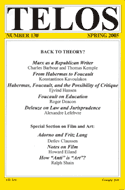 Even readers with a cursory familiarity with Gilles Deleuze’s work will have no trouble surmising his critical attitude toward the law. As an abstracting and generalizing social force, law seems to stand in stark opposition to watchwords like immanence and singularity that pervade Deleuze’s texts. In “A New Image of Law: Deleuze and Jurisprudence,” Alexandre Lefebvre offers a novel interpretation of this antagonism toward the law, starting by distinguishing between law and jurisprudence. As the philosophy that informs the practice of law, jurisprudence interrupts the stasis of the legal code by actively applying it to a case. In turn, a given case takes on a genetic role in future versions of the law (conventionally referred to as precedent). Jurisprudence liberates law from appeals to transcendent values by insisting on its relevance to the here-and-now, as well as its role in the genesis of the yet-to-come. In his article, Lefebvre elaborates on this dynamic, starting with a summary of Deleuzian critiques of law, then moving toward what he terms “a new image of law,” drawing on Henri Bergson’s metaphysics in the process. Even readers with a cursory familiarity with Gilles Deleuze’s work will have no trouble surmising his critical attitude toward the law. As an abstracting and generalizing social force, law seems to stand in stark opposition to watchwords like immanence and singularity that pervade Deleuze’s texts. In “A New Image of Law: Deleuze and Jurisprudence,” Alexandre Lefebvre offers a novel interpretation of this antagonism toward the law, starting by distinguishing between law and jurisprudence. As the philosophy that informs the practice of law, jurisprudence interrupts the stasis of the legal code by actively applying it to a case. In turn, a given case takes on a genetic role in future versions of the law (conventionally referred to as precedent). Jurisprudence liberates law from appeals to transcendent values by insisting on its relevance to the here-and-now, as well as its role in the genesis of the yet-to-come. In his article, Lefebvre elaborates on this dynamic, starting with a summary of Deleuzian critiques of law, then moving toward what he terms “a new image of law,” drawing on Henri Bergson’s metaphysics in the process.
Continue reading →
By Timothy Hall · Friday, July 8, 2011 Timothy Hall’s “Reification, Materialism, and Praxis: Adorno’s Critique of Lukács” appears in Telos 155 (Summer 2011). Read the full version online at the TELOS Online website, or purchase a print copy of the issue here.
This essay focuses on Adorno’s critique of Lukács in Negative Dialectics. While Adorno is generally viewed as a trenchant critic of Lukács, Adorno’s work testifies to a lifelong engagement with Lukács’s early writings, up to and including History and Class Consciousness. The essay looks at the seemingly contradictory critique developed by Adorno that Lukács’s concept of praxis was both idealist and romantic anti-capitalist. It was idealist insofar as a latent subjectivism in his thought led to a “productivist” account of the subject and the social world; it was romantic anti-capitalist in that it opposed an economy based on use value to the capitalist present dominated by the principle of exchange. The essay argues that there is no inconsistency, on Adorno’s part, in maintaining both. Romanticism as a critique is internal to the enlightenment, and the oscillation between idealism and the romantic rejection of it evidenced in Lukács’s work was consistent with the instability at the heart of the idealist account of enlightenment modernity. The essay concludes by speculating on the possibility of an object-centered conception of praxis in Adorno’s work.
Continue reading →
By Lauren Coyle · Tuesday, July 5, 2011 Lauren Coyle’s “The Spiritless Rose in the Cross of the Present: Retracing Hegel in Adorno’s Negative Dialectics and Related Lectures” appears in Telos 155 (Summer 2011). Read the full version online at the TELOS Online website, or purchase a print copy of the issue here.
In response to the general theoretical uncertainty concerning Adorno’s reception of Hegel, this article delineates and interrogates the “Hegelian” and “anti-Hegelian” aspects of Adorno’s Negative Dialectics in view of the recently published lectures. The first section of the article elaborates Adorno’s central points of adherence: (1) in the notion that there is no priority of the subject and that critical theory must return the “freedom to the object”; and (2) in the understanding that there are no “mere facts,” but only mediated appearances of immediacy that should be understood through the historical dialectical unfolding of “objective underlying trends” and “proximate triggers.” The second section outlines and critiques Adorno’s signal departures from Hegel: (1) in Hegel’s notion that determinate negation necessarily yields a positive affirmation, which opens out into to his notions that: (a) all history is progressive becoming despite present suffering and (b) absolute freedom consists in the Spirit’s recognizing itself as all reality, in the final reconciliation of subject and object in the full realization of the identity of subject-object identity and subject-object non-identity; (2) in Hegel’s alleged privileging of the universal over the particular despite the demands of his own dialectic of universal and particular; and (3) Hegel’s ostensibly uncritical use of the antinomy of totality and infinity, which Adorno argues is in fact reflective of a key bourgeois antinomy between the notion of freedom in “closed” political communities, on the one hand, and the “endless” need for the expansion of capitalist value, on the other. The article concludes by positing several points left unresolved in Adorno’s enlistment of Hegel, principally with regard to determinate negation, the dialectic of capital, and the immanent emergence of freedom in the wake of the mass atrocities of modernity.
Continue reading →
By Russell Perkins · Friday, July 1, 2011 Russell Perkins’s “Adorno’s Dreams and the Aesthetic of Violence” appears in Telos 155 (Summer 2011). Read the full version online at the TELOS Online website, or purchase a print copy of the issue here.
Adorno kept detailed record of his dreams throughout his adult life; yet scholars have only recently begun to investigate these exceedingly intimate narratives, largely since their posthumous publication in the volume Dream Notes. This paper links Adorno’s dream writings with his late writing on aesthetics, examining their common preoccupation with the problematic of bearing witness to violence. Whereas Adorno’s dreams are often overtly violent at the level of “plot,” his discussions of modern art are frequently pervaded by figurative language that invokes bodily wounding and pain. I argue that the rhetoric of violence in Adorno’s aesthetics suggests a guiding metaphorical characterization of the modernist artwork as constituted in the gesture of enacting injury upon itself. Aggression and victimhood likewise collide in the quite different register of Adorno’s nightmares, in which Adorno is never merely a passive bystander to suffering. In both of these contexts, we see that insight into violence only becomes possible when neutrality is foregone for standpoints of ambivalent participation, and thus that the suspension of the category of witness becomes the very condition of possibility for testimony.
Continue reading →
|
|