The ongoing Arab uprising against long-standing authoritarian regimes has sparked hope and admiration for the prospect of democratization. Yet in no country can one yet say that democracy has been firmly established—not yet in Tunisia, nor in Egypt (still under military control), nor in any of the other embattled territories. (Despite sectarian strife the two Arab countries approaching a bit a functioning democracy are Iraq and Lebanon.) Given the instability of democracy in the Arab spring, it is crucial to examine not only the potential of an Islamist participation in it, but also the peril of its hijacking. Unfortunately the western discussion often misperceives the role of Islamists. Islamists have not been the leaders of the uprising; on the contrary, like cautious Leninists, they are hoping to take over, eventually with the help of the exceptional sophisticated organizations of their movements. The fact that ruling dictators in the Middle East have typically presented themselves as the alternative to the Islamist movement indirectly gives undeserved credit to Islamists, who can be misunderstood as opponents of dictatorship. This dynamic makes it harder to touch on the core issues frankly. A solid assessment of Islamism and the winds of change in the Arab world require an adequate understanding of the forces in operation.
Detlev Claussen’s “Malentendu? Adorno: A History of Misunderstandings” appears in Telos 155 (Summer 2011). Read the full version online at the TELOS Online website, or purchase a print copy of the issue here.
Adorno lives on through misreadings. Three of his most celebrated sentences—”The whole is the false” (from Minima Moralia, written 1944, published 1951); “Wrong life cannot be lived rightly” (1944); “After Auschwitz, it is barbaric to write poetry” (from Cultural Criticism and Society, 1949)—rightly remain touchstones for understanding Adorno’s Critical Theory. Yet, each of them has come to be so layered with decontextualized misunderstandings that much of the best in Adorno’s thought is in danger of being lost or forgotten. In this article, Claussen brings these phrases (and the thinker who thought them) into a historical and philosophical context, arguing that the misunderstandings of Adorno are not merely coincidental, but follow the social logic of a distorted perception.
Fred Siegel’s talk, “Liberalism and Socialism: The Twisted Path to Reconciliation,” was delivered at the 2011 Telos Conference, held in New York City on January 15–16, 2011.
Telos 155 (Summer 2011) is now available for purchase here.
In the autumn of 1962, the philosopher Theodor Adorno, whose work is the topic of this special issue, wrote bluntly: “It would be advisable . . . to think of progress in the crudest, most basic terms: that no one should go hungry anymore, that there should be no more torture, no more Auschwitz. Only then will the idea of progress be free from lies. It is not a progress of consciousness.” The invitation to crudeness may seem surprising, coming from Adorno, still misrepresented as the pessimistic aesthete, consistently hostile to engaged activism, mass culture, and representational art. Such are the standard stereotypes. Yet here that same Adorno tries to reclaim a radical understanding of progress, the fulfillment of material needs and an empirical alleviation of suffering. Progress diminishes bodily pain; it is not—his rejection of Hegelian idealism is explicit—”a progress of consciousness.”
Since its inception in 1968, Telos has remained an intellectual innovator by providing provocative and prescient discussions of political, social, and cultural changes. Forty-three years later, Telos remains as essential as ever.
Dianna Taylor ‘s “Countering Modernity: Foucault and Arendt on Race and Racism” appears in Telos 154 (Spring 2011). Read the full version at TELOS Online website.
This article explores what the works of Michel Foucault and Hannah Arendt reveal about ways in which harm manifests itself within the context of modern societies, and about how the terrain of modernity might be negotiated such that harm is minimized and the practice of freedom is promoted. Focusing on the specific harm of racism, the article examines how Arendt’s account of the rise and function of Nazism in The Origins of Totalitarianism and Eichmann in Jerusalem reflects a concern with key aspects of the modern form of power that Foucault refers to as biopower. Two important points are derived from this analysis: First, Foucault and Arendt see racism, specifically as reflected in Nazism, as paradigmatic of the destructive potential of modernity. Second, Foucault’s and Arendt’s analyses of Nazi racism as a paradigmatic modern harm reflect a critical “counter-attitude” toward modernity. This counter-attitude provides valuable insight into the workings of and harms produced by modern power and thereby facilitates productive negotiation of the modern landscape.
Our website uses cookies to enhance your experience and show you more relevant content. For more information, please see our privacy policy. By using our site, you agree to our use of cookies.




 Adorno lives on through misreadings. Three of his most celebrated sentences—”The whole is the false” (from Minima Moralia, written 1944, published 1951); “Wrong life cannot be lived rightly” (1944); “After Auschwitz, it is barbaric to write poetry” (from Cultural Criticism and Society, 1949)—rightly remain touchstones for understanding Adorno’s Critical Theory. Yet, each of them has come to be so layered with decontextualized misunderstandings that much of the best in Adorno’s thought is in danger of being lost or forgotten. In this article, Claussen brings these phrases (and the thinker who thought them) into a historical and philosophical context, arguing that the misunderstandings of Adorno are not merely coincidental, but follow the social logic of a distorted perception.
 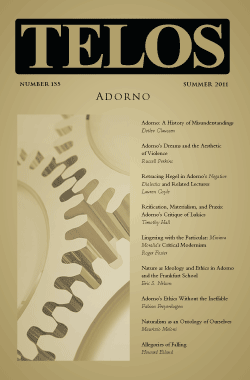 In the autumn of 1962, the philosopher Theodor Adorno, whose work is the topic of this special issue, wrote bluntly: “It would be advisable . . . to think of progress in the crudest, most basic terms: that no one should go hungry anymore, that there should be no more torture, no more Auschwitz. Only then will the idea of progress be free from lies. It is not a progress of consciousness.” The invitation to crudeness may seem surprising, coming from Adorno, still misrepresented as the pessimistic aesthete, consistently hostile to engaged activism, mass culture, and representational art. Such are the standard stereotypes. Yet here that same Adorno tries to reclaim a radical understanding of progress, the fulfillment of material needs and an empirical alleviation of suffering. Progress diminishes bodily pain; it is not—his rejection of Hegelian idealism is explicit—”a progress of consciousness.”
  This article explores what the works of Michel Foucault and Hannah Arendt reveal about ways in which harm manifests itself within the context of modern societies, and about how the terrain of modernity might be negotiated such that harm is minimized and the practice of freedom is promoted. Focusing on the specific harm of racism, the article examines how Arendt’s account of the rise and function of Nazism in The Origins of Totalitarianism and Eichmann in Jerusalem reflects a concern with key aspects of the modern form of power that Foucault refers to as biopower. Two important points are derived from this analysis: First, Foucault and Arendt see racism, specifically as reflected in Nazism, as paradigmatic of the destructive potential of modernity. Second, Foucault’s and Arendt’s analyses of Nazi racism as a paradigmatic modern harm reflect a critical “counter-attitude” toward modernity. This counter-attitude provides valuable insight into the workings of and harms produced by modern power and thereby facilitates productive negotiation of the modern landscape.