By Telos Press · Tuesday, February 15, 2011 Telos Press congratulates Matthias Küntzel on receiving the ADL Paul Ehrlich-Gunther K. Schwerin Human Rights Award. Below is a press release from the Anti-Defamation League announcing the award. Purchase Matthias Küntzel’s Jihad and Jew-Hatred: Islamism, Nazism and the Roots of 9/11 at our website and receive 10% off through the month of February.
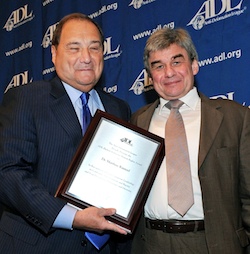 Palm Beach, FL—A German political scientist and writer who has laid bare the genocidal intent of Iran’s nuclear program and exposed a link between the anti-Semitism of the Nazis and of the Iranian regime was honored today by the Anti-Defamation League (ADL) for his ongoing research in the roots and manifestations of modern Jew-hatred. Palm Beach, FL—A German political scientist and writer who has laid bare the genocidal intent of Iran’s nuclear program and exposed a link between the anti-Semitism of the Nazis and of the Iranian regime was honored today by the Anti-Defamation League (ADL) for his ongoing research in the roots and manifestations of modern Jew-hatred.
Dr. Matthias Küntzel was presented with the ADL Paul Ehrlich-Gunther K. Schwerin Human Rights Award during the League’s National Executive Committee meeting in Palm Beach, Florida.
Continue reading →
By Marcia Pally · Tuesday, February 8, 2011 An earlier version of this essay was presented at the 2011 Telos Conference, “Rituals of Exchange and States of Exception: Continuity and Crisis in Politics and Economics.”
 In light of the 2008 global financial crisis, a reassessment of the global market system seems to be afoot. If neoliberalism (too much market) yields the Great Recession, if socialist planning (not enough market) produced the failed economies of the former Soviet bloc, and if social-market combinations (too much centralization of the market) progress towards the slow economic growth and high-cost programs of Western Europe, what are better options? In light of the 2008 global financial crisis, a reassessment of the global market system seems to be afoot. If neoliberalism (too much market) yields the Great Recession, if socialist planning (not enough market) produced the failed economies of the former Soviet bloc, and if social-market combinations (too much centralization of the market) progress towards the slow economic growth and high-cost programs of Western Europe, what are better options?
“New evangelicals,”[1] perhaps unexpectedly for non-believers, offer a few ideas—interesting for their mix of market and common-good positions, and for an apparent paradox. “New evangelicals” work with a sophisticated notion of the common good—though their beliefs and practices rely on the very eighteenth-century principles that fostered unregulated market development. That is, they uphold unencumbered entrepreneurialism in markets, but this commitment makes them entrepreneurs for the benefit of others. This becomes more interesting when one considers that the “new evangelical” paradox has significant effect on the circulation of money and people worldwide. The material here is taken from field research that I did between 2005 and 2010 and which will appear in a book later in 2011 (Eerdmans Publishing).
Continue reading →
By Telos Press · Monday, February 7, 2011 Timothy Wong’s “Steward of the Dying Voice: The Intrusion of Horatio into Sovereignty and Representation” appears in Telos 153 (Winter 2010). Read the full version at TELOS Online website.
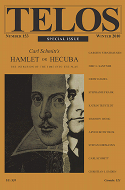 This article examines the issue of early modern sovereign succession and political representation through the figure of Horatio. Using Carl Schmitt’s comments on the “dying voice” in the first appendix of Hamlet or Hecuba, and his theory of political representation, this essay argues that Horatio represents the transitional space between the fading vestiges of political theology, and the first traces constituent sovereignty. In his role as mediator of the sovereign word of King Hamlet and the dying voice of Prince Hamlet, Horatio becomes the proto-constituent subject who signals the genesis of a reoriented political agency that is constituted by popular consent rather than authoritarian rule. Furthermore, Horatio is the paradoxical representative that both represents the body politic (in the sense of the King’s two bodies) to the people and the popular will to itself. This article examines the issue of early modern sovereign succession and political representation through the figure of Horatio. Using Carl Schmitt’s comments on the “dying voice” in the first appendix of Hamlet or Hecuba, and his theory of political representation, this essay argues that Horatio represents the transitional space between the fading vestiges of political theology, and the first traces constituent sovereignty. In his role as mediator of the sovereign word of King Hamlet and the dying voice of Prince Hamlet, Horatio becomes the proto-constituent subject who signals the genesis of a reoriented political agency that is constituted by popular consent rather than authoritarian rule. Furthermore, Horatio is the paradoxical representative that both represents the body politic (in the sense of the King’s two bodies) to the people and the popular will to itself.
Continue reading →
By Richard Gilman-Opalsky · Friday, February 4, 2011 The following text was presented at the 2011 Telos Conference, “Rituals of Exchange and States of Exception: Continuity and Crisis in Politics and Economics.”
(For the people of Tunisia.)
There is a tension in Guy Debord’s crisis theory, which stems from a particular bifurcation in his own consideration of crisis. On the one hand, Debord sought to completely deconstruct the Marxian logic of crisis, but on the other, his own situationist theory of praxis depended on the relationship between crisis and opportunity. In short, Debord abandons any notion of the grand crises of world-historical significance, and looks instead to minor crises of ideology and critique.
Continue reading →
By Samuel Tadros · Thursday, February 3, 2011 One week ago, Egypt was a stable authoritarian regime, prospects of change were minimal and every expert in Washington would have betted on the endurance of its regime. Today, Egypt is in a state of chaos. The regime, even after using its mightiest sword is not able to control the country and the streets of Egypt are in a state of utter lawlessness. As the world stands in awe, confusion, and worry at the unfolding events, perhaps it is important to write the evolving story that is happening in Egypt before any reflections can be made on them.
Continue reading →
By Timothy Stacey · Tuesday, February 1, 2011 A longer version of this essay was presented at the 2011 Telos Conference, “Rituals of Exchange and States of Exception: Continuity and Crisis in Politics and Economics.”
The term “Excellence Critique” connotes a broad array of thinkers, including but not limited to Alisdair MacIntyre, Charles Taylor, Stanley Hauerwas, John Milbank, and Robert Spaemann.[1] While there are clear problems lumping these thinkers together, they share some important qualities. Two such qualities I shall discuss here.
First, none of these thinkers deny the successes of liberalism. All agree that liberalism generates the most “wealth” and “freedom” when these terms are measured via monetary success and moral relativism, respectively. Their argument is not one of efficiency; it is one of excellence. Liberalism, according to these thinkers, fails to fully embrace human flourishing. One way of understanding this failure, I will suggest, is via liberalism’s teleological deficit. By teleology I intend a shared, transcendental, and ineffable conception of the good.
Continue reading →
|
|