By Juan E. Corradi · Friday, February 12, 2010 Not to be caught off guard, most serious journals keep obituaries of the notables that will sooner or later succumb to the passing of time. I have prepared the following for Telos, not only on a man but also on his country. I propose to launch it ahead of the events.
From Hope to Fear: The Dilemma of Radical Equality
Ten years after the triumph of the Chinese revolution, in the Americas the island of Cuba underwent an equivalent upheaval. The Cuban revolution provoked an extraordinary interest and enthusiasm at the time throughout the world. In the middle of the Cold War, Cuba acquired a geopolitical significance out of proportion to its size and economic weight—and almost provoked a nuclear exchange between the two superpowers.
Continue reading →
By Jeremy Fernando · Wednesday, February 10, 2010 This text was presented in January at the 2010 Telos Conference, “From Lifeworld to Biopolitics: Empire in the Age of Obama.”
On the 20th of January, 2009, there was euphoria when Barack Obama was sworn in as the 44th President of the United States of America. Five days earlier, the Lunar New Year arrived, heralding in the Year of the Ox. Perhaps there is no guiding symbol more apt for the year than a castrated bull; a work-horse, domesticated, obedient, and non-independent. After all, in this current climate of an economy in disarray, this seems to be a prudent call—”herd together, buckle down, and move in the same direction.”
Continue reading →
By Timothy Stacey · Tuesday, February 9, 2010 Each Tuesday in the TELOSscope blog, we reach back into the archives and highlight an article whose critical insights continue to illuminate our thinking and challenge our assumptions. Today, Timothy Stacey looks at Paul Gottfried’s “Enforcing ‘Human Rights’: Rejoinder to Rick Johnstone” and Alain de Benoist’s “What is Sovereignty?” both from Telos 116 (Summer 1999).
 As Tony Blair remains a prime candidate for the EU presidency, despite (or, knowing Blair, in spite of) the protestations of his former adversaries at home, it is high time to pose the question of sovereignty in relation to the central enforcement of human rights. And this for four reasons: first, as Prime Minister of Britain, Blair showed little or no respect for localism, preferring the efficiency of top-down reforms from education to policing. If he cared little for provincial politics as the nation’s leader, what is to say he will care for national politics as the continent’s leader? Second, and as a means to achieving this centrism, Blair flouted parliamentary constraints on his leadership. With the EU checks on central control as lackadaisical as they have proved to be in recent years, all it requires is a maverick like Blair to go trampling through the fine red tape that protects national sovereignty. Third, Blair is an unashamed Europhile, in the past proving quite happy to give up his own nation’s sovereignty in the name of EU global clout. Fourth and finally, Blair is the champion of liberal interventionism. Whatever the discrepancy between his excuse for invading Iraq and his reason for staying it through, it is no secret that heavier on Blair’s conscious is whether Iraq was a ripe case for liberal intervention—not whether he lied to the British people. Before Blair becomes a new-age Charlemagne, it is worth assessing the case of sovereignty with respect to human rights. As Tony Blair remains a prime candidate for the EU presidency, despite (or, knowing Blair, in spite of) the protestations of his former adversaries at home, it is high time to pose the question of sovereignty in relation to the central enforcement of human rights. And this for four reasons: first, as Prime Minister of Britain, Blair showed little or no respect for localism, preferring the efficiency of top-down reforms from education to policing. If he cared little for provincial politics as the nation’s leader, what is to say he will care for national politics as the continent’s leader? Second, and as a means to achieving this centrism, Blair flouted parliamentary constraints on his leadership. With the EU checks on central control as lackadaisical as they have proved to be in recent years, all it requires is a maverick like Blair to go trampling through the fine red tape that protects national sovereignty. Third, Blair is an unashamed Europhile, in the past proving quite happy to give up his own nation’s sovereignty in the name of EU global clout. Fourth and finally, Blair is the champion of liberal interventionism. Whatever the discrepancy between his excuse for invading Iraq and his reason for staying it through, it is no secret that heavier on Blair’s conscious is whether Iraq was a ripe case for liberal intervention—not whether he lied to the British people. Before Blair becomes a new-age Charlemagne, it is worth assessing the case of sovereignty with respect to human rights.
Continue reading →
By Etel Sverdlov · Tuesday, February 2, 2010 Each Tuesday in the TELOSscope blog, we reach back into the archives and highlight an article whose critical insights continue to illuminate our thinking and challenge our assumptions. Today, Etel Sverdlov looks at Rick Johnstone’s “Ethnic Purges and Neighborly Pacts: Reflections on a Swiss Statue,” from Telos 115 (Spring 1999).
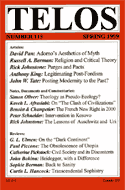 Optimism can never be overrated. It is simply too easy, when examining the world with a keen eye, to become lost within daily strife. For this reason, I found Rick Johnstone’s article “Ethnic Purges and Neighborly Pacts: Reflections on a Swiss Statue” particularly refreshing. Within his text, he traces the development and achievements of Switzerland, emphasizing the modesty of their political ambitions as one of the causes for their success. What saturates the article, however, more than anything, is a committed positive outlook concerning the Swiss. Johnstone glories in their pacifism and applauds them for their tolerance. When analyzing national policy, most people judge countries by what they have accomplished; Johnstone, on the other hand, steps through the looking glass and rejoices in what the Swiss have not done. And what they have not done is a lot. He points out with satisfaction the lack of war monuments to the fallen of World War I in Swiss villages: they had no desire to die by machine-gun fire in the muddy trenches. He emphasizes their invisibility on the political scene: “People jest that no one knows who is the President of Switzerland. . . . If no one knows who the President of Switzerland is, that is because it does not matter, and if it does not matter, that is not because Switzerland is not a success, but because it is, and because its success comes not from above, but from below.” He praises the most useless weapon of war, the Swiss Army Knife—a symbol, with its miniature corkscrew and scissors, of self-reliance and autonomy. Optimism can never be overrated. It is simply too easy, when examining the world with a keen eye, to become lost within daily strife. For this reason, I found Rick Johnstone’s article “Ethnic Purges and Neighborly Pacts: Reflections on a Swiss Statue” particularly refreshing. Within his text, he traces the development and achievements of Switzerland, emphasizing the modesty of their political ambitions as one of the causes for their success. What saturates the article, however, more than anything, is a committed positive outlook concerning the Swiss. Johnstone glories in their pacifism and applauds them for their tolerance. When analyzing national policy, most people judge countries by what they have accomplished; Johnstone, on the other hand, steps through the looking glass and rejoices in what the Swiss have not done. And what they have not done is a lot. He points out with satisfaction the lack of war monuments to the fallen of World War I in Swiss villages: they had no desire to die by machine-gun fire in the muddy trenches. He emphasizes their invisibility on the political scene: “People jest that no one knows who is the President of Switzerland. . . . If no one knows who the President of Switzerland is, that is because it does not matter, and if it does not matter, that is not because Switzerland is not a success, but because it is, and because its success comes not from above, but from below.” He praises the most useless weapon of war, the Swiss Army Knife—a symbol, with its miniature corkscrew and scissors, of self-reliance and autonomy.
Continue reading →
By Michael Marder · Monday, February 1, 2010 This text was presented in January at the 2010 Telos Conference, “From Lifeworld to Biopolitics: Empire in the Age of Obama.”
Carl Schmitt has been often accused of uncritically utilizing metaphysical concepts, such as “the will,” in his political philosophy. In this talk, I will begin to reconstruct the onto-phenomenological foundations of the Schmittian conception of the political will, arguing that it is not a pre-fabricated or transcendental entity, but a historical instant of what Edmund Husserl called “constitutive subjectivity.” The argument entails two crucial theoretical steps. First, I will draw a parallel between Husserl’s account of the crisis of European sciences and Schmitt’s version of the crisis of the political. In each case, the crisis reveals multiple disconnects between the institutional, bureaucratized reality, on the one hand, and the suppressed lifeworld (political or otherwise) that underpins this reality, on the other. Second, I will explore the Schmittian analogue to the Husserlian subject who inhabits this lifeworld. I hope to demonstrate that, for Schmitt, the will is not a numinous, interiorized entity but power in its lived, historical actuality, in other words, political facticity. To reclaim the political lifeworld in 2010, then, we need to tease out the living political will buried beneath the institutionalized, bureaucratized edifice of contemporary politics.
Continue reading →
By Lev Marder · Tuesday, January 26, 2010 Each Tuesday in the TELOSscope blog, we reach back into the archives and highlight an article whose critical insights continue to illuminate our thinking and challenge our assumptions. Today, Lev Marder looks at Russell Berman’s article “From Brecht to Schleiermacher: Religion and Critical Theory,” from Telos 115 (Spring 1999).
Enlightenment forced the individual to turn toward the light and become “enlightened.” Two centuries after this compelling, compulsive transformation began, where has education guided, or misguided, its followers? In Russell Berman’s article “From Brecht to Schleiermacher: Religion and Critical Theory,” a tortured figure emerges. When considering the chastised innocent victim in a discussion of religion, one is conditioned to think back to the inquisition by the Church, stoning under Islamic shariah law, etc. Yet can the discussion of religion be dismissed, condemned, outlawed, or silenced on the basis of the most egregious episodes? Is this figure suffering simply because of religion or, rather, because of a certain dogmatism that is in need of critical discussion? These are some of the questions Berman examines in his article.
Continue reading →
|
|