By Maurizio Meloni · Monday, January 25, 2010 This text was presented in January at the 2010 Telos Conference, “From Lifeworld to Biopolitics: Empire in the Age of Obama.”
Scientific naturalism represents one of the “two countervailing trends that mark the intellectual tenor of our age,” the other being religious worldviews, to follow here Jürgen Habermas’s diagnostic of our present.[1] In a broader intellectual landscape dominated by research programs in neuro- and cognitive science, evolutionary psychology, behavioral genetics and so on, contemporary naturalism symbolizes not only the philosophical framework of these leading intellectual enterprises, but more fundamentally a sort of zeitgeist for our epoch.
Continue reading →
By Adrian Pabst · Wednesday, January 20, 2010 This text was presented in January at the 2010 Telos Conference, “From Lifeworld to Biopolitics: Empire in the Age of Obama.”
Over the past thirty years or so, globalization has supplanted the sovereign national state with the globalized “market-state.” In this complex and non-linear process, the sovereign national state, which provides public investment and universal welfare for the citizenry, has been superseded by the “market-state,” which instead maximizes client and consumer choice by opening up all levels of the economy to global finance and trade, as Philip Bobbitt has documented in his seminal book The Shield of Achilles.[1] Beyond Bobbitt, I have argued elsewhere that the “market-state” fuses centralized bureaucracy with the extension of market exchange to all areas of public policy and the private sphere. In consequence, the institutions of civil society and the practices of civic culture have been largely absorbed into the “market-state” and subordinated to the logic of formal contract and exchange value.[2]
Continue reading →
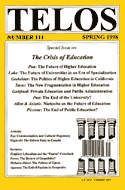
By Marcus Michelsen · Tuesday, January 19, 2010 Each Tuesday in the TELOSscope blog, we reach back into the archives and highlight an article whose critical insights continue to illuminate our thinking and challenge our assumptions. Today, Marcus Michelsen looks at Valerie Allen and Ares Axiotis’s article “Nietzsche on the Future of Education,” from Telos 111 (Spring 1998).
 If someone were to ask me the question “What is authoritative?” I might as well say, “I am. What I give my assent to has authority in my life.” Though true if one admits that for authority to manifest itself it must be recognized by someone, and for something to become authoritative in my life it requires just such a manifestation to me; still, this turns the question around. If I am pursued by the following question “How do I recognize what I should assent to?” the Enlightenment provides me with the answer: “Reason. Reason has authority in our lives. History itself testifies to the reason that formed it in the decisions of great men and in freedom, the spirit of the people. Moreover, to be enlightened means precisely to be in possession of reason.” There are, however, reasons to suppose that such an answer is suspicious, and that the Enlightenment, by glorifying itself, leads us astray. What if, in the belief that authority comes from reason, we have got it wrong? If someone were to ask me the question “What is authoritative?” I might as well say, “I am. What I give my assent to has authority in my life.” Though true if one admits that for authority to manifest itself it must be recognized by someone, and for something to become authoritative in my life it requires just such a manifestation to me; still, this turns the question around. If I am pursued by the following question “How do I recognize what I should assent to?” the Enlightenment provides me with the answer: “Reason. Reason has authority in our lives. History itself testifies to the reason that formed it in the decisions of great men and in freedom, the spirit of the people. Moreover, to be enlightened means precisely to be in possession of reason.” There are, however, reasons to suppose that such an answer is suspicious, and that the Enlightenment, by glorifying itself, leads us astray. What if, in the belief that authority comes from reason, we have got it wrong?
Continue reading →
By Timothy Stacey · Tuesday, January 12, 2010 Each Tuesday in the TELOSscope blog, we reach back into the archives and highlight an article whose critical insights continue to illuminate our thinking and challenge our assumptions. Today, Timothy Stacey looks at Luciano Pellicani’s article “Was Fascism Revolutionary?” from Telos 122 (Winter 2002).
 With wave after wave of Islamic extremist attacks across the globe in the last decade, two schools of thought have begun to emerge: the idealist and the realist. The idealist school says that Islam is dangerous; the realist school claims that economic deprivation is the chief cause of terrorism. Both schools are based on the presupposition that liberalism itself has nothing inherently provocative about it. Crucially, both sides ignore that liberalism can of itself be offensive—not because, as some media pundits suggest, its values are hard to swallow, but because it strictly has no values. There is something distinctly inhuman to this aspect of liberalism that is alienating to those that are new to the liberal rationale. With wave after wave of Islamic extremist attacks across the globe in the last decade, two schools of thought have begun to emerge: the idealist and the realist. The idealist school says that Islam is dangerous; the realist school claims that economic deprivation is the chief cause of terrorism. Both schools are based on the presupposition that liberalism itself has nothing inherently provocative about it. Crucially, both sides ignore that liberalism can of itself be offensive—not because, as some media pundits suggest, its values are hard to swallow, but because it strictly has no values. There is something distinctly inhuman to this aspect of liberalism that is alienating to those that are new to the liberal rationale.
Continue reading →
By Timothy Stacey · Tuesday, January 5, 2010 Each Tuesday in the TELOSscope blog, we reach back into the archives and highlight an article whose critical insights continue to illuminate our thinking and challenge our assumptions. Today, Timothy Stacey looks at Philip Goodchild’s “Truth and Utopia,” from Telos 134 (Spring 2006).
 In the wake of the global economic meltdown, it is once again time to reassess the parameters of the free market. Politicians would have us believe that this reassessment can stand outside of ideology, offering us a clear choice at the ballot between the can-dos and the has-beens of fiscal responsibility. In his article “Truth and Utopia,” Philip Goodchild reveals how this attitude is philosophically misguided, using as it does contingencies of human error as scapegoats for deeper faults of the economy. For Goodchild these faults, alongside those of technology and science, reside in modern optimism, founded on the propositional model of truth, a model that presupposes the positivist Parmenidean maxim truth is true: In the wake of the global economic meltdown, it is once again time to reassess the parameters of the free market. Politicians would have us believe that this reassessment can stand outside of ideology, offering us a clear choice at the ballot between the can-dos and the has-beens of fiscal responsibility. In his article “Truth and Utopia,” Philip Goodchild reveals how this attitude is philosophically misguided, using as it does contingencies of human error as scapegoats for deeper faults of the economy. For Goodchild these faults, alongside those of technology and science, reside in modern optimism, founded on the propositional model of truth, a model that presupposes the positivist Parmenidean maxim truth is true:
Continue reading →
By Alexander García Düttmann · Wednesday, December 30, 2009 “Even the loveliest dream,” Adorno notes in Minima Moralia, “bears like a blemish its difference from reality, the awareness that what it grants is mere illusion.” It is as if, in the moment of waking, one were to experience the way in which the dream is “damaged,” indeed as if there were already something “damaged” in the dream itself. According to Adorno, the “description of the Nature Theater of Oklahoma in Kafka’s Amerika” captures this experience most acutely.
Continue reading →
|
|