By Andrew Walker · Tuesday, December 22, 2009 Each Tuesday in the TELOSscope blog, we reach back into the archives and highlight an article whose critical insights continue to illuminate our thinking and challenge our assumptions. Today, Andrew Walker looks at Roger Foster’s ” Dialectic of Enlightenment as Genealogy Critique,” from Telos 120 (Summer 2001).
 It is often cited as the founding text of Critical Theory in the Frankfurt School tradition. Even Michel Foucault is said to have claimed that he could have saved himself a lot of time had he read Dialectic of Enlightenment years earlier. The book draws together threads from Weber, Freud, Lukács, and Marx in order to show the authors’ view of modernity as a world of restricted thought and suppressed alternatives. Rather than bringing forth a new age of human emancipation, the rise of Enlightenment reason has led to new forms of domination, it has become its opposite, it has reverted to myth. The book analyzes the all-pervasiveness of commoditizing social relations, the totalizing presence of cultural production, and the domination of the critical faculties of rational thought. Though its importance is widely recognized, Dialectic of Enlightenment has often been dismissed as being pessimistic to the point of anachronistic. It should continue to be read and re-read, however, as there is still a great deal of insight into the one-dimensionalism of dominant social thought within its pages. It is often cited as the founding text of Critical Theory in the Frankfurt School tradition. Even Michel Foucault is said to have claimed that he could have saved himself a lot of time had he read Dialectic of Enlightenment years earlier. The book draws together threads from Weber, Freud, Lukács, and Marx in order to show the authors’ view of modernity as a world of restricted thought and suppressed alternatives. Rather than bringing forth a new age of human emancipation, the rise of Enlightenment reason has led to new forms of domination, it has become its opposite, it has reverted to myth. The book analyzes the all-pervasiveness of commoditizing social relations, the totalizing presence of cultural production, and the domination of the critical faculties of rational thought. Though its importance is widely recognized, Dialectic of Enlightenment has often been dismissed as being pessimistic to the point of anachronistic. It should continue to be read and re-read, however, as there is still a great deal of insight into the one-dimensionalism of dominant social thought within its pages.
Continue reading →
By Francisco Unger · Tuesday, December 15, 2009 Each Tuesday in the TELOSscope blog, we reach back into the archives and highlight an article whose critical insights continue to illuminate our thinking and challenge our assumptions. Today, Francisco Unger looks at Michael Marder’s article “Carl Schmitt’s ‘Cosmopolitan Restaurant’: Culture, Multiculturalism, and Complexio Oppositorum,” from Telos 142 (Spring 2008).
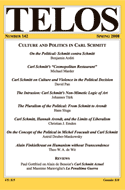 Michael Marder’s essay on Carl Schmitt’s concept of complexio oppositorum, a term elaborated in Schmitt’s Roman Catholicism and Political Form (1923), takes up this “complex of opposites” as a framework for understanding culture. Marder makes the provocative argument that what is normally a decorative centerpiece in the mantle of depoliticized liberalism, “multiculturalism,” can be rescued on Schmittian grounds in order to militate against the somnolence of its former master. When it is understood as the recognition of a charged plurality, or a complex of opposite cultures, multiculturalism satisfies the need for a living politics. Cultures are not paying mere lip service to a common framework of socially entrenched goals, or to the proselytizers of universalism by day (political players by night), but now cultures are seen as vehicles for a people’s political particularity. For Marder, novels, films, languages, manners, etc., can become political weapons by which a disempowered group shatters the fiction of an all-inclusive consensus, and intrudes on the atmosphere of sterility that often accompanies liberalism’s claim to “universality.” Michael Marder’s essay on Carl Schmitt’s concept of complexio oppositorum, a term elaborated in Schmitt’s Roman Catholicism and Political Form (1923), takes up this “complex of opposites” as a framework for understanding culture. Marder makes the provocative argument that what is normally a decorative centerpiece in the mantle of depoliticized liberalism, “multiculturalism,” can be rescued on Schmittian grounds in order to militate against the somnolence of its former master. When it is understood as the recognition of a charged plurality, or a complex of opposite cultures, multiculturalism satisfies the need for a living politics. Cultures are not paying mere lip service to a common framework of socially entrenched goals, or to the proselytizers of universalism by day (political players by night), but now cultures are seen as vehicles for a people’s political particularity. For Marder, novels, films, languages, manners, etc., can become political weapons by which a disempowered group shatters the fiction of an all-inclusive consensus, and intrudes on the atmosphere of sterility that often accompanies liberalism’s claim to “universality.”
Continue reading →
Since its beginnings in 1968, Telos has repeatedly turned to the work of Theodor Adorno, asking how his version of Critical Theory could cross the Atlantic and make sense in the United States. The extraordinary attention paid since to Adorno’s American experience, like that of Alexis de Tocqueville and Gunnar Myrdal, derives in part from a constant fascination with the spectacle of the critical European intellectual’s encounter with the antithetical culture of a resistant America. In this classic meeting of Old World and New, misunderstandings abound. Americans regard the European intellectual as biased and arrogant, spinning grotesque caricatures of America from imagination. The European intellectual, in turn, theoretically inclined, immersed in high culture, and skeptical of American empiricism, generalizes from a narrow, unrepresentative slice of American culture.
Continue reading →
By Nicole Burgoyne · Wednesday, December 9, 2009 Carl Schmitt’s Hamlet or Hecuba: The Intrusion of the Time into the Play is now available in English translation from Telos Press. Nicole Burgoyne recently discussed some of the book’s central arguments with translator David Pan.
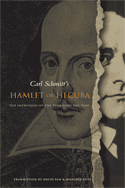 Nicole Burgoyne: Hamlet or Hecuba: The Intrusion of the Time into the Play represents a bit of a departure from Schmitt’s usual juristic theoretical work. At the beginning of the book he makes quite clear that he means to appeal to the literary lover of Shakespeare and to provide a new understanding of the text. How important was literature to Schmitt? Is literature simply another vehicle to explore Schmitt’s other key concepts, such as his definition of the sovereign, the exception, the friend/enemy dichotomy, etc.? Nicole Burgoyne: Hamlet or Hecuba: The Intrusion of the Time into the Play represents a bit of a departure from Schmitt’s usual juristic theoretical work. At the beginning of the book he makes quite clear that he means to appeal to the literary lover of Shakespeare and to provide a new understanding of the text. How important was literature to Schmitt? Is literature simply another vehicle to explore Schmitt’s other key concepts, such as his definition of the sovereign, the exception, the friend/enemy dichotomy, etc.?
David Pan: Literature was important to Schmitt from very early in his career; one of his first publications was a book of literary criticism on the Expressionist poem Nordlicht, by Theodor Däubler. This interest was linked to his political theory to the extent that this theory began with the assumption that politics was based in theology. Though his Roman Catholicism and Political Form theorizes this link in terms of the Catholic Church, his nationalist attitudes brought his interest in theology back to an engagement with the kinds of literary texts, such as Hamlet for England, that make up a national culture.
Continue reading →
By Nicole Burgoyne · Tuesday, December 8, 2009 Each Tuesday in the TELOSscope blog, we reach back into the archives and highlight an article whose critical insights continue to illuminate our thinking and challenge our assumptions. Today, Nicole Burgoyne looks at Donald W. Livingston’s “Lincoln Symbols,” a review of Barry Schwartz’s Abraham Lincoln and the Forge of National Memory, from Telos 122 (Winter 2002).
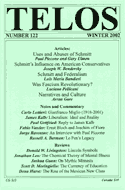 In his 2002 review of Abraham Lincoln and the Forge of National Memory, Donald W. Livingston praises author Barry Schwartz for grappling with the theory of commemorative national memory and images, but then proceeds to tear the substance of Schwartz’s argument to bloody bits. The issue of “truth” proves to be Livingston’s main point of contention in this article, which not only points out the discrepancies between Lincoln myth and reality, but poses a polemical alternative to the ideals that Lincoln is meant to represent. In his 2002 review of Abraham Lincoln and the Forge of National Memory, Donald W. Livingston praises author Barry Schwartz for grappling with the theory of commemorative national memory and images, but then proceeds to tear the substance of Schwartz’s argument to bloody bits. The issue of “truth” proves to be Livingston’s main point of contention in this article, which not only points out the discrepancies between Lincoln myth and reality, but poses a polemical alternative to the ideals that Lincoln is meant to represent.
Continue reading →
By Juan E. Corradi · Thursday, December 3, 2009 It was the dull abruptness of it all. I was walking along the shores of Newport Harbor, with friends, on a fine Thanksgiving afternoon, when the cell phone rang and we got the news from Maria Piccone. Then there was the immediate call to Rome, to the number under his very name. Elena Aga Rossi, in tears, told me it happened in the morning, while walking with a friend, a thrombosis hitting like a bolt from nowhere, and sending him to the big nowhere.
So little to say—and absolutely nothing to do.
Continue reading →
|
|