By Lev Marder · Tuesday, December 1, 2009 Each Tuesday in the TELOSscope blog, we reach back into the archives and highlight an article whose critical insights continue to illuminate our thinking and challenge our assumptions. Today, Lev Marder looks at David M. Rasmussen’s “Preserving the Eidetic Moment: A Contribution of Phenomenology to Critical Theory,” from Telos 145 (Winter 2008).
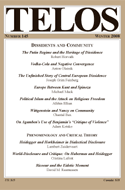 As with Paul Ricouer’s work, David M. Rasmussen’s article “Preserving the Eidetic Moment: A Contribution of Phenomenology to Critical Theory,” from Telos 145, can be praised for refusing to think of theory and praxis in oppositional terms and for preserving the eidetic moment. Relying on his vast experience with the living works he engages and with the theorists of the phenomenological/hermeneutical and critical theory traditions, Rasmussen’s essay exemplifies how theory blends into praxis and praxis into theory. Deliberately injecting subjectivity into an essay that most theorists would claim requires a “scientific” approach, he refuses to hide the subjectivity at the essence of all expression. Where was subjectivity lost in Western thought’s understanding of identity and why should it, why can it, be recovered? As with Paul Ricouer’s work, David M. Rasmussen’s article “Preserving the Eidetic Moment: A Contribution of Phenomenology to Critical Theory,” from Telos 145, can be praised for refusing to think of theory and praxis in oppositional terms and for preserving the eidetic moment. Relying on his vast experience with the living works he engages and with the theorists of the phenomenological/hermeneutical and critical theory traditions, Rasmussen’s essay exemplifies how theory blends into praxis and praxis into theory. Deliberately injecting subjectivity into an essay that most theorists would claim requires a “scientific” approach, he refuses to hide the subjectivity at the essence of all expression. Where was subjectivity lost in Western thought’s understanding of identity and why should it, why can it, be recovered?
Continue reading →
By Etel Sverdlov · Tuesday, November 24, 2009 Each Tuesday in the TELOSscope blog, we reach back into the archives and highlight an article whose critical insights continue to illuminate our thinking and challenge our assumptions. Today, Etel Sverdlov looks at Elena Aga Rossi and Giovanni Orsina’s article “The United States According to the Italian Communist Press (1945–1953),” from Telos 127 (Spring 2004).
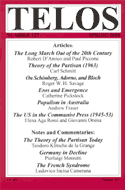 I wonder at times whether the Internet provides people around the world with greater access to the “truth.” Possibly as a result of the widespread availability of almost any information, propaganda today must become more subtle and broad generalizations, or even bold lies, more covert. Such distortions—some deliberate, some unintentional—once permeated Italian communist publications. In their article “The United States According to the Italian Communist Press (1945–1953),” Elena Aga Rossi and Giovanni Orsina trace the rhetoric with which the Italian communists attacked the United States. What stands out most within their analysis is the striking similarity between the charges that the communists and capitalists hurled at each other. I wonder at times whether the Internet provides people around the world with greater access to the “truth.” Possibly as a result of the widespread availability of almost any information, propaganda today must become more subtle and broad generalizations, or even bold lies, more covert. Such distortions—some deliberate, some unintentional—once permeated Italian communist publications. In their article “The United States According to the Italian Communist Press (1945–1953),” Elena Aga Rossi and Giovanni Orsina trace the rhetoric with which the Italian communists attacked the United States. What stands out most within their analysis is the striking similarity between the charges that the communists and capitalists hurled at each other.
Continue reading →
By Marcus Michelsen · Tuesday, November 17, 2009 Each Tuesday in the TELOSscope blog, we reach back into the archives and highlight an article whose critical insights continue to illuminate our thinking and challenge our assumptions. Today, Marcus Michelsen looks at Todd Samuel Presner’s “Heidegger, Arendt, and the Modernity of Mass Death,” from Telos 135 (Summer 2006).
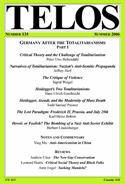 We are all going to die. Of course, this is a platitude. Is death a social or a personal event? It is a strange point of intersection where an inexpressibly personal experience gives expression to meaning for the group. A meaning that is enjoyed or suffered by people who, in a very clear sense, are not taking part in the very event that serves as its point of origin. Whose event, then, is my death? This question becomes irrelevant in the face of mass death, because, here, my death ceases to be a singular event. It is buried in a crowd, innumerable through the multiplication of the killed—my life and my death are both stolen from me. How are we to think of this other kind of death? We are all going to die. Of course, this is a platitude. Is death a social or a personal event? It is a strange point of intersection where an inexpressibly personal experience gives expression to meaning for the group. A meaning that is enjoyed or suffered by people who, in a very clear sense, are not taking part in the very event that serves as its point of origin. Whose event, then, is my death? This question becomes irrelevant in the face of mass death, because, here, my death ceases to be a singular event. It is buried in a crowd, innumerable through the multiplication of the killed—my life and my death are both stolen from me. How are we to think of this other kind of death?
Continue reading →
By Ying Ma · Saturday, November 14, 2009 President Barack Obama, unlike his predecessor George W. Bush, has not made promoting freedom abroad his cause. When he arrives in China on November 15 for his first state visit, however, he will not be able to ignore freedom’s latest, most momentous development: the Chinese government has divorced economic freedom from political freedom for the past three decades and has largely made it work.
Continue reading →
By Philip Crone · Tuesday, November 10, 2009 Each Tuesday in the TELOSscope blog, we reach back into the archives and highlight an article whose critical insights continue to illuminate our thinking and challenge our assumptions. Today, Philip Crone looks two articles about the Frankfurt School: Ben Morgan’s “The Project of the Frankfurt School,” from Telos 119 (Spring 2001), and James Gordon Finlayson’s “Morality and Critical Theory: On the Normative Problem of Frankfurt School Social Criticisms,”from Telos 146 (Spring 2009).
In an earlier post on the TELOSscope blog, Nicole Burgoyne highlighted a 2001 interview with Paul Piccone in which he discussed the appearance of Telos in the 1960s. Piccone listed a number of ideological currents that played major formative roles in the early years of Telos, including Frankfurt School critical theory. Forty years after the first issue of Telos was published the journal is still going strong, but can the same be said of the critical theory of the Frankfurt School? The Frankfurt School itself long predates Telos; the beginnings of its program can be traced to the 1920s when the Institute for Social Research was founded by Carl Grünberg. The Frankfurt School, or at least what is known as its “first generation,” reached its apex with the publication of the second edition of Max Horkheimer and Theodor Adorno’s Dialectic of Enlightenment in 1947. While thinkers influenced by this first generation continue to exert enormous intellectual influence, the ideas of the original group itself have waned.
Continue reading →
By Marcus Michelsen · Tuesday, October 27, 2009 Each Tuesday in the TELOSscope blog, we reach back into the archives and highlight an article whose critical insights continue to illuminate our thinking and challenge our assumptions. Today, Marcus Michelson looks at Jean-Michel Landry’s “Confession, Obedience, and Subjectivity: Michel Foucault’s Unpublished Lectures On the Government of the Living,” from Telos 146 (Spring 2009).
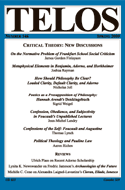 Why do we obey? Even when people rebel, it seems they simply reconstitute a form of obedience. We all know the old cliché “they aren’t rebels, they’re just following a ‘rebellious’ social code.” The way people dress, their hairstyle, tattoos, earrings, piercings, etc., only seem to reinforce our belief in their obedience to well-defined social practices. Even if we aren’t all playing by the same rules, we are all playing by rules. Do we even know what it would mean anymore to rebel? In the meantime, cultural critics admonish our decline, criticizing us for adhering to more philistine, insipid, or self-defeating values. But doesn’t this criticism amount to saying that we are just obeying the wrong thing, whereas obedience itself is simply presupposed? Could obedience really be ubiquitous, and if so, how did we get this way? On the other hand, how can we describe a legitimate form of autonomy? Why do we obey? Even when people rebel, it seems they simply reconstitute a form of obedience. We all know the old cliché “they aren’t rebels, they’re just following a ‘rebellious’ social code.” The way people dress, their hairstyle, tattoos, earrings, piercings, etc., only seem to reinforce our belief in their obedience to well-defined social practices. Even if we aren’t all playing by the same rules, we are all playing by rules. Do we even know what it would mean anymore to rebel? In the meantime, cultural critics admonish our decline, criticizing us for adhering to more philistine, insipid, or self-defeating values. But doesn’t this criticism amount to saying that we are just obeying the wrong thing, whereas obedience itself is simply presupposed? Could obedience really be ubiquitous, and if so, how did we get this way? On the other hand, how can we describe a legitimate form of autonomy?
Continue reading →
|
|