By Etel Sverdlov · Tuesday, October 20, 2009 Each Tuesday in the TELOSscope blog, we reach back into the archives and highlight an article whose critical insights continue to illuminate our thinking and challenge our assumptions. Today, Etel Sverdlov looks at Arden Pennell’s “Why Are They So Happy? Berlin’s Memorial to the Murdered Jews of Europe in Local Context,” from Telos 144 (Fall 2008).
 In all honesty, children playing under the shadow of the presidential statue in the Lincoln Memorial, sweethearts embracing behind the slabs of the World War II plaza, or families picnicking in the shade of the Vietnam Memorial, seem odd and incongruous. Monuments are rarely expected to act as recreational spaces. Rather, the heavy subject matter solemnified in each should lend to reflection and concentration. The opposite, however, is the case with the Berlin Memorial to the Murdered Jews of Europe, where the plaza filled with uniform rectangles of various heights provides visitors with a place to sunbathe, to cuddle, to play, to eat. In her article “Why Are They So Happy? Berlin’s Memorial to the Murdered Jews of Europe in Local Context,” from Telos 144 (Fall 2008), Arden Parnell examines the cultural history of the area in order to explain why the monument has been adopted and used with such unaccustomed cheerfulness. In all honesty, children playing under the shadow of the presidential statue in the Lincoln Memorial, sweethearts embracing behind the slabs of the World War II plaza, or families picnicking in the shade of the Vietnam Memorial, seem odd and incongruous. Monuments are rarely expected to act as recreational spaces. Rather, the heavy subject matter solemnified in each should lend to reflection and concentration. The opposite, however, is the case with the Berlin Memorial to the Murdered Jews of Europe, where the plaza filled with uniform rectangles of various heights provides visitors with a place to sunbathe, to cuddle, to play, to eat. In her article “Why Are They So Happy? Berlin’s Memorial to the Murdered Jews of Europe in Local Context,” from Telos 144 (Fall 2008), Arden Parnell examines the cultural history of the area in order to explain why the monument has been adopted and used with such unaccustomed cheerfulness.
Continue reading →
By David Pan · Monday, October 19, 2009 The 2010 Telos Conference is scheduled for Saturday, January 16, 2010, in New York City. The topic will be “From Lifeworld to Biopolitics: Empire in the Age of Obama.” Click here to register at the Telos Institute website.
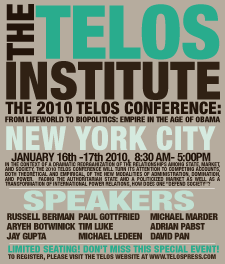 In the context of a dramatic reorganization of the relationships among state, market, and society, the 2010 Telos conference will turn its attention to competing accounts, both theoretical and empirical, of the new modalities of administration, domination, and power. Facing the authoritarian state and a politicized market, how does one “defend society”? Has the strong state and a repoliticization of society returned in the name of left populism in the United States? How does international power operate in new forms of empire? How will Obama’s foreign policy and the economic crisis affect the structure of global relations? In the context of a dramatic reorganization of the relationships among state, market, and society, the 2010 Telos conference will turn its attention to competing accounts, both theoretical and empirical, of the new modalities of administration, domination, and power. Facing the authoritarian state and a politicized market, how does one “defend society”? Has the strong state and a repoliticization of society returned in the name of left populism in the United States? How does international power operate in new forms of empire? How will Obama’s foreign policy and the economic crisis affect the structure of global relations?
Continue reading →
By Philip Crone · Tuesday, October 13, 2009 Each Tuesday in the TELOSscope blog, we reach back into the archives and highlight an article whose critical insights continue to illuminate our thinking and challenge our assumptions. Today, Philip Crone looks at Fabio Vander’s “Kant and Schmitt on Preemptive War,” from Telos 125 (Fall 2002), and Michael Mack’s “Toward a Redefinition of Europe’s Political Identity: Spinoza’s Non-hierarchical Vision,” from Telos 145 (Winter 2008).
In the wake of the terrorist attacks of September 11, President Bush addressed a joint session of Congress, announcing the global war on terrorism and articulating the Bush doctrine of preemptive military action. His speech was followed shortly by the American-led invasion of Afghanistan, and a year later his administration began to make its case for war against Iraq. The formal campaign for the war began with President Bush’s address to the UN Security Council on September 12 and eventually led to the adoption of UN Security Council Resolution 1441, which called for “serious consequences” should Iraq not comply with weapons inspections.
Continue reading →
By Nicole Burgoyne · Tuesday, October 6, 2009 Each Tuesday in the TELOSscope blog, we reach back into the archives and highlight an article whose critical insights continue to illuminate our thinking and challenge our assumptions. Today, Nicole Burgoyne looks at Jonathan Leo’s “The Chemical Theory of Mental Illness,” from Telos 122 (Winter 2002).
 Even the first-time reader of Freud recognizes some outdated theory, in part because he or she has already heard Freudian psychology made fun of as part of the pop culture understanding of psychotherapy. But has Freud’s legacy—talk therapy—become obsolete in education as well as in practice? In his 2002 article “The Chemical Theory of Mental Illness,” Jonathan Leo reviews two books that analyze a still dominant trend toward biological psychiatry in modern day academia and the general public. Leo takes a closer look at the idea that mental illnesses are just like other diseases, chemical imbalances that should be rectified by introducing ameliorating substances. Even the first-time reader of Freud recognizes some outdated theory, in part because he or she has already heard Freudian psychology made fun of as part of the pop culture understanding of psychotherapy. But has Freud’s legacy—talk therapy—become obsolete in education as well as in practice? In his 2002 article “The Chemical Theory of Mental Illness,” Jonathan Leo reviews two books that analyze a still dominant trend toward biological psychiatry in modern day academia and the general public. Leo takes a closer look at the idea that mental illnesses are just like other diseases, chemical imbalances that should be rectified by introducing ameliorating substances.
Continue reading →
By Timothy W. Luke · Thursday, October 1, 2009 Telos Press Publishing is proud to announce the newest addition to our book list: Hamlet or Hebuca: The Intrusion of the Time into the Play by Carl Schmitt, available for the first time in English translation.
Though Carl Schmitt is best known for his legal and political theory, his 1956 Hamlet or Hecuba provides an innovative and insightful analysis of Shakespeare’s tragedy in terms of the historical situation of its creation. Arguing that the construction of the figure of Hamlet was shaped by the politics of James I succession to the throne, Schmitt uses this interpretation to develop a theory of myth and politics that serves as a cultural foundation for his concept of political representation. More than literary criticism or historical analysis, Schmitt’s book lays out a comprehensive theory of the relationship between aesthetics and politics that responds to alternative ideas laid out by Walter Benjamin and Theodor W. Adorno. Jennifer R. Rust’s and Julia Reinhard Lupton’s introduction places Schmitt’s work in the context of contemporary Renaissance studies, and David Pan’s afterword analyzes the links to Schmitt’s political theory. Presented in its entirety in an authorized translation, Hamlet or Hecuba is essential reading for scholars of Shakespeare and of Schmitt alike.
Continue reading →
By Marcus Michelsen · Tuesday, September 29, 2009 Each Tuesday in the TELOSscope blog, we reach back into the archives and highlight an article whose critical insights continue to illuminate our thinking and challenge our assumptions. Today, Marcus Michelsen looks at Jean-Claude Paye’s “From the State of Emergency to the Permanent State of Exception,” from Telos 136 (Fall 2006).
 How long ago was 9/11? Is this really a new era? What does it look like? For many, for perhaps all of us, the terrorist attacks eight years ago came as a surprise and brought us to question our understanding of the world around us. Our answers have emerged in renewed and reinvigorated passions for social and international justice. Collectively, however, there is no one vision we can all subscribe to. Some blame the United States for the terrorist attacks; others call for the government to hunt down the terrorists and kill them. In the heat of the moment, emotions flare and opinions are erratic. How long ago was 9/11? Is this really a new era? What does it look like? For many, for perhaps all of us, the terrorist attacks eight years ago came as a surprise and brought us to question our understanding of the world around us. Our answers have emerged in renewed and reinvigorated passions for social and international justice. Collectively, however, there is no one vision we can all subscribe to. Some blame the United States for the terrorist attacks; others call for the government to hunt down the terrorists and kill them. In the heat of the moment, emotions flare and opinions are erratic.
Continue reading →
|
|