By William Tullius · Monday, September 21, 2009 James V. Schall’s “Revelation and Political Philosophy: On Locating the Best City” appears in Telos 148. William Tullius follows up with some questions.
William Tullius: You wrote in your article that: “Political philosophy, at its best, is the discipline strategically located to reflect on how God, cosmos, man, and polity belong together.” Yet, fundamentally, political philosophy is “aware of its own inability to answer its own highest questions”; namely, in what does the “best city” consist. The answer to political philosophy is supplied by revelation, which answers that political philosophy is capable of recognizing as an intelligible gift. If, however, political philosophy is subject to this sort of limit from the start such that it is dependent for its own answers upon something higher, what do you see as the need for political philosophy in the first place and what does this imply for the relation between faith and reason?
James V. Schall: Political philosophy is not subject to any limits “from the start.” It arrives at its limits—my book is called precisely, At the Limits of Political Philosophy—by seeking itself to answer all its own questions. Philosophy must first be philosophy. We need political philosophy “in the first place” so that we know what it knows and, also, what it does not know but would like to know. Unless this reflection on what is known and what is not known by the discipline takes place in an inquiring mind, revelation has nothing to which to address itself. The great phrase fides quaerens intellectum means exactly that some intellect must be actively asking itself what it knows about political things. Thus, I would say that faith cannot be faith until reason becomes itself active reason knowing what it can know. Once this relationship is clarified or spelled out, we can wonder whether philosophy does not become more philosophy under this impetus.
Continue reading →
By Russell A. Berman · Wednesday, September 16, 2009 When asked whether the U.S. government considers Mahmoud Ahmadinejad to be the “legitimate president” of Iran, White House spokesman Robert Gibbs responded laconically that “he’s the elected leader,” according to an AP report of August 4. The phrasing—and the omission of any reference to the brutal suppression of Iranian protests—offers an insight into key political orientations of the current regime. What counts is the outcome, not the process; what matters are the ends, not the means; and what is of greatest importance is the state and its apparatus, not society and its complexities. No doubt, the Obama administration’s caution on this matter reflects its effort to emphasize diplomacy, as the opportunity for states to talk with states, and to back off from the democratization agenda of its predecessor. The way it has taken sides in Iran is, at least, consistent with its values. Diplomatic negotiations take place over the heads or behind the backs of society, which is why state departments and foreign ministries frequently find themselves at odds with the values of the polities they purport to represent.
This priority of state-to-state relations internationally corresponds domestically to the priority of the state over society. None of the expansion of policing powers of the previous era has been significantly retracted, while the management of the economy proceeds at a brisk pace, with the prospect of a biopolitical administration increasingly likely. Current events are breathing new life into Critical Theory’s nightmare of a “totally administered society.” Anxiety about the growth of the managerial state defined classical Critical Theory, and this was frequently enough one of the key issues that separated it from the orthodox left. For Telos, the political developments of the last third of the twentieth century seemed to indicate various rollbacks in the state apparatus and the potential emancipation of society. Has that historical episode come to an end?
Continue reading →
By Philip Crone · Tuesday, September 15, 2009 Each Tuesday in the TELOSscope blog, we reach back into the archives and highlight an article whose critical insights continue to illuminate our thinking and challenge our assumptions. Today, Philip Crone looks at Catherine Pickstock’s “Justice and Prudence: Principles of Order in the Platonic City,” from Telos 119 (Spring 2001), as well as a response to Pickstock’s article from Donald C. Hodges and Christopher A. Pynes.
 Recent discussions surrounding the death of Senator Ted Kennedy and talk about health care reform have reintroduced some of the most fundamental questions about justice and society into American political discourse. As ill-informed and histrionic as many of today’s arguments are, the matters being discussed are of great importance. And while at first it may not seem to have much relevance to the issues currently discussed, Plato’s Republic is in many ways the first comprehensive and influential work of Western political philosophy. The key questions of the Republic—the roles of social groups, the ideal qualifications for civic leaders, and the guiding principles for society—continue to have great contemporary relevance. Recent discussions surrounding the death of Senator Ted Kennedy and talk about health care reform have reintroduced some of the most fundamental questions about justice and society into American political discourse. As ill-informed and histrionic as many of today’s arguments are, the matters being discussed are of great importance. And while at first it may not seem to have much relevance to the issues currently discussed, Plato’s Republic is in many ways the first comprehensive and influential work of Western political philosophy. The key questions of the Republic—the roles of social groups, the ideal qualifications for civic leaders, and the guiding principles for society—continue to have great contemporary relevance.
Continue reading →
By Timothy W. Luke · Friday, September 11, 2009 Coming on November 1, Matthias Küntzel’s Jihad and Jew-Hatred: Islamism, Nazism and the Roots of 9/11 will be available in paperback format. Pre-order your copy now and save 20% off the cover price.
“In this short, powerful, passionate and thoughtful book, Matthias Küntzel explores how and why radical Islam emerged as the most important political and ideological movement in world politics to place hatred of the Jews at the center of its ideology and policy following the defeat of the Nazi regime . . . Kuentzel’s reconstruction impels us to rethink the issue of continuity and break before and after 1945 and expand our horizons beyond Europe to encompass the trans-national diffusion and impact of Nazism and fascism on the Arab and Islamic world.” (From the foreword by Jeffrey Herf, Professor of History, University of Maryland).
For anyone interested in exploring the mindset of hatred that led to the crimes in New York and Washington on September 11th, 2001, this book is a must-read. For readers interested in the history of Nazi Germany and the Holocaust, this book is a challenge to think outside of a narrowly European context. For everyone, this book provides crucial insight into the roots of terror that continue to threaten all of us.
Continue reading →
By Etel Sverdlov · Tuesday, September 8, 2009 Each Tuesday in the TELOSscope blog, we reach back into the archives and highlight an article whose critical insights continue to illuminate our thinking and challenge our assumptions. Today, Etel Sverdlov looks at Robert Hovarth’s “The Putin Regime and the Heritage of Dissidence” published in Telos 145 (Winter 2008), a special issue on “Dissidents and Community.”
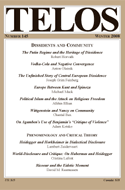 As the child of Russian immigrants who fled the Soviet Union just before it collapsed, I grew up in a unique time-warp. Not knowing the modern Russia, I was raised on Soviet songs, movies, and references. I thought it simply an amusing situation for a child to experience, but as Robert Horvath’s “The Putin Regime and the Heritage of Dissidence” makes clear, this sort of modern disconnect plays a strong, and damaging, part in contemporary Russian politics. Throughout the history of the Soviet Union, individuals of conviction found ways of subtly revolting against the oppressive Communist regime. Once that empire fell, however, these men began to feel the sting of obscurity. Sergei Kovalyov, “the most prominent former dissident in the State Duma,” Vladimir Voinovich, a Soviet satirist, and the most famous of the group, Alexander Solzhenitsyn, the long-bearded writer, all found themselves increasingly irrelevant in the new “democratic” Russia. The generation they belonged to had fallen away. As the child of Russian immigrants who fled the Soviet Union just before it collapsed, I grew up in a unique time-warp. Not knowing the modern Russia, I was raised on Soviet songs, movies, and references. I thought it simply an amusing situation for a child to experience, but as Robert Horvath’s “The Putin Regime and the Heritage of Dissidence” makes clear, this sort of modern disconnect plays a strong, and damaging, part in contemporary Russian politics. Throughout the history of the Soviet Union, individuals of conviction found ways of subtly revolting against the oppressive Communist regime. Once that empire fell, however, these men began to feel the sting of obscurity. Sergei Kovalyov, “the most prominent former dissident in the State Duma,” Vladimir Voinovich, a Soviet satirist, and the most famous of the group, Alexander Solzhenitsyn, the long-bearded writer, all found themselves increasingly irrelevant in the new “democratic” Russia. The generation they belonged to had fallen away.
Continue reading →
By Nicole Burgoyne · Tuesday, September 1, 2009 Welcome to the launch of TELOSthreads, a new website feature that showcases the online archive of Telos articles from the past decade. Each Tuesday in the TELOSscope blog, we will reach back into the archives and highlight an article whose critical insights continue to illuminate our thinking and challenge our assumptions. We’ve also set up an index of TELOSthreads topics, which will allow you to browse the archive thematically. For the first article in this series, we turn to Jorge Raventos’s 2001 interview with Paul Piccone, “From the New Left to Postmodern Populism: An Interview with Paul Piccone,” published in Telos 122 (Winter 2002).
In a 2001 interview with Paul Piccone, Telos‘s founding editor discussed the emergence of the journal within the context of the New Left of the 1960s. For Piccone, Telos existed as a kind of opposition within the opposition, a political force that drew critical strength from what was then a vibrant New Left, but which also largely took issue with the movement.
Continue reading →
|
|