By Saladdin Ahmed · Monday, October 3, 2022 On September 16, 2022, Mahsa Amini, a twenty-two-year-old Kurdish woman, died in captivity three days after she was abducted by “morality police” in Tehran for allegedly breaking the dress code imposed by the Iranian ruling regime. Almost immediately protests broke out across the country. As of the time of writing these lines, a week after Mahsa Amini’s death, the popular protests are only intensifying and thereby insisting on the revolutionary event-ness (per Badiou) of the historical moment. What instigated the protests is not the exceptionality of the incident but rather the commonality of what it represents in terms of legalized violence against the doubly and triply marginalized.
In all societies that live under oppressive regimes, revolt takes place regularly and in various individual and collective forms. Once in a while, an incident would have a domino effect triggering a simultaneous, unplanned, popular uprising that overwhelms the police apparatuses for a few days, weeks, or more. Sometimes the protested regime would not get a chance to resume its totalitarian grip on power, which may result in the ultimate collapse of the police state altogether. While the Arab Spring movements successfully brought down several oppressive regimes, the Islamist movements hijacked almost every popular uprising, which resulted in widespread disbelief in the democratic plausibility and strategic effectiveness of uprisings. However, what happened in the Arab Spring is something Iranians already experienced in the 1979 revolution when Khomeini’s followers hijacked the revolution. While this Iranian uprising, like the uprisings of the Arab Spring, might suffer from the absence of a revolutionary agenda for establishing a new social and political order, it will nonetheless be immune to at least one type of counterrevolutionary infection, which is Islamism. This protest movement’s spontaneous adoption of the Rojava-Bakur revolution’s motto, “Jin, Jiyan, Azadi,” “Women, Life, Freedom,” is a promising sign in terms of the prospects of moving beyond not only religious fundamentalism but also other forms of male-chauvinism and nationalism.
Continue reading →
By David Pan · Monday, October 3, 2022 Telos 200 (Fall 2022): The Place of Truth at the University is now available for purchase in our store. Individual subscriptions to Telos are also available in both print and online formats.
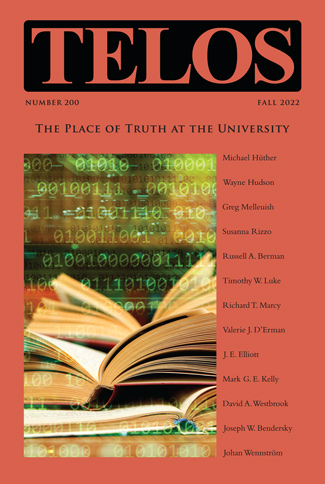 The place of truth at the university has always been elsewhere. Scientific conclusions are after all hypotheses, subject to continuing examination and critique in a process that forever defers the arrival at a final truth. In addition to this unbridgeable temporal distance from truth, there is a spatial distance to the extent that the university is subject to a larger purposive context that stands outside of scientific activity itself. A researcher can be objective by being non-prejudicial in collecting facts and weighing arguments but can never be neutral in terms of the goals of the research, which must always be established before the research begins and from outside of the research project itself.[1] Research cannot begin until an interest in some question has been expressed, and such an interest has generally not been up to the researcher to decide. Whether the goal of medical research will be to protect humans from a virus or attack humans with a virus will be determined by the sponsor of the research rather than the researcher, who at best may decline to take part in some forms of research. If the determiners of the goals of the university are not the professors themselves but the society that sponsors their work, it is within this external values framework that the truth of the university must be found. The place of truth at the university has always been elsewhere. Scientific conclusions are after all hypotheses, subject to continuing examination and critique in a process that forever defers the arrival at a final truth. In addition to this unbridgeable temporal distance from truth, there is a spatial distance to the extent that the university is subject to a larger purposive context that stands outside of scientific activity itself. A researcher can be objective by being non-prejudicial in collecting facts and weighing arguments but can never be neutral in terms of the goals of the research, which must always be established before the research begins and from outside of the research project itself.[1] Research cannot begin until an interest in some question has been expressed, and such an interest has generally not been up to the researcher to decide. Whether the goal of medical research will be to protect humans from a virus or attack humans with a virus will be determined by the sponsor of the research rather than the researcher, who at best may decline to take part in some forms of research. If the determiners of the goals of the university are not the professors themselves but the society that sponsors their work, it is within this external values framework that the truth of the university must be found.
Continue reading →
By David Pan · Monday, September 26, 2022 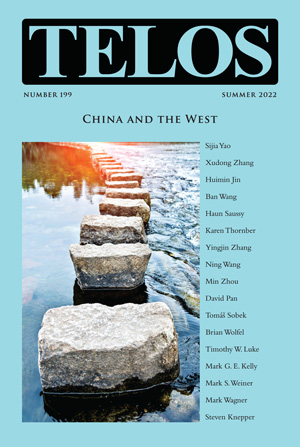 By appealing to our common humanity, the idea of human rights and the idea of a “community of common destiny for mankind” promoted by the Chinese Communist Party seem to be referring to the same thing. Yet the two ideas are clearly opposed to each other, since the goal of the second idea is to supplant the first one. By opposing the idea of human rights and an existing international order that values the autonomy of nation-states and the rule of law, the Chinese Communist Party’s version of common humanity envisions a subordination of international order to Chinese power. One response to these opposing views of the meaning of common humanity would be to deny that such an idea might have any legitimacy at all and to then conclude that the only commonality we share would be a will to power. This stance, by denying the possibility of a common set of values, would undermine attempts at cultural exchange and comparison, as well as the legitimacy of any critique. The human rights ideal, by contrast, begins with recognizing, at a minimum, those transgressions that all humans seek to avoid, including torture, genocide, and enslavement. Such agreement provides the first step for a cultural comparison, which cannot begin until we define a common value. By defining such a value, it becomes possible to compare different manifestations of that value as well as to formulate a critique. In a follow-up to last week’s podcast with Sijia Yao, this week’s podcast with Xudong Zhang addresses the role of the idea of a common humanity for establishing the parameters of a cultural comparison between China and the West. By appealing to our common humanity, the idea of human rights and the idea of a “community of common destiny for mankind” promoted by the Chinese Communist Party seem to be referring to the same thing. Yet the two ideas are clearly opposed to each other, since the goal of the second idea is to supplant the first one. By opposing the idea of human rights and an existing international order that values the autonomy of nation-states and the rule of law, the Chinese Communist Party’s version of common humanity envisions a subordination of international order to Chinese power. One response to these opposing views of the meaning of common humanity would be to deny that such an idea might have any legitimacy at all and to then conclude that the only commonality we share would be a will to power. This stance, by denying the possibility of a common set of values, would undermine attempts at cultural exchange and comparison, as well as the legitimacy of any critique. The human rights ideal, by contrast, begins with recognizing, at a minimum, those transgressions that all humans seek to avoid, including torture, genocide, and enslavement. Such agreement provides the first step for a cultural comparison, which cannot begin until we define a common value. By defining such a value, it becomes possible to compare different manifestations of that value as well as to formulate a critique. In a follow-up to last week’s podcast with Sijia Yao, this week’s podcast with Xudong Zhang addresses the role of the idea of a common humanity for establishing the parameters of a cultural comparison between China and the West.
Continue reading →
By Telos Press · Monday, September 26, 2022 In today’s episode of the Telos Press Podcast, David Pan talks with Xudong Zhang about his article “China and the West: Methodologies for Comparison,” from Telos 199 (Summer 2022). An excerpt of the article appears here. In their conversation they discuss how the specific comparison between China and the West leads to new methodologies of comparison; how a thematic mode of comparison works to bring China and the West in relation to each other; how the need for both a closed horizon, indicating a kind of self-isolation, and a common humanity relate to one another; how comparison can be framed within a context of both movement and action; and how comparison links the particular to the universal. If your university has an online subscription to Telos, you can read the full article at the Telos Online website. For non-subscribers, learn how your university can begin a subscription to Telos at our library recommendation page. Print copies of Telos 199 are available for purchase in our online store.
Continue reading →
By David Pan · Monday, September 19, 2022 China has been intensively engaging with the West for over a century in its attempts to develop economic, political, and military power. At first limiting itself to appropriating Western technology, Chinese intellectuals eventually began to assimilate Western culture, literature, and ideas comprehensively, though of course doing so in a way that integrated them into their own cultural and political traditions. Its brand of communism, for instance, combines Western Marxism with forms of governance shaped by the long dynastic era of Chinese history. The Chinese assimilation of Western traditions establishes a basic openness to the West while also providing strategies for dealing with the West in times of conflict. On the one hand, China’s economic and political rise has been built upon a history of admiration for the West and the consequent ability to emulate Western practices. On the other hand, this intimate knowledge of the West has allowed China to take advantage of Western prejudices in order to undermine its structures, exploiting for instance the norms of free trade in a way that has undermined those very norms.
Continue reading →
By Telos Press · Monday, September 19, 2022 In today’s episode of the Telos Press Podcast, David Pan talks with Sijia Yao about her article “Third Term Comparison,” from Telos 199 (Summer 2022). An excerpt of the article appears here. In their conversation they discuss the difference between world literature and comparative literature, as well as the methodological advantages of comparison; the pervasiveness of biases in both Chinese and Western discourses about the other, and how these biases should be approached; the difference between a binary comparison and a third term comparison; how one can do a third term comparison; and how a third term comparison of D. H. Lawrence and Eileen Chang avoids the binary opposition between China and the West. If your university has an online subscription to Telos, you can read the full article at the Telos Online website. For non-subscribers, learn how your university can begin a subscription to Telos at our library recommendation page. Print copies of Telos 199 are available for purchase in our online store.
Continue reading →
|
|