By François Debrix · Wednesday, July 18, 2007 This is the final part of a review of Jean-Claude Paye’s Global War on Liberty, recently published by Telos Press Publishing and available in our store. Part 1 of the review is here, and part 2 is here. The review will soon appear in full in the journal.
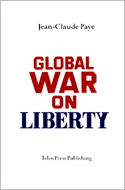 There is much to be admired in Paye’s path-breaking reflection on the nature of a new normative order that comes to life after the implementation of a permanent state of exception. And he must be congratulated for taking seriously what so many others have only announced, imagined, or theorized, and for performing the painstaking “archeological” work of uncovering the basic rules of formation of the new political regime that hides behind legal exceptionality. Still, towards the end of Global War on Liberty, Paye’s inability to provide a more innovative and thought-provoking critical conclusion is disappointing. Instead, Paye needlessly insists on retrieving the ideas of dictatorship and totalitarianism, as if those concepts could provide a grand conceptual finale to his study. Closing with these obsolete political concepts and labels does not do justice to the originality of Paye’s contribution and potentially diminishes its value. But there are two other errors that become obvious at the end of Global War on Liberty, and they are hard to reconcile with the rest of Paye’s analysis. There is much to be admired in Paye’s path-breaking reflection on the nature of a new normative order that comes to life after the implementation of a permanent state of exception. And he must be congratulated for taking seriously what so many others have only announced, imagined, or theorized, and for performing the painstaking “archeological” work of uncovering the basic rules of formation of the new political regime that hides behind legal exceptionality. Still, towards the end of Global War on Liberty, Paye’s inability to provide a more innovative and thought-provoking critical conclusion is disappointing. Instead, Paye needlessly insists on retrieving the ideas of dictatorship and totalitarianism, as if those concepts could provide a grand conceptual finale to his study. Closing with these obsolete political concepts and labels does not do justice to the originality of Paye’s contribution and potentially diminishes its value. But there are two other errors that become obvious at the end of Global War on Liberty, and they are hard to reconcile with the rest of Paye’s analysis.
Continue reading →
By François Debrix · Tuesday, July 17, 2007 This is the second part of a review of Jean-Claude Paye’s Global War on Liberty, recently published by Telos Press Publishing and available in our store. Part 1 of the review is here, and part 3 is here. The review will soon appear in full in the journal.
Beyond the Suspension of the Law
Paye writes that “the rule of law becomes increasingly formal, not only because its content, the protection of private life and the defense of individual and public liberties, turns out to be very limited, but also by the practical possibility offered to the executive power to free itself completely from the last safeguards of legal order” (34). He adds: “The strengthening of the executive relative to the other powers makes possible the general and permanent suspension of the law. It is the instrument for setting up a state of exception” (34). For Paye, the state of legal/constitutional exception implemented in most Western democracies is not about a temporary suspension of the law, one that might guarantee a preservation of existing democratic principles in countries like the United States, Great Britain, France, Belgium, Italy, or the European Union in general (the cases that Paye spends his time detailing in Global War on Liberty). More importantly, it is also more than a suppression of democratic legal and judicial systems, and of the individual rights that these normally guarantee, that would become a new rule of permanence, a new long-lasting condition of suspension of the rule of law, whereby politics could become the product of a succession of ad hoc decisions made by government officials and bureaucrats (as Agamben and others have intimated).
Continue reading →
By François Debrix · Monday, July 16, 2007 The following review will soon appear in Telos, and we are presenting it here on the Telos Press blog in three installments. Jean-Claude Paye’s Global War on Liberty is available in our store.
Jean-Claude Paye. Global War on Liberty. Trans. James H. Membrez. New York: Telos Press, 2007. Pp. 261.
The state of emergency exists for the long term. It emerges as a new type of political system, dedicated to defending democracy and human rights. . . . [T]he citizen must be willing to renounce his/her concrete freedoms for a lengthy period of time in order to maintain a self-proclaimed and abstract democratic order. [1]
Belgian sociologist Jean-Claude Paye has collected several of his recent essays about the suspension of the rule of law, the emergence of a permanent state of exception, abuses of authority, and the generalized condition of restriction of freedom in Western societies since 9/11 in a single volume, La fin de l’état de droit, now translated, updated, and published by Telos Press under the title Global War on Liberty. [2] Paye’s essays over the past five to six years have positioned him as one of the leading critical voices of the post-9/11 era. His critique of the so-called democratic state—from the United States to Europe—and of the transformation of liberal systems of constitutional governance into police, military and security orders actually had been initiated before 9/11. [3] Unfortunately most social, political, and legal theorists (particularly in the English-speaking world) paid little attention to Paye’s incisive reflections prior to the terrorist attacks in the United States. The recent translation of some of his texts into English has given Paye’s scholarship the visibility it deserves. With the publication of Global War on Liberty, Paye finds a place among the critical theorists who must be read if one is to make sense of, carefully reflect upon, and devise challenges to the contemporary condition of state abuse, imperial domination, and proliferation of daily insecurities.
Continue reading →
By Russell A. Berman · Monday, June 25, 2007 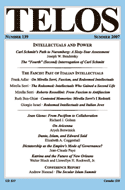 Intellectuals and power: the relationship has always been fraught with tensions, dangers and disappointments. A certain enlightenment utopia imagined a world ruled by reason as a formula for universal peace and prosperity. If only the brightest—who, in this account, are identical with the best—could hold the reins of power, their intelligent schemes could banish the benighted habits of humanity. This aspiration to empower intellectuals took on various shapes during the past century, from the Leninist party, whose mission it was to lead the backward working class, treated as never class-conscious enough to act on its own, to the allegedly post-ideological technocracy of bureaucrats, constantly issuing new regulations on the lives of the rest of us. The mishaps are many. Intellectuals, finding themselves at a distance from political centers, succumb to a will to power, a desire to control. Should they succeed, their efforts to impose their plans on to the social world often take a repressive turn. More likely, they do not succeed but fool themselves about their own significance, projecting categories onto power only to facilitate systematic misunderstanding. Such is the fate of intellectuals who draw close to power or who participate in movements, deluding themselves about their import or having to come to grips with their own disillusionment. Intellectuals and power: the relationship has always been fraught with tensions, dangers and disappointments. A certain enlightenment utopia imagined a world ruled by reason as a formula for universal peace and prosperity. If only the brightest—who, in this account, are identical with the best—could hold the reins of power, their intelligent schemes could banish the benighted habits of humanity. This aspiration to empower intellectuals took on various shapes during the past century, from the Leninist party, whose mission it was to lead the backward working class, treated as never class-conscious enough to act on its own, to the allegedly post-ideological technocracy of bureaucrats, constantly issuing new regulations on the lives of the rest of us. The mishaps are many. Intellectuals, finding themselves at a distance from political centers, succumb to a will to power, a desire to control. Should they succeed, their efforts to impose their plans on to the social world often take a repressive turn. More likely, they do not succeed but fool themselves about their own significance, projecting categories onto power only to facilitate systematic misunderstanding. Such is the fate of intellectuals who draw close to power or who participate in movements, deluding themselves about their import or having to come to grips with their own disillusionment.
Yet this is not only about the intellectuals themselves; it is also about the reason that they, purportedly, carry into political debate. Through its modern history, reason loses suppleness, growing every more instrumental, oriented toward the pursuit of scientistic solutions rather than a reflective investigation of the world. Catastrophic outcomes ensue, as with the self-described sciences of race for Nazi Germany and economics for Soviet Russia. Arendt wrote about the “logicality” of this degraded rational thought; for Horkheimer and Adorno, it represented the dialectic reversion of enlightenment reason into the mythic consciousness it thought it had long before overcome. The question of the relationship of intellectuals to power is inseparable from this fate of reason: the more instrumental reason grows through the process of modernity, the more technocratic intellectual empowerment becomes.
Continue reading →
By Hans Ulrich Gumbrecht · Wednesday, June 13, 2007 To listen to Richard Rorty in a discussion or especially in a lecture was—regardless of the extent to which one agreed with him—always a rhetorical pleasure and an intellectual event. But to walk with him across campus could turn into a minor pain. For in personal conversation, Rorty often seemed uninterested or even clumsy, no matter how unmistakably clear his feelings and strong opinions resonated through his words. Rorty found an ideal solution for this on the birthdays of his wife, Mary, whom he loved with the enthusiasm of a young student: disguised as a waiter with a green apron, he could attend to his guests, without having to talk about anything more concrete than the selection of wines and cocktails.
Like only few of his predecessors, Richard Rorty lived his philosophy of an undramatic attention to others with unyielding but flexible consistency. When he again changed his university ten years ago, his new colleagues would have been delighted simply with the enhanced prestige that listing Rorty’s name in the catalogue brought to an institution formerly famous primarily due to the natural sciences. But he dedicated himself to his new department with greater intensity even than those young professors who have to prove themselves for tenure. There was never a faculty meeting that he did not attend well prepared; there was no class paper that Rorty did not read thoroughly and comment on extensively; there was no lecture class that he did not constantly rethink in terms of content and pedagogical strategy. This is how he understood the role of the democratic citizen. Yet this all may not have been fully independent of the polemical pleasure he took in working in a department of comparative literature—with the daily hope of provoking those analytic colleagues whose canon and style of thought have dominated Anglo-American philosophy for decades—but also motivated by the conviction that analytic philosophy had ended up as a specialization inimical to thinking; and while this analytic philosophy became irrelevant for life outside the academy, Rorty had become the public intellectual and charismatic university teacher who most represented its opposite internationally.
To think without authoritarian directives and to live one’s own life—on an elementary level, these may have been Richard Rorty’s highest values. Indebted, of course, to the enlightenment legacy as much as his personal friend Jürgen Habermas, Rorty was blindly convinced that such freedom would have to lead to a generous engagement for all of suffering and oppressed humanity. When this expectation was disappointed, the soft spoken philosopher could make demands and mount accusations with the obstinacy of a sectarian. In a discussion during the early Bush years, he seriously suggested that the university no longer hire anyone suspected of having voted for the Republican Party. When a colleague asked ironically if this would not pave the way to an “intellectual reeducation camp,” no one laughed louder and with more sympathy for the objection than did Rorty.
To write and teach in close proximity to this vulnerable, enormously well read and often ingenious Richard Rorty gave one the encouraging certainty of being in the presence of intellectual greatness. Since his death last Friday, before the intensive pain of an incurable disease had begun, the name of Richard Rorty has joined the canon of critical optimistic American writers and thinkers of the past, a canon which he shaped and disseminated: Whitman, Emerson, Dewey and finally Davidson. Men like them—and like Richard Rorty—are indispensable for everyone who cannot live without the mobility of thinking and who therefore have an understanding of how fragile, and how strong, thoughts can be.
Continue reading →
By Telos Press · Saturday, June 9, 2007 Richard Rorty, the leading American philosopher and heir to the pragmatist tradition, passed away on Friday, June 8.
He was Professor of Comparative Literature emeritus at Stanford University. In April the American Philosophical Society awarded him the Thomas Jefferson Medal. The prize citation reads: “In recognition of his influential and distinctively American contribution to philosophy and, more widely, to humanistic studies. His work redefined knowledge ‘as a matter of conversation and of social practice, rather than as an attempt to mirror nature’ and thus redefined philosophy itself as an unending, democratically disciplined, social and cultural activity of inquiry, reflection, and exchange, rather than an activity governed and validated by the concept of objective, extramental truth.”
At the awards ceremony, presenter Lionel Gossman celebrated Dr. Rorty as an advocate of “a deeply liberal, democratic, and truly American way of thinking about knowledge.” Dr. Rorty’s published works include Philosophy and the Mirror of Nature (1979), Consequences of Pragmatism (1982), Contingency, Irony, and Solidarity (1988), Objectivity, Relativism and Truth: Philosophical Papers I (1991), Essays on Heidegger and Others: Philosophical Papers II (1991), Achieving Our Country: Leftist Thought in Twentieth Century America (1998), Truth and Progress: Philosophical Papers III (1998), and Philosophy and Social Hope (2000).
Continue reading →
|
|