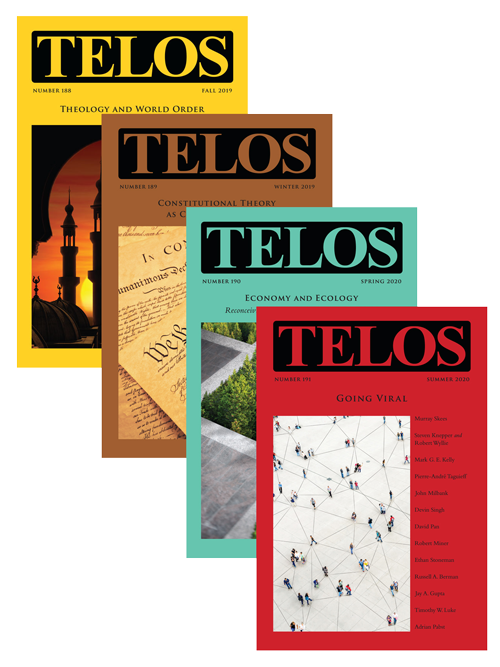
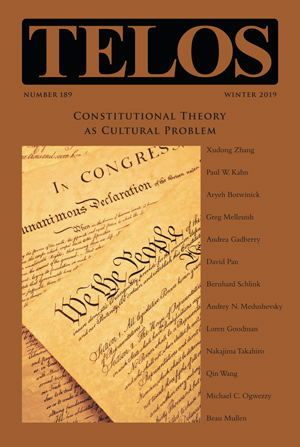
By Andrey N. Medushevsky · Thursday, January 2, 2020 Andrey N. Medushevsky’s “Law and Revolution: The Impact of Soviet Legitimacy on Post-Soviet Constitutional Transformation” appears in Telos 189 (Winter 2019), a special issue on constitutional theory. Read the full article at the Telos Online website, or purchase a print copy of the issue in our online store. Individual subscriptions to Telos are available in both print and online formats.
 The systematic investigation of the Russian revolutionary tradition in comparative, historical, and functional perspective provides the opportunity to understand its impact on the creation of the modern world and the contemporary social and political system. This article discusses the meaning, formation, and evolution of the Soviet project—the concept and practice of social and legal reorganization in Russia inspired by Marxist philosophical ideas and fulfilled during the period from the Bolshevik Revolution of 1917 until the collapse of the Soviet regime in 1991. Employing a cognitive theoretical approach in historical studies, the author examines the role of Communist myth in the formation of the Soviet state, the ideological and legal grounds of one-party dictatorship, the nature of nominal constitutionalism, and the role of institutional continuity in the formation of the current political system. He shows the place of the permanent grounds (ideology, nominal constitutionalism, and dictatorial impetus) as well as the place of changing parameters of the project (Soviet, federative, and class-oriented regulation) regarding their formal and informal influence on the political regime’s legitimacy and the cumulative impact on the system’s transformation and failure. In this context, the author discusses the evolution of the legitimating formula of the political regime from Tsarist times to the collapse of the Soviet regime, as represented in ideological programmatic, nominal Soviet constitutionalism (1918, 1924, 1936, and 1977 Soviet constitutions) and changing practices of the social mobilization. That makes possible the general evaluation of the revolutionary heritage and its influence on the current post-Soviet ideological priorities, political system, legal transformation, and prospects for its modernization. The systematic investigation of the Russian revolutionary tradition in comparative, historical, and functional perspective provides the opportunity to understand its impact on the creation of the modern world and the contemporary social and political system. This article discusses the meaning, formation, and evolution of the Soviet project—the concept and practice of social and legal reorganization in Russia inspired by Marxist philosophical ideas and fulfilled during the period from the Bolshevik Revolution of 1917 until the collapse of the Soviet regime in 1991. Employing a cognitive theoretical approach in historical studies, the author examines the role of Communist myth in the formation of the Soviet state, the ideological and legal grounds of one-party dictatorship, the nature of nominal constitutionalism, and the role of institutional continuity in the formation of the current political system. He shows the place of the permanent grounds (ideology, nominal constitutionalism, and dictatorial impetus) as well as the place of changing parameters of the project (Soviet, federative, and class-oriented regulation) regarding their formal and informal influence on the political regime’s legitimacy and the cumulative impact on the system’s transformation and failure. In this context, the author discusses the evolution of the legitimating formula of the political regime from Tsarist times to the collapse of the Soviet regime, as represented in ideological programmatic, nominal Soviet constitutionalism (1918, 1924, 1936, and 1977 Soviet constitutions) and changing practices of the social mobilization. That makes possible the general evaluation of the revolutionary heritage and its influence on the current post-Soviet ideological priorities, political system, legal transformation, and prospects for its modernization.
Continue reading →
By Xudong Zhang and David Pan · Monday, December 16, 2019 Telos 189 (Winter 2019), a special issue on Constitutional Theory as Cultural Problem, edited by Xudong Zhang and David Pan, is now available for purchase in our store. Individual subscriptions to Telos are also available in both print and online formats.
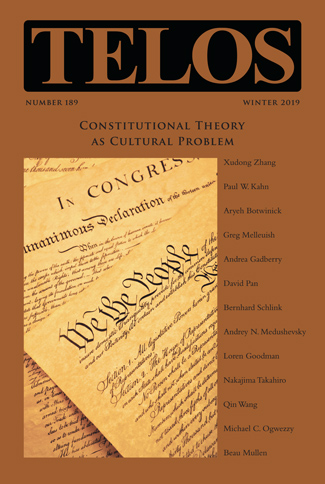 The challenges faced by the liberal democratic model of government in the twenty-first century have made constitutional theory into an urgent topic of global concern. Both the second Iraq war and the revolutions of the Arab Spring frustrated hopes of an easy global trajectory toward liberal democracy. If there was the hope that liberation would mean the establishment of liberal constitutional norms, the result has been that emancipation from tyranny does not naturally lead in a particular political direction. Meanwhile, established liberal democracies, from the United States to Europe to India, are facing upheavals that have prompted many to question the stability of the model itself, leading to the need to revise a constitutional theory that up to now has been built around the liberal democratic model. While the constitutional state, as theory and practice in modern Europe, North America, and Asia, continues to be the common point of reference, its stability and legitimacy can no longer be taken for granted, thus requiring renewed thinking about its history and cultural foundations. The challenges faced by the liberal democratic model of government in the twenty-first century have made constitutional theory into an urgent topic of global concern. Both the second Iraq war and the revolutions of the Arab Spring frustrated hopes of an easy global trajectory toward liberal democracy. If there was the hope that liberation would mean the establishment of liberal constitutional norms, the result has been that emancipation from tyranny does not naturally lead in a particular political direction. Meanwhile, established liberal democracies, from the United States to Europe to India, are facing upheavals that have prompted many to question the stability of the model itself, leading to the need to revise a constitutional theory that up to now has been built around the liberal democratic model. While the constitutional state, as theory and practice in modern Europe, North America, and Asia, continues to be the common point of reference, its stability and legitimacy can no longer be taken for granted, thus requiring renewed thinking about its history and cultural foundations.
Continue reading →
By Saladdin Ahmed · Thursday, December 12, 2019 For decades, Sunni Islamism was led by Saudi Wahabism, while the Muslim Brotherhood developed strategies for taking over governments. When King Salman assumed power in Saudi Arabia in 2015, a major shift took place in Saudi politics. For the first time in the history of the kingdom, Wahabis were confronted in the centers of power. This coincided with the escalation of Turkey’s Islamist ambitions to become the leading Sunni imperial power, led by Erdoğan. The center of Sunni Islamism gradually moved from Saudi Arabia to Turkey, and this was reinforced when the Saudis came out in support of Abdel Fattah el-Sisi in Egypt against the Muslim Brotherhood’s attempts to reinstall their ousted president, Mohamed Morsi. Erdoğan, on the other hand, lost a strategic ally when Morsi was deposed by el-Sisi.
Parallel to this shift of the Sunni centers of gravity, Al-Qaida was losing ground while ISIS emerged as the main force capable of recruiting fundamentalist youth to join jihad. As many of Al-Qaida’s funding sources dried up due to new Saudi policies, Turkey did everything short of openly professing support to empower ISIS. Erdoğan’s regime allowed tens of thousands of jihadis to join ISIS from 2012, when ISIS became a major force in the Syrian and Iraqi civil wars, to 2018, when it ultimately fell under the Kurdish attacks supported by the United States.
Continue reading →
By Saladdin Ahmed · Tuesday, December 10, 2019 Despite a decade of resistance since the Iranian Green Revolution in 2009, another Middle East and North Africa (MENA) has yet to be born. In its way lie Sunni and Shia Islamist blocs, which have been remarkably successful in preventing entire societies from stepping forward. In countries where they have assumed state power, Islamist forces have been aggressive and totalitarian, while elsewhere they have hijacked popular liberal movements of regime change in recent years. Ultimately, if the anti-Islamist resistance does not soon bring down the main sponsors of the Sunni and Shia blocs—the Turkish and Iranian regimes, respectively—the coming era will be no less bloody than the period from 1919 to 1945.
In my view, the avalanche that will topple the regime in Iran is gaining speed, but as for the Sunni bloc, I am less optimistic. The Kurds are the last obstacle to Erdoğan’s neo-Ottoman caliphate, and it seems they are being left to face their heroic yet tragic fate alone. If the Islamist momentum of militarization and mobilization is allowed to continue building, it will eventually shatter the prospects for international peace. Perhaps only then, looking back on these days, will liberal democracies recognize their own culpability for failing to support anti-Islamist struggles in the region.
Continue reading →
By Telos Press · Monday, December 9, 2019 New from Telos Press: Anthropocene Alerts: Critical Theory of the Contemporary as Ecocritique, by Timothy W. Luke. Order your copy in our online store, and save 20% on the list price by using the coupon code BOOKS20 during the checkout process.
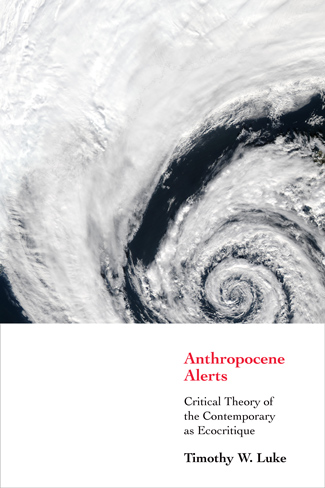 From the late 1970s, Timothy W. Luke has developed critical analyses of significant social, political, and cultural conflicts, with a particular focus on the entangled politics of culture, economy, and nature. Luke’s “ecocritiques,” many of which first appeared in the pages of Telos, advance a critical theory of the contemporary that takes aim at our ongoing ecological crisis, a period marked by rapid climate change, extensive biodiversity loss, and deep ecospheric damage. The essays collected here range across diverse topics, from the politics of the Anthropocene, Paolo Soleri’s urban design experiments, the Unabomber manifesto, the Trump administration’s attacks on environmental protections, and the informationalization of ecological change, to community agriculture projects, deep ecology, the symbolic politics of climate change treaties, Edward Abbey’s ecological writings, and the biopolitics of accelerationism and the Dark Enlightenment. Taken together, this collection documents crucial moments in Luke’s project of ecocritique as well as the commitment of Telos to environmental criticism, political theory, and policy analysis. From the late 1970s, Timothy W. Luke has developed critical analyses of significant social, political, and cultural conflicts, with a particular focus on the entangled politics of culture, economy, and nature. Luke’s “ecocritiques,” many of which first appeared in the pages of Telos, advance a critical theory of the contemporary that takes aim at our ongoing ecological crisis, a period marked by rapid climate change, extensive biodiversity loss, and deep ecospheric damage. The essays collected here range across diverse topics, from the politics of the Anthropocene, Paolo Soleri’s urban design experiments, the Unabomber manifesto, the Trump administration’s attacks on environmental protections, and the informationalization of ecological change, to community agriculture projects, deep ecology, the symbolic politics of climate change treaties, Edward Abbey’s ecological writings, and the biopolitics of accelerationism and the Dark Enlightenment. Taken together, this collection documents crucial moments in Luke’s project of ecocritique as well as the commitment of Telos to environmental criticism, political theory, and policy analysis.
Continue reading →
By Maxwell Kennel · Friday, November 15, 2019 Maxwell Kennel’s “Periodization and Providence: Time and Eternity between Nietzsche’s Zarathustra and Augustine’s Confessions” appears in Telos 188 (Fall 2019). Read the full article at the Telos Online website, or purchase a print copy of the issue in our online store. Individual subscriptions to Telos are available in both print and online formats.
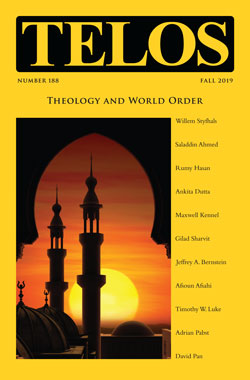 In order to address the politics of temporal regulation and periodization, while considering ways in which competing religious and secular narratives construct contemporary subjectivity, this article compares the quasi-autobiographical narratives of Friedrich Nietzsche’s Thus Spoke Zarathustra and Saint Augustine’s Confessions. Looking beneath the surface differences between these two works, this study draws out surprising affinities and continuities between Zarathustra and the Confessions and compares each work’s vision of time and eternity. By examining Zarathustra’s parable of the gate and its punctuating moment (Augenblick) alongside Augustine’s notion of the distentio animi in book 11 of the Confessions, this article questions competing Christian and anti-Christian narratives and their use of teleology and providence in the periodization of time, and concludes by contesting these narratives from the standpoint of postsecular critique. In order to address the politics of temporal regulation and periodization, while considering ways in which competing religious and secular narratives construct contemporary subjectivity, this article compares the quasi-autobiographical narratives of Friedrich Nietzsche’s Thus Spoke Zarathustra and Saint Augustine’s Confessions. Looking beneath the surface differences between these two works, this study draws out surprising affinities and continuities between Zarathustra and the Confessions and compares each work’s vision of time and eternity. By examining Zarathustra’s parable of the gate and its punctuating moment (Augenblick) alongside Augustine’s notion of the distentio animi in book 11 of the Confessions, this article questions competing Christian and anti-Christian narratives and their use of teleology and providence in the periodization of time, and concludes by contesting these narratives from the standpoint of postsecular critique.
Continue reading →
|
|