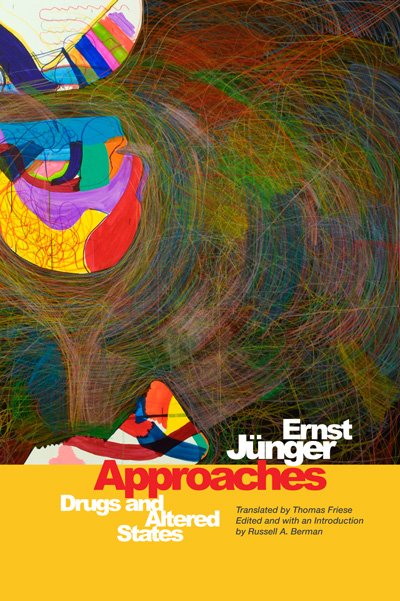
By Telos Press · Tuesday, September 1, 2015 Telos Press Publishing is pleased to announce that Ernst Jünger’s Eumeswil is now available for purchase. Order your copy today in our online store.
Eumeswil
by Ernst Jünger
Translated by Joachim Neugroschel
Edited and with an Introduction by Russell A. Berman
 Eumeswil, ostensibly a post-apocalyptic science fiction novel, is effectively a comprehensive synthesis of Ernst Jünger’s mature thought, with a particular focus on new and achievable forms of individual freedom in a technologically monitored and managed postmodern world. Here Jünger first fully develops his figure of the anarch, the inwardly liberated and outwardly pragmatic individual, who lives peacefully in the heart of Leviathan and is yet able to preserve his individuality and freedom. Composed of a series of short passages and fragments, Eumeswil follows the reflections of Martin Venator, a historian living in a futuristic city-state ruled by a dictator known as the Condor. Through Venator, the prototypical anarch, Jünger offers a broad and uniquely insightful analysis of history from the post-historic perspective and, at the same time, presents a vision of future technological developments, including astonishingly prescient descriptions of today’s internet (the luminar), smartphone (the phonophore), and genetic engineering. At once a study of accommodation to tyranny and a libertarian vision of individual freedom, Eumeswil continues to speak to the contradictions and possibilities inherent in our twenty-first-century condition. Eumeswil, ostensibly a post-apocalyptic science fiction novel, is effectively a comprehensive synthesis of Ernst Jünger’s mature thought, with a particular focus on new and achievable forms of individual freedom in a technologically monitored and managed postmodern world. Here Jünger first fully develops his figure of the anarch, the inwardly liberated and outwardly pragmatic individual, who lives peacefully in the heart of Leviathan and is yet able to preserve his individuality and freedom. Composed of a series of short passages and fragments, Eumeswil follows the reflections of Martin Venator, a historian living in a futuristic city-state ruled by a dictator known as the Condor. Through Venator, the prototypical anarch, Jünger offers a broad and uniquely insightful analysis of history from the post-historic perspective and, at the same time, presents a vision of future technological developments, including astonishingly prescient descriptions of today’s internet (the luminar), smartphone (the phonophore), and genetic engineering. At once a study of accommodation to tyranny and a libertarian vision of individual freedom, Eumeswil continues to speak to the contradictions and possibilities inherent in our twenty-first-century condition.
Continue reading →
By Telos Press · Thursday, August 27, 2015 In a new interview with Karmel Melamed in the Jewish Journal, Matthias Küntzel discusses the history of antisemitism in Iran, a topic he explores in detail in his new book Germany and Iran: From the Aryan Axis to the Nuclear Threshold. Purchase your copy of the book in our online store.
Continue reading →
By Arno Tausch · Monday, August 24, 2015
 This article presents statistical estimates of ISIL support in the Muslim world, based on Pew data covering 42 percent of the total global Muslim population on favorability of four terror organizations, to be well compared with ISIL: Hamas, Hezbollah, the Taliban, and al Qaeda, and the favorability of suicide bombing. It is assumed that these data (average support rates) reflect the true, but unknown, rates of ISIL support, which will be at somewhere around 17 percent of the entire global Muslim population. The article analyzes mechanisms that contribute towards ISIL favorability, such as anti-Americanism, the hatred of the State of Israel, and the advance of violent Islamism. Finally a comparison of the evolving terror scene with the conflict in Northern Ireland is also outlined. This article presents statistical estimates of ISIL support in the Muslim world, based on Pew data covering 42 percent of the total global Muslim population on favorability of four terror organizations, to be well compared with ISIL: Hamas, Hezbollah, the Taliban, and al Qaeda, and the favorability of suicide bombing. It is assumed that these data (average support rates) reflect the true, but unknown, rates of ISIL support, which will be at somewhere around 17 percent of the entire global Muslim population. The article analyzes mechanisms that contribute towards ISIL favorability, such as anti-Americanism, the hatred of the State of Israel, and the advance of violent Islamism. Finally a comparison of the evolving terror scene with the conflict in Northern Ireland is also outlined.
Continue reading →
By Telos Press · Tuesday, August 11, 2015 Writing in the new issue of the Israel Journal of Foreign Affairs, Soli Shahvar reviews Matthias Küntzel’s Germany and Iran: From the Aryan Axis to the Nuclear Threshold, published by Telos Press. Read the full review here (subscription required). You can purchase your copy of Germany and Iran in our online store.
Continue reading →
By Telos Press · Monday, August 3, 2015 Telos Press Publishing is pleased to announce that Ernst Jünger’s Eumeswil is now available for pre-order. The book will be released on September 1, 2015. Pre-order your copy today, and we will ship it as soon as it becomes available.
Continue reading →
By Matteo Calla · Thursday, July 30, 2015 This article places Benjamin’s late work in dialogue with recent attempts in media theory and structuralism to think the subject and historical contingency together. It argues their apparent incompatibility is reflected in Benjamin’s writing in the form of a recurrent contradiction between historical materialism and transhistorical theology. Through a reconstruction of the theorist’s historicization of an earlier theological theory of the fall of language in his Marxian-inflected work of the 1930’s, it claims that Benjamin initiates a historicist reconceptualization of the impasse of the Kantian subject onto being as the product of a particular field of mediation arising with mass modernity. Yet following the rejection of his nascent version of the Arcades Project by Adorno and the Marxist Institute for Social Research in 1938, theology returns as an attempt to reconceive of an aesthetic-formal break with this impasse. Benjamin’s late theorization of his materialist historiography thus represents a dialectical attempt to think materialism and theology, history and being together, with the aim of mediating not only distraction, but a revolutionary destruction of the subject and the historical order producing it.
Continue reading →
|
|