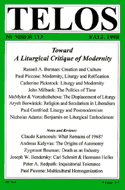
 Catherine Pickstock’s “Liturgy and Modernity,” from Telos 113 (Fall 1998), is an effort to find an alternative to liberal individualism and social fragmentation in modernity. Pickstock finds this alternative in liturgy: a liturgical critique of modernity where “liturgy” functions as a thoroughly political category. Liturgy is specially equipped to confront modernity due to its nature as ritual behavior (and therefore universal among humans). Yet the liturgical is to be favored over “ritual” for two reasons. First, ritual has already been relegated to its own “delimited sphere” in modernity, where it is viewed as a private superstructural category. Furthermore, ritual in the modern mind is regarded merely as “mechanical repetitions divorced from any informing narrative.” Liturgy, on the other hand, responds to the former challenge by its nature as “a pattern of social action” (not a delimited sphere) and responds to the latter by its foundation in a “privileged transcendent signifier.”
|
The following paper was presented at the 2015 Telos Conference, held on February 13–15, 2015, in New York City. For additional details about the conference, please visit the Telos-Paul Piccone Institute website. In my short essay, I would like to outline a new strategy of the universalization of history, which emerges from the analysis of modern Jewish practice of philosophizing. I call it a Marrano strategy, by building an analogy between the religious practices of the late-medieval Sephardic Jewry, which was forced to convert to Christianity but kept Judaism “undercover,” and the philosophical intervention of modern Jewish thinkers who spoke the seemingly universal idiom of Western philosophy but, at the same time, impregnated it “secretly” with motives deriving from their “particular” background.[1] Yet, they did not do it in order to abolish the universalist perspective, but to transform it; for the last heirs of this “Marrano” line, Walter Benjamin and Jacques Derrida, the proper universalism amounts to an after-Babel project of mending the broken whole from within, horizontally, without assuming the lofty position of a general meta-language, but through the effort of multi-linguality. Telos 171 (Summer 2015) is now available for purchase in our store. Writing at the Times of Israel, Jeffrey Herf explains why Matthias Küntzel’s Germany and Iran: From the Aryan Axis to the Nuclear Threshold should be on your must-read list this summer. You can purchase a copy in our online store. Save 20% through the end of June by using the coupon code TELOS1968. We’re celebrating forty-seven years of publishing the journal Telos by offering a 20% discount on all books and back issues purchased at our online store between now and the end of May. Just enter the coupon coupon code TELOS1968 during the checkout process to apply the discount to your order. It’s been many years since that momentous summer of 1968, when we published the very first issue of Telos, but we are still going strong thanks to the support and engagement of readers like you. From all of us at Telos Press, thank you for being a part of our continuing journey in the worlds of philosophy, politics, and critical theory. |
   |
|||
|
Privacy Policy · Data Protection Copyright © 2026 Telos Press Publishing · All Rights Reserved |
||||
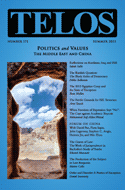 Standard accounts of American politics invoke an oscillation between idealist and realist inclinations. The idealists appeal to principles, which they identify as fundamental to the American polity, especially those enshrined in the founding documents: life, liberty, and the pursuit of happiness, transformed into a broad democratization agenda. Of course, revisionist critics have no difficulty in pointing out the failure of that agenda, i.e., the extent to which the empirical history of the country fell far short of realizing its ideals. Yet even that critique, smugly put forward to debunk naïve idealism, in some basic ways is itself indebted to the same idealism, insofar as the complaint of insufficient democratization also implies a call for more democracy, the very core of the idealist program. This is why neo-conservatives and their left-liberal adversaries always had more in common than met the eye (as was abundantly clear to traditional conservatives).
 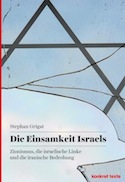 Die Einsamkeit Israels: Zionismus, die israelische Linke und die iranische Bedrohung (Israel’s Solitude: Zionism, the Israeli Left, and the Iranian Threat), by the German political scientist Stephan Grigat, is an important contribution to the overall debate on the Middle East, and it was published just in time, given the background of the Lausanne negotiations with Iran. Grigat dispels the current euphoria about the “breakthrough in Lausanne” and illuminates the many existing darker sides of the Lausanne deal. The present reviewer is of the opinion that, particularly in view of the special historical responsibility of Continental Europe, a careful reconsideration of the realities created in Lausanne and the considerable role played by the EU foreign policy machinery is necessary and that the other side in the conflict—the side of Israel—is also being heard.