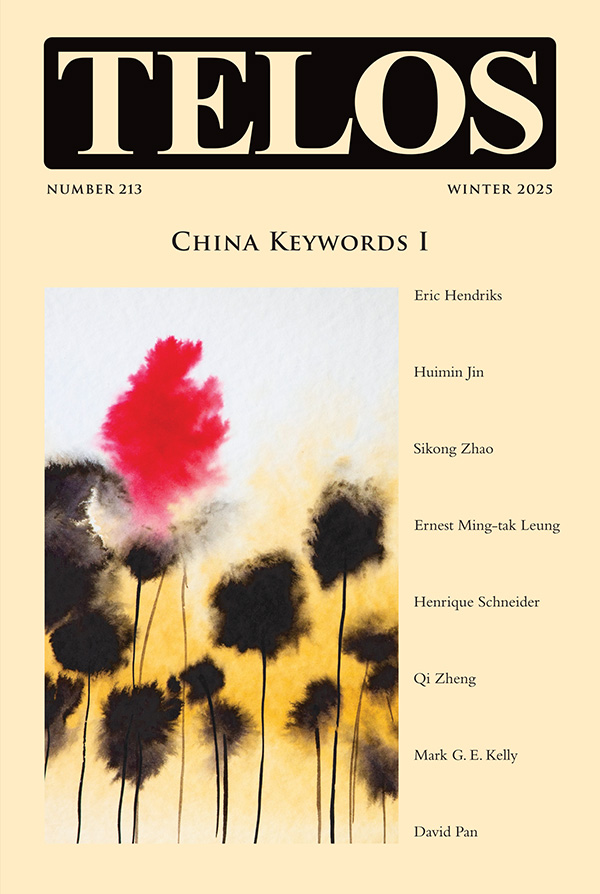
Telos 214 (Spring 2026): China Keywords II is now available for purchase in our store. Individual subscriptions to Telos are also available in both print and online formats.
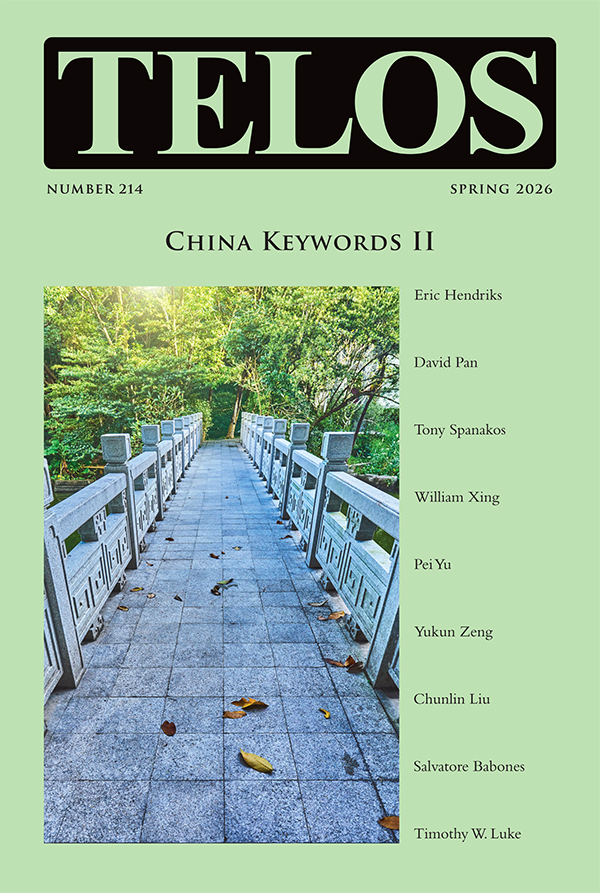 Modern China emerged through the struggle with the customs and traditions of imperial China. This struggle continues in present-day attempts to think through how earlier customs, on the one hand, remain active in Chinese culture and, on the other, have been transformed by China’s modernization. And then there are the customs that have been cut off by modernity; to what extent and in which ways can or should they be revived?
The central challenge is that China has undergone spectacular political and social transformations over the past century, meaning that older ideas and customs must now operate within an entirely new sociopolitical context. Consider how different the political imagination was in imperial (neo-)Confucian China, which placed the imperial court at the center of the cosmos. Before the late nineteenth and early twentieth centuries, China saw itself as Zhongguo (中国) or Zhonghua (中华), meaning the “Middle Kingdom” and the “central civilization,” respectively. Thus, far from conceiving itself as merely one country among others, it imagined itself as the morality-carrying center of the tianxia (天下), “all under heaven,” which could only be harmoniously ordered if its Chinese center itself was properly ordered.