By Telos Press · Monday, July 20, 2020 The following interview was conducted by Alexander Wendt on July 5, 2020, and originally appeared in German on Tichys Einblick on July 13, 2020. Translated by Russell A. Berman.
Alexander Wendt: Professor Bolz, the costs of the coronavirus pandemic are still unknown, but they will surely leave deep scars for years to come. Will our society return from post-materialism to a society with hard materialist concerns with numbers and balance sheets?
Norbert Bolz: Even before the coronavirus crisis, I had doubts as to whether the notion of a post-material society made much sense. To my mind, the “post-material” term only makes real sense as a description of digitalization and the rise of information technology. But the superstructure that is usually meant by “post-material” seems to me to be mainly a substitute for religion, and it never had the real significance for society that many ascribe to it.
Continue reading →
By Telos Press · Friday, February 21, 2020 Writing in the new issue of Philosophy in Review, Adam Sliwowski reviews Carl Schmitt’s The Tyranny of Values and Other Texts, translated by Samuel Garrett Zeitlin, edited by Russell A. Berman and Samuel Garrett Zeitlin, with a preface by David Pan. Order your copy in our online store, and save 20% on the list price by using the coupon code BOOKS20 during the checkout process.
An excerpt:
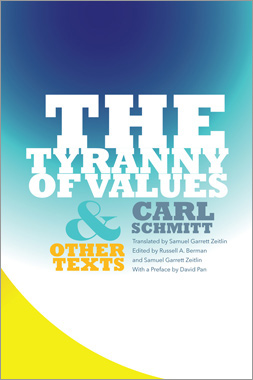 The works of Carl Schmitt—a German jurist and political theorist infamous for his involvement with National Socialism—continue to have wide international appeal, influencing scholars in a number of fields from political science and jurisprudence to political-theology and existential philosophy. Nevertheless, much of his prolific oeuvre, written over the span of almost 70 years, remains untranslated into English. With The Tyranny of Values and Other Texts, Samuel Garrett Zeitlin takes a step in filling this gap with an edited collection of finely translated and helpfully annotated texts that appear in English for the first time. This collection of occasional pieces, spanning from the Weimar era to the Cold War, shows Schmitt responding to a diverse array of socio-political exigencies and world-historical developments, while also shedding light on many of the central themes of Schmitt’s work, such as the distinction between legality and legitimacy, land and sea, the nomos of the earth, and the figure of the partisan. The works of Carl Schmitt—a German jurist and political theorist infamous for his involvement with National Socialism—continue to have wide international appeal, influencing scholars in a number of fields from political science and jurisprudence to political-theology and existential philosophy. Nevertheless, much of his prolific oeuvre, written over the span of almost 70 years, remains untranslated into English. With The Tyranny of Values and Other Texts, Samuel Garrett Zeitlin takes a step in filling this gap with an edited collection of finely translated and helpfully annotated texts that appear in English for the first time. This collection of occasional pieces, spanning from the Weimar era to the Cold War, shows Schmitt responding to a diverse array of socio-political exigencies and world-historical developments, while also shedding light on many of the central themes of Schmitt’s work, such as the distinction between legality and legitimacy, land and sea, the nomos of the earth, and the figure of the partisan.
Continue reading →
By Telos Press · Monday, December 9, 2019 New from Telos Press: Anthropocene Alerts: Critical Theory of the Contemporary as Ecocritique, by Timothy W. Luke. Order your copy in our online store, and save 20% on the list price by using the coupon code BOOKS20 during the checkout process.
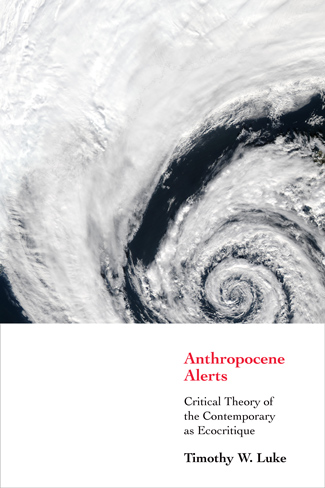 From the late 1970s, Timothy W. Luke has developed critical analyses of significant social, political, and cultural conflicts, with a particular focus on the entangled politics of culture, economy, and nature. Luke’s “ecocritiques,” many of which first appeared in the pages of Telos, advance a critical theory of the contemporary that takes aim at our ongoing ecological crisis, a period marked by rapid climate change, extensive biodiversity loss, and deep ecospheric damage. The essays collected here range across diverse topics, from the politics of the Anthropocene, Paolo Soleri’s urban design experiments, the Unabomber manifesto, the Trump administration’s attacks on environmental protections, and the informationalization of ecological change, to community agriculture projects, deep ecology, the symbolic politics of climate change treaties, Edward Abbey’s ecological writings, and the biopolitics of accelerationism and the Dark Enlightenment. Taken together, this collection documents crucial moments in Luke’s project of ecocritique as well as the commitment of Telos to environmental criticism, political theory, and policy analysis. From the late 1970s, Timothy W. Luke has developed critical analyses of significant social, political, and cultural conflicts, with a particular focus on the entangled politics of culture, economy, and nature. Luke’s “ecocritiques,” many of which first appeared in the pages of Telos, advance a critical theory of the contemporary that takes aim at our ongoing ecological crisis, a period marked by rapid climate change, extensive biodiversity loss, and deep ecospheric damage. The essays collected here range across diverse topics, from the politics of the Anthropocene, Paolo Soleri’s urban design experiments, the Unabomber manifesto, the Trump administration’s attacks on environmental protections, and the informationalization of ecological change, to community agriculture projects, deep ecology, the symbolic politics of climate change treaties, Edward Abbey’s ecological writings, and the biopolitics of accelerationism and the Dark Enlightenment. Taken together, this collection documents crucial moments in Luke’s project of ecocritique as well as the commitment of Telos to environmental criticism, political theory, and policy analysis.
Continue reading →
By Telos Press · Wednesday, May 22, 2019 Writing at the American Interest, Matthias Küntzel analyzes the divide between the United States and Germany regarding Donald Trump’s decision last year to withdraw the U.S. from the nuclear deal with Iran. In his book Germany and Iran: From the Aryan Axis to the Nuclear Threshold, published by Telos Press Publishing, Küntzel presents an extensive and detailed historical account of German-Iranian relations from the early twentieth century to the present, which provides essential context for understanding this split. Save 20% on your purchase of Küntzel’s Germany and Iran in our online store by using the coupon code BOOKS20 during checkout.
An excerpt from Küntzel’s recent essay:
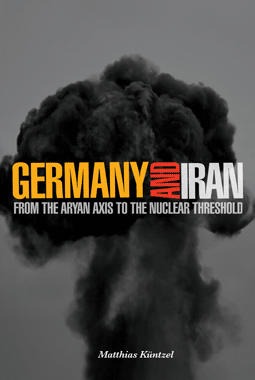 Trump’s decision is not without risk. Given the nature of the Iranian regime, irrational responses and war scenarios can’t be ruled out. Exactly one year after the United States left the deal, Iranian President Hassan Rouhani announced a partial withdrawal, saying Iran would keep excess enriched uranium and heavy water instead of selling it. Continuing the policy of nuclear blackmail, he threatens to resume higher uranium enrichment after 60 days. However, at least for the time being, Tehran seems not to be interested in a massive escalation. Trump’s decision is not without risk. Given the nature of the Iranian regime, irrational responses and war scenarios can’t be ruled out. Exactly one year after the United States left the deal, Iranian President Hassan Rouhani announced a partial withdrawal, saying Iran would keep excess enriched uranium and heavy water instead of selling it. Continuing the policy of nuclear blackmail, he threatens to resume higher uranium enrichment after 60 days. However, at least for the time being, Tehran seems not to be interested in a massive escalation.
Trump’s alternative approach—to put sufficient economic and political pressure on the Iranian leadership to compel it to sign a new agreement that would address not only Iran’s nuclear ambitions but also its missile program and regional warmongering—may be a long shot, but it is worth trying. Effective sanctions, however, require the cooperation of Iran’s most important trade partners, Germany and the European Union. And that is where the problem starts.
Continue reading →
By Telos Press · Friday, February 1, 2019 Writing at Infrapolitical Deconstruction, Gerardo Muñoz reviews the new English translation of Carl Schmitt’s The Tyranny of Values and Other Texts, now available from Telos Press Publishing. Order your copy in our online store, and save 20% on the list price by using the coupon code BOOKS20 during the checkout process.
An excerpt:
As David Pan correctly observes in the Preface, the Schmitt that we encounter here is one that is confronting the transformations of political enmity in light of a gloomy and dangerous takeover of a global civil war. In fact, one could most definitely argue that the Schmitt thinking within the Cold War epochality is one that is painstakingly searching for a “Katechon,” that restraining force inherited from Christian theology in order to give form to the ruination of modern legal and political order. The global civil war, cloaked under a sense of acknowledged Humanism, now aimed at the destruction of the enemy social’s order and form of life. This thematizes the existential dilemma of a jurist who was consciousness of the dark shadow floating over the efficacy of Western jurisprudence. In other words, the post-war Schmitt is one marked by a profound Hamletian condition in the face of the technical neutralization of every effective political theology. This condition puts Schmitt on the defensive, rather than on the offensive, as his later replies to Erik Peterson, Hans Blumenberg, or Jacob Taubes render visible.
Continue reading →
By Telos Press · Monday, December 17, 2018 New from Telos Press: The Tyranny of Values and Other Texts, by Carl Schmitt. Translated by Samuel Garrett Zeitlin, edited by Russell A. Berman and Samuel Garrett Zeitlin, and with a preface by David Pan. Order your copy in our online store, and save 20% on the list price by using the coupon code BOOKS20 during the checkout process.
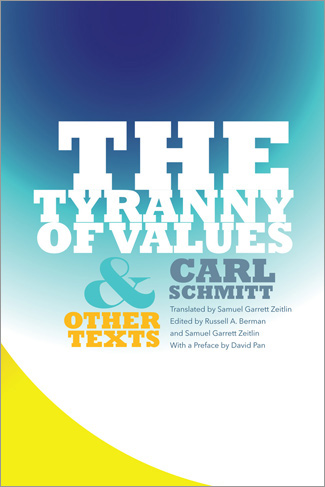 Written during the Weimar Republic, the Nazi era, and the Cold War, this collection of occasional pieces provides an instructive look at the ways in which Carl Schmitt employed his theories in order to make judgments about contemporary historical events and problems. Covering topics such as the political significance of universalism and jurisprudence, the meaning of the partisan, the world-historical significance of the Cold War, the deterioration of metaphysics into “values,” the relationship between theoretical concepts and concrete historical situations, and his views on thinkers such as Machiavelli, Bodin, and Rousseau, these essays establish a revealing counterpoint to his more formal work. They react on the one hand directly to contemporary political questions and demonstrate the way in which he saw the immediate historical significance of his ideas. On the other hand, he also feels free to provide in these pieces the kinds of methodological reflections that help us to better understand the particular epistemological framework that makes his thought so unique. Written during the Weimar Republic, the Nazi era, and the Cold War, this collection of occasional pieces provides an instructive look at the ways in which Carl Schmitt employed his theories in order to make judgments about contemporary historical events and problems. Covering topics such as the political significance of universalism and jurisprudence, the meaning of the partisan, the world-historical significance of the Cold War, the deterioration of metaphysics into “values,” the relationship between theoretical concepts and concrete historical situations, and his views on thinkers such as Machiavelli, Bodin, and Rousseau, these essays establish a revealing counterpoint to his more formal work. They react on the one hand directly to contemporary political questions and demonstrate the way in which he saw the immediate historical significance of his ideas. On the other hand, he also feels free to provide in these pieces the kinds of methodological reflections that help us to better understand the particular epistemological framework that makes his thought so unique.
Continue reading →
|
|