By Telos Press · Monday, October 10, 2016 “Dutschke’s phrase ‘the long march’ managed to combine both Mao and Trotsky, since the contemporary Trotskyite strategy was ‘enterism,’ that is, the infiltration of institutions such as trade unions and universities and their subversion from the inside. For the humorless Dutschke and his unlikely collaborator, the bon vivant scion of a grand bourgeois Chilean family Gaston Salvatore, the armed struggle in the Third World was dialectically connected to the sabotage tactics of the urban guerrillas in the developed world. The phrase that Dutschke took from Guevara, ‘Create two, three, many Vietnams,’ was not just a slogan designed to ignite the passions of the crowds. He very seriously conceived of the student revolution in 1967–68 as an integral part of a global anti-imperialist, anti-colonial struggle.”
—Elliot Neaman, Free Radicals: Agitators, Hippies, Urban Guerrillas, and Germany’s Youth Revolt of the 1960s and 1970s
Continue reading →
By Telos Press · Friday, October 7, 2016 “The human is a land-being, a land-dweller. He stands and walks and moves upon the firmly grounded earth. This is his standpoint and his soil; through it he receives his viewpoint; this defines his impressions and his way of seeing the world. He receives not only his field of vision but also the form of his gait and his movements, his shape as a living being born and moving upon the earth.”
—Carl Schmitt, Land and Sea: A World-Historical Meditation
Continue reading →
By Telos Press · Wednesday, October 5, 2016 “Incidentally, I notice that our professors, trying to show off to their students, rant and rail against the state and against law and order, while expecting that same state to punctually pay their salaries, pensions, and family allowances, so that they value at least this kind of law and order. Make a fist with the left hand and open the right hand receptively—that is how one gets through life.”
—Ernst Jünger, Eumeswil
Continue reading →
By Telos Press · Monday, October 3, 2016 Elliot Neaman’s Free Radicals: Agitators, Hippies, Urban Guerrillas and Germany’s Youth Revolt of the 1960s and 1970s is now available for purchase in our online store. Save 20% on the list price by using the coupon code BOOKS20 during the checkout process. Also available in ebook format at Amazon.com (Kindle) and Barnes & Noble (NOOK).
Free Radicals
Agitators, Hippies, Urban Guerrillas, and Germany’s
Youth Revolt of the 1960s and 1970s
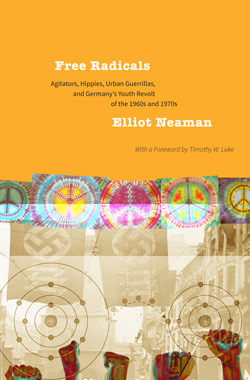 by Elliot Neaman by Elliot Neaman
With a Foreword by Timothy W. Luke
Elliot Neaman’s Free Radicals presents a comprehensive panorama of the West German youth revolt in the 1960s, as well as its subsequent fragmentation and descent into terrorism in the 1970s. Neaman argues that the activists of the 1960s fundamentally misconstrued the nature of the young German republic, conflating it with earlier problematic German polities, and offered hazy world-shattering utopias to replace it based on artificial historical comparisons. The student radicals at first were swept along by liberalizing forces, but then made a decisive turn against reform in favor of an aggressive rejection of the existing order.
Continue reading →
By Telos Press · Thursday, September 29, 2016 “It wasn’t death that frightened him—that was a certainty—but rather the element of chance, the tumbling movement through time and space, which could descend any second into annihilation—this feeling of having worth and yet not being more than an ant that could be squashed in the street by the heedless step of a giant. Why, if there were a Creator, had he given men the desire to penetrate into the essence of a world that he could never fully fathom? Wouldn’t it be better if men lived like animals or plants than always with this terrible anxiety lurking beneath the surface of everything that they said and did?”
—Ernst Jünger, Sturm, describing the Battle of the Somme, whose centenary is this year.
Continue reading →
By Telos Press · Thursday, September 22, 2016 “Some believe themselves to be experiencing the end of the world. In reality we are only experiencing the end of the relation between land and sea, which had held up to this point. Still, human angst [Angst] in the face of the new is often as great as the angst in the face of the void, even when the new is the overcoming of the void. Thus, the many see only senseless disorder, where, in reality, a new sense struggles for its order. Admittedly, the old nomos falls away and with it a whole system of received measures, norms, and relations. But that which is coming is not therefore only measurelessness or a nothingness hostile to nomos. Even in the embittered struggle of old and new forces, just measures emerge and sensible proportions are constructed.”
—Carl Schmitt, Land and Sea: A World-Historical Meditation
Continue reading →
|
|