By Telos Press · Monday, June 6, 2011
Since its inception in 1968, Telos has remained an intellectual innovator by providing provocative and prescient discussions of political, social, and cultural changes. Forty-three years later, Telos remains as essential as ever.
Continue reading →
By Telos Press · Tuesday, April 12, 2011 From the Sharjah Call for Action website:
International and local art community condemns unwarranted dismissal of Sharjah Art Foundation Director Jack Persekian and the censorship of artworks in the Sharjah Biennial.
On April 6th, 2011, Jack Persekian, Director of the Sharjah Art Foundation since 2005, was dismissed without notice by the ruler of Sharjah, HH. Sheikh Sultan Bin Mohammad Al Qasimi. The sudden termination of Persekian’s post came after a public outcry over the perceived offensive content in an artwork exhibited in the 10th edition of the Sharjah Biennial by Algerian artist, journalist and activist Mustapha Benfodil.
Continue reading →
By Telos Press · Tuesday, February 15, 2011 Telos Press congratulates Matthias Küntzel on receiving the ADL Paul Ehrlich-Gunther K. Schwerin Human Rights Award. Below is a press release from the Anti-Defamation League announcing the award. Purchase Matthias Küntzel’s Jihad and Jew-Hatred: Islamism, Nazism and the Roots of 9/11 at our website and receive 10% off through the month of February.
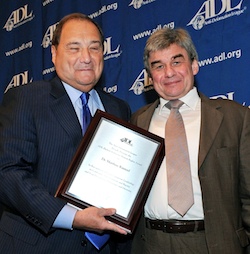 Palm Beach, FL—A German political scientist and writer who has laid bare the genocidal intent of Iran’s nuclear program and exposed a link between the anti-Semitism of the Nazis and of the Iranian regime was honored today by the Anti-Defamation League (ADL) for his ongoing research in the roots and manifestations of modern Jew-hatred. Palm Beach, FL—A German political scientist and writer who has laid bare the genocidal intent of Iran’s nuclear program and exposed a link between the anti-Semitism of the Nazis and of the Iranian regime was honored today by the Anti-Defamation League (ADL) for his ongoing research in the roots and manifestations of modern Jew-hatred.
Dr. Matthias Küntzel was presented with the ADL Paul Ehrlich-Gunther K. Schwerin Human Rights Award during the League’s National Executive Committee meeting in Palm Beach, Florida.
Continue reading →
By Telos Press · Monday, February 7, 2011 Timothy Wong’s “Steward of the Dying Voice: The Intrusion of Horatio into Sovereignty and Representation” appears in Telos 153 (Winter 2010). Read the full version at TELOS Online website.
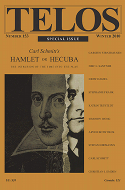 This article examines the issue of early modern sovereign succession and political representation through the figure of Horatio. Using Carl Schmitt’s comments on the “dying voice” in the first appendix of Hamlet or Hecuba, and his theory of political representation, this essay argues that Horatio represents the transitional space between the fading vestiges of political theology, and the first traces constituent sovereignty. In his role as mediator of the sovereign word of King Hamlet and the dying voice of Prince Hamlet, Horatio becomes the proto-constituent subject who signals the genesis of a reoriented political agency that is constituted by popular consent rather than authoritarian rule. Furthermore, Horatio is the paradoxical representative that both represents the body politic (in the sense of the King’s two bodies) to the people and the popular will to itself. This article examines the issue of early modern sovereign succession and political representation through the figure of Horatio. Using Carl Schmitt’s comments on the “dying voice” in the first appendix of Hamlet or Hecuba, and his theory of political representation, this essay argues that Horatio represents the transitional space between the fading vestiges of political theology, and the first traces constituent sovereignty. In his role as mediator of the sovereign word of King Hamlet and the dying voice of Prince Hamlet, Horatio becomes the proto-constituent subject who signals the genesis of a reoriented political agency that is constituted by popular consent rather than authoritarian rule. Furthermore, Horatio is the paradoxical representative that both represents the body politic (in the sense of the King’s two bodies) to the people and the popular will to itself.
Continue reading →
By Telos Press · Thursday, January 13, 2011 Drew Daniel’s “‘Neither Simple Allusions Nor True Mirrorings’: Seeing Double with Carl Schmitt” appears in Telos 153 (Winter 2010). Read the full version at TELOS Online website.
In response to recent criticisms of Schmitt’s argument as “tendentious” and symptomatic, this essay seeks to perform a reparative reading of the central claim of Hamlet or Hecuba for a substantial resemblance between the events within Shakespeare’s play and the murky circumstances surrounding the death of King James’s father, Lord Darnley. First, the historical archive surrounding Lord Darnley’s death is sounded for evidence that might support Schmitt’s claim and illuminate unresolved questions within the plot of Hamlet (in particular, the mysterious “sins” referred to by the Ghost). Secondly, the archive of James’s own published writings on sovereignty, demonology, and witchcraft are placed into relation with Jean Bodin’s similar writings, and brought to bear upon Schmitt’s reading of Shakespeare’s ghost scenes. The cruxes within Shakespeare’s play and Schmitt’s text about the ghost scene (“spirit of health” or “goblin damned”? Catholic or Protestant?) illuminate the relationship between sovereignty and demonology in early modern England: the two discourses are linked by the attempt to establish the divine status of sovereignty and the corresponding subordination of demons and ghosts to theologically established limits and laws. Departing from Schmitt’s initial arguments, this essay extends them in order to illuminate the political-theological terrain within which Hamlet functions.
Continue reading →
By Telos Press · Thursday, December 23, 2010 Season’s Greetings from all of us at Telos Press!

Continue reading →
|
|