By Telos Press · Tuesday, March 1, 2016 From the Desk of Mary Piccone, Publisher
Dear Friends of Telos,
I am reaching out to you and asking for your help.
When you purchase a subscription to Telos, you make it possible for us to publish the kinds of writing that you want to read. As a small independent publisher, we rely on the support of our readers to continue producing new, challenging works in politics, philosophy, and critical theory.
If your library is not a current subscriber to Telos, you have the power to influence your library’s decision to subscribe. It’s your recommendation and your interest in Telos, rather than sales calls from publishers, that make a difference in library subscription decisions.
And when it comes to our books, it really helps support our mission when you order directly from our online store at telospress.com. Online shopping sites like Amazon require publishers to accept significant distribution costs to carry their books, and that is certainly challenging for small independent presses like ours. At our website, you can save 20% on the list price of all our books. Just enter the coupon code BOOKS20 during the checkout process, and the discount will be applied to your order.
My passion for continuing Telos is to keep Paul Piccone’s legacy alive and thriving. Telos is a unique forum that gives each of you a place to speak and be heard, and now more than ever such forums are essential. This May we are celebrating forty-eight years of publishing our journal. Let’s make it fifty, and then a hundred. Paul would be proud!
Warm wishes,
Mary Piccone
Publisher, Telos Press Publishing
Continue reading →
By Donald W. Wortham · Monday, February 29, 2016
We live in a world where there is no universal agreement about values, nor what counts as right action, nor what sorts of lives can be counted as whole and integrated; we are dis-integrated persons. This is the core problem identified by Alasdair MacIntyre in After Virtue. How does this problem manifest itself? Many of us do not know our neighbors; home economics devolves into impersonalized encounters with big-box retail. We are anonymous to our CEO, who operates at seven levels of managerial remove. Participatory governance seems an abstraction. Religious or civic involvement, if we choose to engage, is often just another consumer choice. The combination of these factors leads many to feelings of alienation, powerlessness, even anger, but not to beatitudo, to joyful wholeness.
Continue reading →
By Matthew Bagot · Friday, February 26, 2016 Luigi Sturzo (1871–1959) was an Italian priest, social reformer and the founder in 1919 of the Popular Party that later became the Christian Democratic Party, and social theorist who wrote extensively about history during the last century. Regarding history, Sturzo’s great contribution is his account of the formation and development of the “International Community” as one of the concrete forms of human society subject to its general laws. Sturzo locates the roots of this concept in the Christian revelation of human equality before God and the subsequent religious duty to love one’s neighbor in a manner that transcends the traditional boundaries of the ancient world. Thus the social values of the pre-Christian world are inverted, and human personality assumes the mantle previously held by the social and ethnic bonds of that era.
Continue reading →
By Terence Hoyt · Thursday, February 25, 2016 This article argues that after more than two centuries, our system of justice is no longer functioning as intended by its founders. I argue that this breakdown can be ultimately traced to a philosophical dilemma at the heart of American civilization: the assumption that economic self-interest can by itself sustain ethical care for a common good. In treating economic freedom as a moral absolute, the American right has misconstrued the practical purpose of freedom and undermined justice and equality for all. In contrast to the ahistorical claim of libertarians that economic freedom should be treated as a moral value, the goal of the founders of the United States was very concrete: enabling most citizens to get basic economic needs met in peace and security. Free and open elections and a system of checks and balances would motivate the naturally more powerful to manage their own passions in ways that contributed to a common good. By contrast, in unchecked political systems that arose by the struggle for dominance among the powerful few, the de facto rulers lacked any motive to act in ways that were consistent with the interests of the average citizen. As Thrasymachus claims in Plato’s Republic, they habitually wrote laws that benefited themselves at the expense of everyone else.
Continue reading →
By Simas Čelutka · Tuesday, February 23, 2016 In his essay “Carl Schmitt on Friends, Enemies and the Political,” Andrew Norris inquires into the question that I have been interested in for quite some time: political friendship in Carl Schmitt’s political philosophy. Schmitt’s interpreters usually focus on the issue of enmity in his concept of the political, not least because Schmitt himself elaborates on the existential significance of political enmity much more extensively. From a conceptual point of view, however, political friendship should be viewed as at least equally relevant a part of Schmitt’s account of the political. The specific criterion of the political is famously the distinction “between friend and enemy,” not simply an indefatigable presence of political enmity. Norris should be lauded for his attempt to foreground a crucial, though still insufficiently explored, notion of a political (public) friend in Schmitt’s Concept of the Political.
Continue reading →
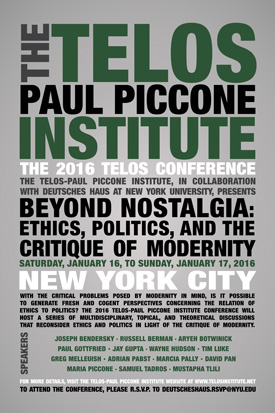
By Lukas Szrot · Monday, February 22, 2016 The following paper was presented at the 2016 Telos Conference, held on January 16–17, 2016, in New York City. For additional details about this and upcoming conferences, please visit the Telos-Paul Piccone Institute website.
 What is modernity? First, a period “occasioned by a peculiarly ahistorical view of the world, which is flattened into an eternal present. The world we experience appears to exhaust all possible worlds.” Second, modernity is deeply rooted in the three Kantian principles of Enlightenment: “‘What can know?’ the question of knowledge; of the ‘What should I do?’ which is the question of ethics, and of the ‘What can I hope?'” What is modernity? First, a period “occasioned by a peculiarly ahistorical view of the world, which is flattened into an eternal present. The world we experience appears to exhaust all possible worlds.” Second, modernity is deeply rooted in the three Kantian principles of Enlightenment: “‘What can know?’ the question of knowledge; of the ‘What should I do?’ which is the question of ethics, and of the ‘What can I hope?'”
The Western modern project is dependent upon both Greek and Hebrew antiquity. In ancient Ionia, Thales of Miletus predicted a solar eclipse, Anaximander predicted the changing of the seasons, Theodorus invented the ruler, the carpenter’s square, and the level, and Hippocrates began accumulating medical knowledge through trial and error. These “pre-Socratic” Ionians were merchants and artisans; they worked with their hands, whereas the Athenians were engaged primarily in contemplation.
Continue reading →
|
|