A miasma of exhaustion and obsolescence pervades Michel Houellebecq’s Submission. It is occasionally punctured by explicit expressions of a pornographic libidinality, but these, in the end, serve only as desperate manifestations of increasingly temporary respites. The end is nigh, if it didn’t already happen. Houellebecq’s universe remains what it has been repeatedly—a universe of male libidinal desire, its intensifying frustrations and anxieties monumentally projected onto the background of the specters of the civilizational decline of the West. Houellebecq is at the tired end of the secular liberal dream of possessive individualism and sexual freedom, or, as the narrator puts it rather succinctly: “In the end, my cock was all I had” (81).
|
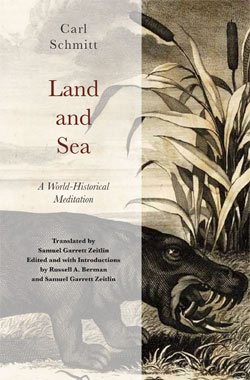
Telos 173 (Winter 2015) is now available for purchase in our store. For scholars of religion and literature, Michel Houellebecq’s Submission glimmers like a shiny lure. The storyline contains the sorts of details that appeal to an easy and seductive journalistic gloss. The year is 2022. A charismatic Muslim prime minister is elected in France, and an almost caricatured series of events follows: men and women are separated; the university president converts to Islam and weds a young wife; professors are coerced to convert or retire early; and so on. Add to the plot Houellebecq’s professed Islamophobia and the massacre at Charlie Hebdo, and you have the ingredients of a newsworthy book to be addressed by critics, journalists, and readers across the world. Like a number of reviewers, I initially found myself lured to consider religion, secularism, and contemporary French politics against the backdrop of the newly published English translation. But as I began reading, I was confronted with a challenge of a different sort. Michel Houellebecq’s novel Submission raises important questions about the cultural crises of modernity. It reflects on the dialectics of post-secularism and post-democracy in ways that have become particularly salient in light of the terror attacks in Paris and San Bernadino. Beginning with Vincent Lloyd’s post today, TELOSscope presents a series of discussions of the novel that will appear over the next several days. The violence of November 13, 2015, in Paris was met with an avalanche of grief and sympathy from around the world. Similar feelings followed the attack on Charlie Hebdo several months earlier. Paris is an iconic and beloved city; to see blood and bullet holes on the streets of Paris caused pain. Or rather, it causes professions of emotion. In an age of personal mediation, when we are expected to advertise our feelings about world events nearly in real time through tweets and Facebook posts, it is an open question how much feelings are felt—though they are most certainly performed. Affect circulates with ever increasing velocity, but such affect is increasingly shallow, more like a shared way of talking than anything having to do with inwardness. This does not mean mediated emotions are insignificant. As leftist critics of such public mourning charge, shared ways of talking about the world lead to shared ways of seeing the world and can ultimately legitimate violent ways of acting in the world. The following article was originally published in the Greek newspaper To Vima on December 21, 1997, on the occasion of the 70th anniversary of the first publication of Martin Heidegger’s Being and Time. I consider Being and Time to be one of the overrated books of the century. To be precise, I regard it as a collection of platitudes expressed in pretentious and obscure language. Whoever goes beyond the narrow philosophical perspective and surveys the history of ideas and problems in its totality arrives at this conclusion. Being very one-sidedly educated as a rule, philosophers usually inflate the importance of things that take place in their own field and consider an author original solely because he introduces them to one or two new concepts. In reality, the philosophy of the Modern Era did not create its own problematic but followed, directly or indirectly, in a better or worse manner, the rapid changes that occurred chiefly in the natural sciences to begin with, and subsequently in the social and human sciences. The epistemologically oriented philosophy of the subject was developed in the seventeenth and eighteenth centuries as an attempt to provide answers to questions raised by the mathematical physics of the time (the distinction between primary and secondary qualities, causality, substance). The social and human sciences, whose foundations were laid in the eighteenth century and which came into their own in the nineteenth, introduced a perspective that has proven fatal for philosophy’s vital myth, namely, that of the autonomy of spirit, since they demonstrated its dependence not only on “irrational” and “existential” factors but on “non-spiritual,” socioeconomic, and historical ones too. Telos Press Publishing is pleased to announce that Carl Schmitt’s Land and Sea: A World-Historical Meditation is now available for purchase. Order your copy today in our online store.
Translated by Samuel Garrett Zeitlin Originally published in 1942, at the height of the Second World War, Land and Sea: A World-Historical Meditation recounts Carl Schmitt’s view of world history “as a history of the battle of sea powers against land powers and of land powers against sea powers.” Schmitt here unfolds his view of world history from the Peloponnesian War to European colonial expansion to the birth pangs of capitalism, while polemically setting Nazi Germany as a continental land power against Britain and the United States as its maritime enemies. In Land and Sea, Schmitt offers his interpretations of the rise of Venice, piracy, “corsair capitalism,” the spatial revolution of European colonial expansion, the rise of the British empire, and his readings of thinkers as diverse as Seneca, Shakespeare, Herman Melville, and Benjamin Disraeli. This new and authorized edition from Telos Press Publishing, translated by Samuel Garrett Zeitlin and edited by Russell A. Berman and Samuel Garrett Zeitlin, includes extensive textual annotations that compare critical variations between the original 1942 edition of Land and Sea and the subsequent editions published in 1954 and 1981. |
   |
|||
|
Privacy Policy · Data Protection Copyright © 2026 Telos Press Publishing · All Rights Reserved |
||||
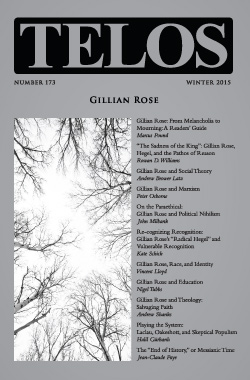 Gillian Rose (1947–1995) had an influence in excess of her literary output and treatment in secondary literature. Author of eight books, two articles, and four book reviews, she also had important, though perhaps hidden, effects on the UK academic scene through academic friendship, doctoral supervision, and interdisciplinary work. She inspired many students and colleagues, even where she does not appear in bibliographies or citations. She made major contributions to introducing the Frankfurt School to the UK; aided the Hegel renaissance in English-language scholarship; and was an early critic of post-structuralism and political theology. Several of the papers gathered here were first given at a conference at Durham University on January 9, 2015, to mark the twentieth year since Rose’s death. That conference and this special issue of Telos are premised on the view that Rose’s work still has much philosophical insight and inspiration to offer. The authors of these papers were students, colleagues, and/or friends of Rose, or studied her work as part of their doctoral research. The diversity of their fields reflects some of the range and interdisciplinarity of Rose’s own work: Hegel, social theory, Marxism, politics, race, recognition theory, education, and theology. We hope that this issue provokes a renewed interest in what Rose can still offer us today.