By Erik Pomrenke · Tuesday, September 26, 2017 As an occasional feature on TELOSscope, we highlight a past Telos article whose critical insights continue to illuminate our thinking and challenge our assumptions. Today, Erik Pomrenke looks at Adam Kotsko’s “On Agamben’s Use of Benjamin’s ‘Critique of Violence'” from Telos 145 (Winter 2008).
“On Agamben’s Use of Benjamin’s ‘Critique of Violence'” represents an illuminating attempt by Adam Kotsko to reassert the primacy of Walter Benjamin over Carl Schmitt in Giorgio Agamben’s work. These two thinkers serve alongside Heidegger, Aristotle, Foucault, and Arendt as the center of Agamben’s genealogy of bare life; as such, configuring this constellation correctly is of signal importance to the reception of Agamben’s Homo Sacer project. Kotsko contends that Benjamin’s primacy is both a theoretical and chronological matter.
Continue reading →
By David Pan · Thursday, September 14, 2017 The following paper was presented at the conference “After the End of Revolution: Constitutional Order amid the Crisis of Democracy,” co-organized by the Telos-Paul Piccone Institute and the National Research University Higher School of Economics, September 1–2, 2017, Moscow..
The idea of liberal democracy only makes sense because of a basic contradiction between liberalism and democracy. As a description of a form of government, democracy designates a government by the people, whose decision-making power would not be restricted by any higher authority. The power of democracy derives from its ability to mobilize a majority of the members of a political order for collective goals. This rule by popular will can also entail a freedom from higher authorities, including such entities like monarchs and aristocrats, but also ecclesiastical or moral authorities that would establish basic values for guiding decision-making. Since democracy alone would lack constraints on the popular will, liberalism, as a set of principles that include protection of minorities and freedom of expression, is needed to provide the limitations on democratic decision-making that protect democracy from erratic and changes in the public mood. As such, liberalism sets a limit on democratic power, and the basic contradiction between democracy and liberalism maintains a dynamic equilibrium between popular will and liberal principles that can be stabilizing due to its flexibility.
Continue reading →
By Telos Press · Wednesday, September 6, 2017 In a new review essay in Thesis Eleven, Peter Murphy writes about Carl Schmitt’s Land and Sea: A World-Historical Meditation, translated into English by Samuel Garrett Zeitlin and published by Telos Press Publishing. Purchase your copy of Schmitt’s Land and Sea in our online store and save 20% by using the coupon code BOOKS20.
An excerpt from the review:
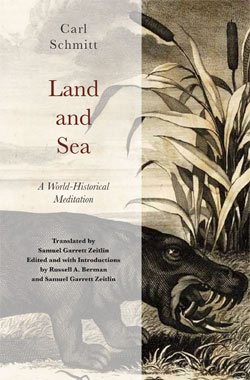 Samuel Zeitlin’s adroit, elegant translation of Carl Schmitt’s Land and Sea is sparkling to read. The book moves along with great energy, vibrant economy, and penetrating succinctness. The translation deftly conveys a book that is as short and direct as it is world-historical in scope. Its inquisitive reach expands as its flinty prose shrinks to the point of pithy, terse deliberateness. In 100-odd crisp pages it moves with panoptic concision from the ‘Potamic’ river cultures of the Middle East to the inland sea of the Mediterranean and across the oceans of modernity. The volume is beautifully produced by Telos Press. Samuel Zeitlin’s adroit, elegant translation of Carl Schmitt’s Land and Sea is sparkling to read. The book moves along with great energy, vibrant economy, and penetrating succinctness. The translation deftly conveys a book that is as short and direct as it is world-historical in scope. Its inquisitive reach expands as its flinty prose shrinks to the point of pithy, terse deliberateness. In 100-odd crisp pages it moves with panoptic concision from the ‘Potamic’ river cultures of the Middle East to the inland sea of the Mediterranean and across the oceans of modernity. The volume is beautifully produced by Telos Press.
Continue reading →
By Mitchell Dean · Wednesday, July 12, 2017 This paper takes its initial inspiration from Carl Schmitt’s claim in 1927 that the “original democratic phenomenon . . . is acclamation,” and draws upon the interchange between religious and political forms of acclamation observed by Ernst Hartwig Kantorowicz and Erik Peterson and elaborated recently by Giorgio Agamben. If Schmitt is correct, then acclamation is central to the construction of “the people” who by definition are the source of political legitimacy. What is required then is what I have called an “analytics of publicity” that would study the different ways in which the public is formed through different forms of acclamation.
Continue reading →
By Timothy W. Luke · Thursday, May 11, 2017 Assessing asymmetric wars in the abstract is a problematic task, even though most are “small wars” fought by “big nations.” Armed conflicts with these characteristics brim with persistent, undeclared, and low-intensity violence. It rarely is extinguished, and the lingering injuries sustain even more violence on the same scale. Many of these small wars began in Asia, Africa, Latin America, or the Middle East during, or not long after, World War II. Armed resistance there never completely ended; instead it intensified with decolonization and/or postcolonial state failure. Now virtually institutionalized in many violent wild zones around the world, low-intensity wars also flare up as asymmetric conflicts between rich countries and poor peoples, Westernized nations and anti-Western movements, liberal democratic states and illiberal theocratic insurgents after 1989.
Continue reading →
By Brian J. Fox · Tuesday, March 28, 2017 Carl Schmitt is frequently assumed to have primarily been a Catholic intellectual, or Christian political theologian, at least until becoming alienated from the Church in the mid-1920’s. The jurist’s book Political Theology is quite logically a main source of evidence for this standard interpretation of Schmitt’s intellectual biography. However, an assumption of Schmitt’s Catholic, or even simply Christian, bona fides serves more as a distraction in understanding the origins and contours of his early thought. This mistaken narrative hides the degree to which Schmitt’s brand of secular and proto-Hobbesian decisionism is contrary to the thought of his claimed forebears among nineteenth-century counter-revolutionary Catholic theorists.
Continue reading →
|
|