By Sheldon Lu · Friday, September 29, 2017 Sheldon Lu’s “Cosmopolitanism and Alternative Modernity in Twentieth-Century China” appears in Telos 180 (Fall 2017), a special issue on Cosmopolitanism and China. Read the full article at the Telos Online website, or purchase a print copy of the issue in our online store. Individual subscriptions to Telos are now available in both print and online formats.
My essay joins the revisionist project of rewriting modern Chinese intellectual history. The historiography of modern China usually foregrounds the theme of nationalism in the grand narrative of China’s arduous struggles for liberation, anti-imperialism, anti-colonialism, and anti-capitalism. Radical breaks from the Chinese tradition or from the outside world have occurred in the form of a series of earth-shaking revolutions throughout the twentieth century: the Republican Revolution that overthrows the Qing Dynasty in 1911; the Communist Revolution that leads to the founding of the People’s Republic in 1949; the Cultural Revolution (1966–1976); and so forth. Amidst the fiery rhetoric of revolution, the voice of a conciliatory, non-revolutionary, mild cosmopolitanism could be easily muffled. This essay attempts to re-examine the discourse and practice of cosmopolitanism in twentieth-century China.
Continue reading →
By Melody Yunzi Li · Tuesday, September 19, 2017 Melody Yunzi Li’s “‘At Home in the World”: Hong Kong as a Cosmopolitan City in Xu Xi’s The Unwalled City” appears in Telos 180 (Fall 2017), a special issue on Cosmopolitanism and China. Read the full article at the Telos Online website, or purchase a print copy of the issue in our online store.
Hong Kong is unique for its hybrid nature in language and culture. Drawing upon Ulf Hannerz’s model of cosmopolitans and locals, this paper argues that Hong Kongese are cosmopolitans and locals in one, other than the dichotomy raised by Hannerz. The paper considers how Xu Xi’s novel The Unwalled City questions any overarching or simplified understanding of cosmopolitanism and its utopian parlance of seamless linguistic-cultural coexistence. For Xu Xi, writing in English provides a crucially literary tactic with which to construct her multiple ethnic identities and eclectic images.
Continue reading →
By Ning Wang · Wednesday, September 13, 2017 Telos 180 (Fall 2017) is now available for purchase in our store.
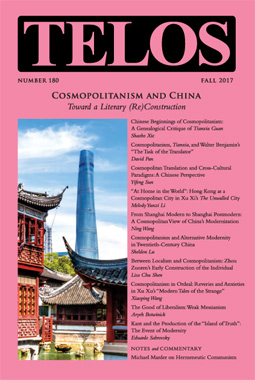 In Western as well as international academia today, along with the acceleration of globalization more generally, humanities scholars have constructed a sort of theoretical discourse of globalization. In doing so, they have found it useful to refer to the old-fashioned philosophical concept of cosmopolitanism, which is very close to the theoretical construction of the discourse of globalization. Although it has previously been discussed over the history of Western philosophy, cosmopolitanism is once again a cutting-edge theoretical topic. The term nowadays frequently appears in the works of political philosophers and sociologists, and it is increasingly being taken up and debated by literary and cultural studies scholars as well, particularly with regard to the rise of world literature as the highest phase of comparative literature. Obviously, most of their work interprets and deals with cosmopolitanism from the perspectives of political philosophy and culture, while touching to some degree upon literary and cultural production and criticism. Moreover, most of the scholarship dealing with cosmopolitanism only occurs within a Western context. In this respect, the present special issue of Telos may well fill a gap in international cosmopolitanism scholarship. The recent interest in world literature in the field of comparative literature is undoubtedly associated with the rise of cosmopolitanism in the contemporary era. In the articles collected here, cosmopolitanism will mainly be addressed from literary and cultural perspectives, and, more importantly, they will move beyond the limits of Eurocentric or West-centric ways of thinking and modes of research by dealing exclusively with cosmopolitanism and China: its parallel relations with ancient Chinese philosophy, its impact on modern Chinese literature and intellectual thought, and its recent significance to China’s modernization and globalization. In Western as well as international academia today, along with the acceleration of globalization more generally, humanities scholars have constructed a sort of theoretical discourse of globalization. In doing so, they have found it useful to refer to the old-fashioned philosophical concept of cosmopolitanism, which is very close to the theoretical construction of the discourse of globalization. Although it has previously been discussed over the history of Western philosophy, cosmopolitanism is once again a cutting-edge theoretical topic. The term nowadays frequently appears in the works of political philosophers and sociologists, and it is increasingly being taken up and debated by literary and cultural studies scholars as well, particularly with regard to the rise of world literature as the highest phase of comparative literature. Obviously, most of their work interprets and deals with cosmopolitanism from the perspectives of political philosophy and culture, while touching to some degree upon literary and cultural production and criticism. Moreover, most of the scholarship dealing with cosmopolitanism only occurs within a Western context. In this respect, the present special issue of Telos may well fill a gap in international cosmopolitanism scholarship. The recent interest in world literature in the field of comparative literature is undoubtedly associated with the rise of cosmopolitanism in the contemporary era. In the articles collected here, cosmopolitanism will mainly be addressed from literary and cultural perspectives, and, more importantly, they will move beyond the limits of Eurocentric or West-centric ways of thinking and modes of research by dealing exclusively with cosmopolitanism and China: its parallel relations with ancient Chinese philosophy, its impact on modern Chinese literature and intellectual thought, and its recent significance to China’s modernization and globalization.
Continue reading →
By Russell A. Berman · Monday, June 15, 2015 Telos 171 (Summer 2015) is now available for purchase in our store.
 Standard accounts of American politics invoke an oscillation between idealist and realist inclinations. The idealists appeal to principles, which they identify as fundamental to the American polity, especially those enshrined in the founding documents: life, liberty, and the pursuit of happiness, transformed into a broad democratization agenda. Of course, revisionist critics have no difficulty in pointing out the failure of that agenda, i.e., the extent to which the empirical history of the country fell far short of realizing its ideals. Yet even that critique, smugly put forward to debunk naïve idealism, in some basic ways is itself indebted to the same idealism, insofar as the complaint of insufficient democratization also implies a call for more democracy, the very core of the idealist program. This is why neo-conservatives and their left-liberal adversaries always had more in common than met the eye (as was abundantly clear to traditional conservatives). Standard accounts of American politics invoke an oscillation between idealist and realist inclinations. The idealists appeal to principles, which they identify as fundamental to the American polity, especially those enshrined in the founding documents: life, liberty, and the pursuit of happiness, transformed into a broad democratization agenda. Of course, revisionist critics have no difficulty in pointing out the failure of that agenda, i.e., the extent to which the empirical history of the country fell far short of realizing its ideals. Yet even that critique, smugly put forward to debunk naïve idealism, in some basic ways is itself indebted to the same idealism, insofar as the complaint of insufficient democratization also implies a call for more democracy, the very core of the idealist program. This is why neo-conservatives and their left-liberal adversaries always had more in common than met the eye (as was abundantly clear to traditional conservatives).
Continue reading →
By Jacob Dreyer · Thursday, May 29, 2014  In China as in the Soviet Union, it seemed particularly cruel to “political” prisoners that thieves, rapists, and murderers should be placed higher in the camp hierarchy than they were. From the perspective of the CCP, this often touched on the point of class origins, for of course the intellectual class often emerged from the urban bourgeoisie, whereas the common criminals come from the dodgy, poor neighborhoods or, in their rural equivalent, poor, burned-out villages. However, what the victorious revolutionaries sought to achieve was the laborious process of lifting the world off of its axle and inverting it, like a gigantic bureau drawer; of course all sorts of things fall out, and if they are delicate, shatter. The intellectual class was, and is, that class which had already begun lifting themselves out of the material world, on their own terms, with thought. For those authorities who wish to arrange a collective transfer of all resources and persons from the old world into a still unimaginable new one, this individualistic secession from the world is a most dangerous form of treason, in comparison to which the rapes, knifings, stolen bread, and liquor of the underclass are all too easy to forgive. For the latter are simply operating the system in their own disadvantaged way, with the same objectives, finally, as the capitalists and lords, whereas the thinkers seek to float away entirely. It is for this reason that in the camps, the political prisons were considered “external contradictions,” the criminals, “internal contradictions.” In China as in the Soviet Union, it seemed particularly cruel to “political” prisoners that thieves, rapists, and murderers should be placed higher in the camp hierarchy than they were. From the perspective of the CCP, this often touched on the point of class origins, for of course the intellectual class often emerged from the urban bourgeoisie, whereas the common criminals come from the dodgy, poor neighborhoods or, in their rural equivalent, poor, burned-out villages. However, what the victorious revolutionaries sought to achieve was the laborious process of lifting the world off of its axle and inverting it, like a gigantic bureau drawer; of course all sorts of things fall out, and if they are delicate, shatter. The intellectual class was, and is, that class which had already begun lifting themselves out of the material world, on their own terms, with thought. For those authorities who wish to arrange a collective transfer of all resources and persons from the old world into a still unimaginable new one, this individualistic secession from the world is a most dangerous form of treason, in comparison to which the rapes, knifings, stolen bread, and liquor of the underclass are all too easy to forgive. For the latter are simply operating the system in their own disadvantaged way, with the same objectives, finally, as the capitalists and lords, whereas the thinkers seek to float away entirely. It is for this reason that in the camps, the political prisons were considered “external contradictions,” the criminals, “internal contradictions.”
Continue reading →
By Jacob Dreyer · Tuesday, May 13, 2014 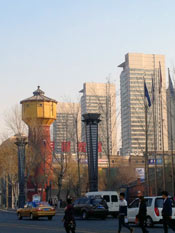 As has been observed about Russian and Japanese modernisms, Chinese modernism was initiated with a sense of lack: the contact with an Other civilization (e.g., that of the West) more capable of controlling reality, one more materially powerful. If revolution is a rupture with the past, the Chinese revolution constituted a rupture with a relationship to space that flowed through the subjective experience of poetry, and its replacement with an ongoing process of rationalization, mapping, understanding—one often initiated by colonizers, whether the Westerners in the treaty ports, or the Japanese in the North. In other words, a subject trained to interact with an environment on the basis of a tradition of poetry, painting, and landscape architecture, in which the self was holistically internalized into a larger built environment, was forced to confront an environment in the process of transformation: mountains became mines, forests became timber, and of course, humans became factory workers.[3] As has been observed about Russian and Japanese modernisms, Chinese modernism was initiated with a sense of lack: the contact with an Other civilization (e.g., that of the West) more capable of controlling reality, one more materially powerful. If revolution is a rupture with the past, the Chinese revolution constituted a rupture with a relationship to space that flowed through the subjective experience of poetry, and its replacement with an ongoing process of rationalization, mapping, understanding—one often initiated by colonizers, whether the Westerners in the treaty ports, or the Japanese in the North. In other words, a subject trained to interact with an environment on the basis of a tradition of poetry, painting, and landscape architecture, in which the self was holistically internalized into a larger built environment, was forced to confront an environment in the process of transformation: mountains became mines, forests became timber, and of course, humans became factory workers.[3]
Continue reading →
|
|