By Russell A. Berman · Monday, March 8, 2021 To read more in depth from Telos, subscribe to the journal here.
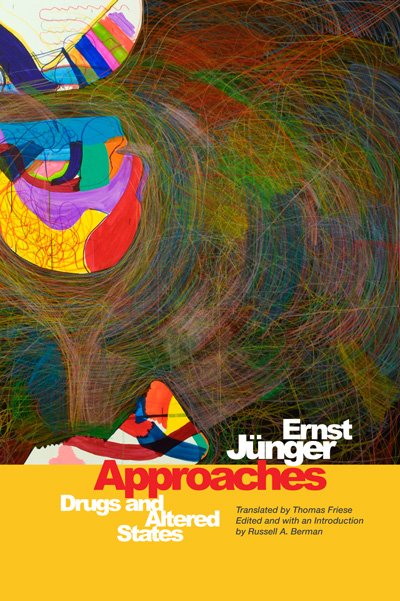
 A distinctive feature of public debate in Germany involves prominent literary authors, especially novelists, expounding on current political matters in major newspapers. Thomas Brussig’s essay “Risk More Dictatorship,” translated here, belongs to this genre. Known especially for his satire of East Germany, Heroes Like Us, Brussig chose a provocative title that seems to echo and respond to Chancellor Willy Brandt’s appeal more than fifty years ago to “risk more democracy.” Brandt was speaking in 1969 at a pivotal moment in the history of West Germany, indeed of the whole world, in the face of the protests during the previous year; Brussig in contrast appeals for “more dictatorship” in the face of the coronavirus pandemic, which he depicts as a potentially similar turning moment, with an accelerated “learning process,” that calls old certainties into question. These include the “end of history” claim that liberal democracy is inevitable; Brussig suggests that the “impotence” of democracies in the face of the pandemic raises the question as to whether other forms of government might be superior. The Chinese model of dictatorship casts a shadow across the essay. A distinctive feature of public debate in Germany involves prominent literary authors, especially novelists, expounding on current political matters in major newspapers. Thomas Brussig’s essay “Risk More Dictatorship,” translated here, belongs to this genre. Known especially for his satire of East Germany, Heroes Like Us, Brussig chose a provocative title that seems to echo and respond to Chancellor Willy Brandt’s appeal more than fifty years ago to “risk more democracy.” Brandt was speaking in 1969 at a pivotal moment in the history of West Germany, indeed of the whole world, in the face of the protests during the previous year; Brussig in contrast appeals for “more dictatorship” in the face of the coronavirus pandemic, which he depicts as a potentially similar turning moment, with an accelerated “learning process,” that calls old certainties into question. These include the “end of history” claim that liberal democracy is inevitable; Brussig suggests that the “impotence” of democracies in the face of the pandemic raises the question as to whether other forms of government might be superior. The Chinese model of dictatorship casts a shadow across the essay.
Continue reading →
By Telos Press · Tuesday, February 16, 2021 In today’s episode of the Telos Press Podcast, Camelia Raghinaru talks with Russell A. Berman about his article “Reflections on Rights,” one of a group of essays from Telos 192 (Fall 2020) on the U.S. State Department’s Commission on Unalienable Rights. An excerpt of the article appears here. If your university has an online subscription to Telos, you can read the full article at the Telos Online website. For non-subscribers, learn how your university can begin a subscription to Telos at our library recommendation page. Purchase a print copy of Telos 192 in our online store.
Listen to the podcast here.
Continue reading →
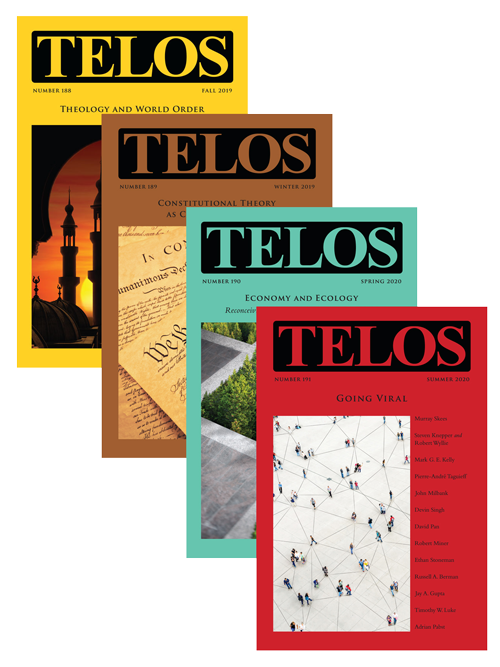
By Russell A. Berman · Wednesday, June 17, 2020 The following essay is part of a group of responses to the COVID-19 pandemic that appear in Telos 191 (Summer 2020): Going Viral, which is now available for purchase in our store. Individual subscriptions to Telos are also available in both print and online formats.
 As of this writing, the precise origin of the Chinese virus, SARS CoV-2, remains unclear. It is however known that cases predated the eruption in the “wet market” in Wuhan—which in the meantime has been reopened, suggesting at least that Chinese authorities do not believe it was the source of the pandemic. The alternative theory that the virus escaped from experiments in one of Wuhan’s virology laboratories therefore remains plausible. In any case, it is certain that Wuhan was the first epicenter and that state authorities used repressive power to delay alerting the world by possibly more than a month. With that additional time, the spread of the disease might have been contained, or its dissemination at least impeded, if China and the World Health Organization had acted with transparency and integrity. They did not. As of this writing, the precise origin of the Chinese virus, SARS CoV-2, remains unclear. It is however known that cases predated the eruption in the “wet market” in Wuhan—which in the meantime has been reopened, suggesting at least that Chinese authorities do not believe it was the source of the pandemic. The alternative theory that the virus escaped from experiments in one of Wuhan’s virology laboratories therefore remains plausible. In any case, it is certain that Wuhan was the first epicenter and that state authorities used repressive power to delay alerting the world by possibly more than a month. With that additional time, the spread of the disease might have been contained, or its dissemination at least impeded, if China and the World Health Organization had acted with transparency and integrity. They did not.
Continue reading →
By David Pan · Monday, June 15, 2020 Telos 191 (Summer 2020): Going Viral is now available for purchase in our store. Individual subscriptions to Telos are also available in both print and online formats.
 While “going viral” has taken on a new meaning by recuperating an old one, it is the virtual experience that seems to be more enduring. Not only has the pandemic sped up the shifting of human activity onto virtual platforms, but the viral dynamics of social media seem set to outlast the microbial versions: it has turned out to be easier to lock down the Wuhan virus than President Trump’s Twitter feed. Yet in both cases, it is unclear whether it is the actual spread or the fear that is the greater danger. For this fear leads to the call for more authoritarian measures, whether this means censoring Twitter posts or locking down the population. But if viral spread leads to the reassertion of sovereignty, we also come to realize that the freedoms we have taken for granted are in fact the result of a curated space, in which the rules for interaction have always formed the hidden framework within which our lives have unfolded. As these framing conditions come into focus during the crisis, we have the opportunity to reimagine them in such a way as to retrieve sovereignty not as a kind of authoritarian reaction but as an understanding of how our values must inform the boundaries we set. This issue of Telos considers how the experience of going viral has come to dominate our political life as well as how our reflection on this process can free us to consider the alternatives. While “going viral” has taken on a new meaning by recuperating an old one, it is the virtual experience that seems to be more enduring. Not only has the pandemic sped up the shifting of human activity onto virtual platforms, but the viral dynamics of social media seem set to outlast the microbial versions: it has turned out to be easier to lock down the Wuhan virus than President Trump’s Twitter feed. Yet in both cases, it is unclear whether it is the actual spread or the fear that is the greater danger. For this fear leads to the call for more authoritarian measures, whether this means censoring Twitter posts or locking down the population. But if viral spread leads to the reassertion of sovereignty, we also come to realize that the freedoms we have taken for granted are in fact the result of a curated space, in which the rules for interaction have always formed the hidden framework within which our lives have unfolded. As these framing conditions come into focus during the crisis, we have the opportunity to reimagine them in such a way as to retrieve sovereignty not as a kind of authoritarian reaction but as an understanding of how our values must inform the boundaries we set. This issue of Telos considers how the experience of going viral has come to dominate our political life as well as how our reflection on this process can free us to consider the alternatives.
Continue reading →
By Russell A. Berman · Thursday, April 9, 2020 Once upon a time, there was an illusion that the state would disappear. It was the fiction Marxists told each other at bedtime, and it was the lie of the Communists, once they had seized state power. For even as they built up their police apparatus and their archipelago of gulags, they kept promising that one day the state would eventually disappear.
Of course, in a sense, they were right because Communism ended and so did the Communist states in Russia and Eastern Europe. Yet the death of those regimes is in no way an argument for the death of statehood itself.
The state is the expression of sovereignty, and sovereignty is the ability of national communities to decide their own fates. Such independence is far from obsolete, and certainly not for the countries on the eastern flank of the European Union. After years of Russian occupation, they have regained their state sovereignty. They will continue to insist on it, and rightly so.
Continue reading →
By Aaron Zack · Thursday, January 18, 2018 Aaron Zack’s “Sovereignty and Grand Strategy: Some Observations on the Rise of China and Decline of the Americans” appears in Telos 181 (Winter 2017). Read the full article at the Telos Online website, or purchase a print copy of the issue in our online store. Individual subscriptions to Telos are now available in both print and online formats.
The rise and decline of great powers are not solely material in nature but also moral, political, and cultural. Many modern theorists emphasize the material factors in rise and decline, but older political thinkers focused on moral-political explanations. Carl Schmitt defines the essence of the political as the distinction between friend and enemy. A rising sovereign will effectively distinguish between friends and enemies and act in the interest of a political community. A decaying sovereign will gradually lose its capacity to both make a rational distinction between friends and enemies and act in the interest of the (fading) political community. True grand strategy therefore depends upon a robust sovereign—a decayed sovereign faces difficulty in implementing an effective or optimal grand strategy.
Continue reading →
|
|