By Telos Press · Tuesday, January 18, 2022 The second Telos Student Seminar will pair an essay by Huimin Jin, “Cultural Self-Confidence and Constellated Community: An Extended Discussion of Some Speeches by Xi Jinping” (Telos 195, Summer 2021, pp. 93–113), with an excerpt from Cornelius Castoriadis, “The Crisis of Western Societies” (Telos 53, Fall 1982, pp. 17–28). Our virtual gathering will feature Prof. Jin, who will be joining us from China, as well as a scholar representing the views of Castoriadis.
Modeled on the study groups from which Telos first grew, yet reconceived for the digital age, the Telos Student Seminars (TSS) provide a forum for students around the world to engage with critical theory by discussing a common set of paired texts from Telos—one current essay, and one pertinent essay from our archives—to connect the past and present of the journal to its future. TSS also provides an opportunity for students to be published on TELOSscope.
We seek teachers and scholars from around the world under whose aegis TSS groups can meet and who can provide students with intellectual encouragement and support. An institutional library subscription is necessary. Would you like to join us? Contact tss@telospress.com.
For more information about the Telos Student Seminars, click here.
Continue reading →
By Telos Press · Thursday, January 6, 2022 The Telos Student Seminars provide a forum for students around the world to engage with critical theory by discussing a common set of paired texts from Telos—one current essay and one pertinent essay from our archives. The following reports from our first Telos Student Seminars at Concordia University in Irvine, California, and the Hopkins-Nanjing Center in Nanjing, China, compare Paul Kahn’s “Law and Representation: Observations from an American Constitutionalist” (Telos 195, Summer 2021) and Paul Piccone’s “The Crisis of Liberalism and the Emergence of Federal Populism” (Telos 89, Fall 1991). The Irvine seminar advocates addressing the political challenges highlighted by Kahn and Piccone through a new American civil religion “built on mysticism,” while the Nanjing group took the seminar as an occasion for a wide-ranging, cross-cultural discussion about society and politics. Telos Student Seminars participants across the globe will gather virtually for a discussion with Paul Kahn at the end of this month. For more details about the Telos Student Seminars, including summaries of the two essays under discussion, click here.
Read the reports here.
Continue reading →
By Jaimey Fisher and Sheldon Lu · Wednesday, December 15, 2021 Telos 197 (Winter 2021): The Modern City in World Cinema, edited by Jaimey Fisher and Sheldon Lu, is now available for purchase in our store. Individual subscriptions to Telos are also available in both print and online formats.
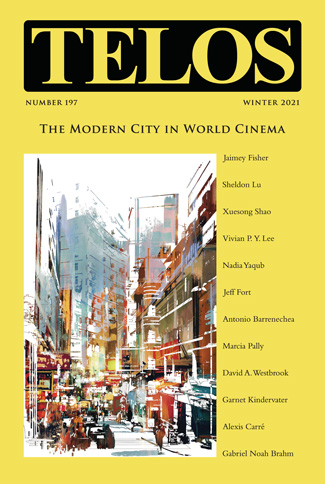 The theme of this special issue of Telos is the modern city in world cinema. Its various essays examine the depiction of cities and their constitutive contexts through the lens of critical theory, political theory, cultural theory, and film theory. The contributors tackle a range of topics: the experience of modernity in urban contexts; cities in relation to civil society and the public sphere; the metropolis and cosmopolitanism; the urban/rural divide; cities and gendered, racial, and class divides; urban planning and urban space; film as a particular medium, with specific parameters, in the broader age of media; film as mass entertainment and as revolutionary propaganda. Even with this wide range of topics and their themes, there are many more to be explored, herein and elsewhere, so complex and rich are the relations of the urban to the cinematic. The theme of this special issue of Telos is the modern city in world cinema. Its various essays examine the depiction of cities and their constitutive contexts through the lens of critical theory, political theory, cultural theory, and film theory. The contributors tackle a range of topics: the experience of modernity in urban contexts; cities in relation to civil society and the public sphere; the metropolis and cosmopolitanism; the urban/rural divide; cities and gendered, racial, and class divides; urban planning and urban space; film as a particular medium, with specific parameters, in the broader age of media; film as mass entertainment and as revolutionary propaganda. Even with this wide range of topics and their themes, there are many more to be explored, herein and elsewhere, so complex and rich are the relations of the urban to the cinematic.
Continue reading →
By Russell A. Berman · Saturday, August 28, 2021 The following essay originally appeared at The Hill. It is republished here by permission of the author.
The Biden administration promised to return American foreign policy to reliability and international leadership after the disruptions of the Trump years. Yet its egregious mismanagement of the exit from Afghanistan has damaged America’s global standing and undercut the credibility of three of the administration’s foreign policy planks.
President Biden and Secretary of State Antony Blinken were supposed to repair transatlantic relations by reassuring our European allies, give priority to human rights in all decisions, and counter Chinese ambitions. The deeply flawed execution of the Afghanistan withdrawal undermines all those aspirations and leaves the Biden foreign policy vision in shambles. The diplomatic team that was supposed to bring professionalism has left America rudderless.
Continue reading →
By David Pan · Friday, June 18, 2021 Telos 195 (Summer 2021): Global Perspectives on Constitutionalism and Populism is now available for purchase in our store. Individual subscriptions to Telos are also available in both print and online formats.
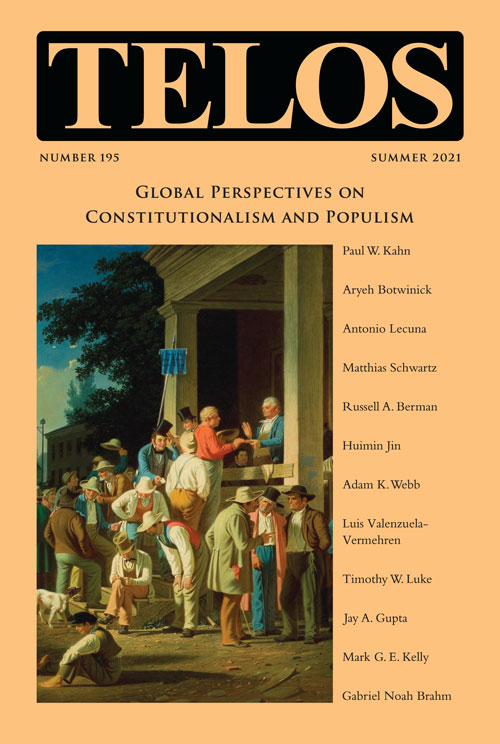 After watching the images of the January 6 Capitol riot, many Americans concluded that right-wing populism threatens the basic rules of our constitutional order. In this view, the U.S. Constitution establishes a universal order that is detached from any particular orientation and provides the neutral ground upon which differences can be discussed, while populists upset the rules of discussion and destroy the basis of a common project. Consequently, since populism is at odds with the Constitution, the solution would be to try to reimpose a measure of rationality upon the unruly. Yet the nagging concern behind this perspective is not just the violation of rules but the suspicion that populism is ultimately motivated by racism and sexism. In this case, the real opposition would not be between constitutionalism and populism but between two understandings of the Constitution, that is, two conceptions of the character of the people, one egalitarian and the other racist. The difficulty is that the laws of a constitution cannot exist independently of a people with a specific history. Rules cannot be neutral but imply a perspective on the world, and the conflict between constitutionalism and populism may in fact be a symptom of a conflict between two factions within the people, each of which is attempting to establish itself as the proper representation of the will of the people as a whole. After watching the images of the January 6 Capitol riot, many Americans concluded that right-wing populism threatens the basic rules of our constitutional order. In this view, the U.S. Constitution establishes a universal order that is detached from any particular orientation and provides the neutral ground upon which differences can be discussed, while populists upset the rules of discussion and destroy the basis of a common project. Consequently, since populism is at odds with the Constitution, the solution would be to try to reimpose a measure of rationality upon the unruly. Yet the nagging concern behind this perspective is not just the violation of rules but the suspicion that populism is ultimately motivated by racism and sexism. In this case, the real opposition would not be between constitutionalism and populism but between two understandings of the Constitution, that is, two conceptions of the character of the people, one egalitarian and the other racist. The difficulty is that the laws of a constitution cannot exist independently of a people with a specific history. Rules cannot be neutral but imply a perspective on the world, and the conflict between constitutionalism and populism may in fact be a symptom of a conflict between two factions within the people, each of which is attempting to establish itself as the proper representation of the will of the people as a whole.
Continue reading →
By Thomas Brussig · Monday, March 8, 2021 This essay was published in the Süddeutsche Zeitung on February 9, 2021, and appears here in translation with permission of the author. Footnotes have been added for clarification. Translated by Russell A. Berman, with comments here. The author intends the title as an ironic reference to Chancellor Willy Brandt’s 1969 statement that Germany “must risk more democracy.”
To read more in depth from Telos, subscribe to the journal here.
 The corona crisis remains an experience of helplessness, even though infection rates are falling. Despite all the limitations on everyday life and despite the start of the vaccinations, an end to the restrictions is nowhere in sight—even though a few countries have succeeded in stopping the virus. The feeling of helplessness in the face of corona is due to the fact that we have had to surmount the corona crisis with the tools of democracy. The corona crisis remains an experience of helplessness, even though infection rates are falling. Despite all the limitations on everyday life and despite the start of the vaccinations, an end to the restrictions is nowhere in sight—even though a few countries have succeeded in stopping the virus. The feeling of helplessness in the face of corona is due to the fact that we have had to surmount the corona crisis with the tools of democracy.
Sigmund Freud spoke of “three blows to humanity”: first, the Copernican worldview that pushed us out of the center of the universe; second, Darwinism, according to which we did not descend from God but from monkeys; and third, psychoanalysis, which teaches that we are not self-determined but only act due to hidden, unconscious, and instinctual motivations. Now we can speak of three blows to democracy, although it was only thirty years ago when liberal self-consciousness stood at its high point. According to the popular thesis of an “end of history,” market economies and democracy had achieved such an indisputable victory that nothing would stop their spread around the world.
Continue reading →
|
|