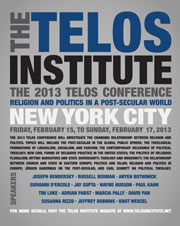
The following paper was presented at the Seventh Annual Telos Conference, held on February 15–17, 2013, in New York City.
 In the following, I wish to offer two reflections on the question of religion in Benjamin’s thought, the first of which pertains to the subject of translation, the second of which pertains to history. I will address the former first, for it is here, namely in Benjamin’s concept of “pure language,” that I have derived the eponymous notion of “pure religion.” These reflections will conclude in the form of open-ended questions, which I will elucidate at this time in order to orient my audience with regards to my stakes. The first question is whether the translatability of religious scripture is a condition of possibility for the multiplicity of world religions, and if so, what might the implications of this be. The second question, which I will distill from the first, is whether historicity, or what is in Benjamin the strife between historical materialism and historiography, grounds the essence, or “purity,” of religious experience.