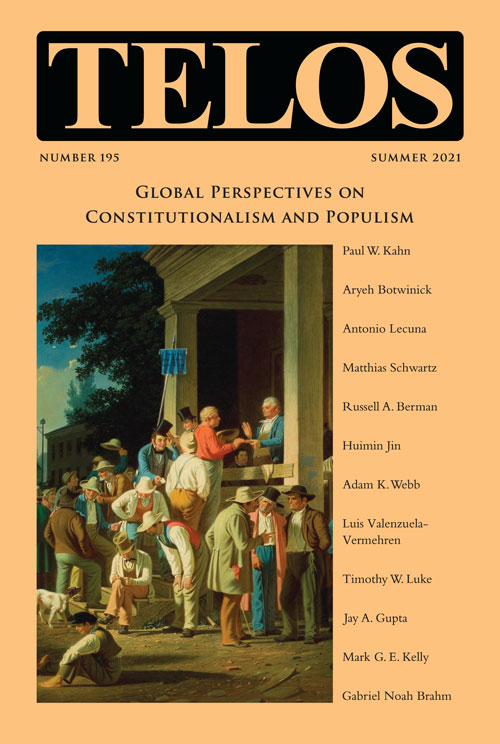
By David Pan · Friday, June 18, 2021 Telos 195 (Summer 2021): Global Perspectives on Constitutionalism and Populism is now available for purchase in our store. Individual subscriptions to Telos are also available in both print and online formats.
 After watching the images of the January 6 Capitol riot, many Americans concluded that right-wing populism threatens the basic rules of our constitutional order. In this view, the U.S. Constitution establishes a universal order that is detached from any particular orientation and provides the neutral ground upon which differences can be discussed, while populists upset the rules of discussion and destroy the basis of a common project. Consequently, since populism is at odds with the Constitution, the solution would be to try to reimpose a measure of rationality upon the unruly. Yet the nagging concern behind this perspective is not just the violation of rules but the suspicion that populism is ultimately motivated by racism and sexism. In this case, the real opposition would not be between constitutionalism and populism but between two understandings of the Constitution, that is, two conceptions of the character of the people, one egalitarian and the other racist. The difficulty is that the laws of a constitution cannot exist independently of a people with a specific history. Rules cannot be neutral but imply a perspective on the world, and the conflict between constitutionalism and populism may in fact be a symptom of a conflict between two factions within the people, each of which is attempting to establish itself as the proper representation of the will of the people as a whole. After watching the images of the January 6 Capitol riot, many Americans concluded that right-wing populism threatens the basic rules of our constitutional order. In this view, the U.S. Constitution establishes a universal order that is detached from any particular orientation and provides the neutral ground upon which differences can be discussed, while populists upset the rules of discussion and destroy the basis of a common project. Consequently, since populism is at odds with the Constitution, the solution would be to try to reimpose a measure of rationality upon the unruly. Yet the nagging concern behind this perspective is not just the violation of rules but the suspicion that populism is ultimately motivated by racism and sexism. In this case, the real opposition would not be between constitutionalism and populism but between two understandings of the Constitution, that is, two conceptions of the character of the people, one egalitarian and the other racist. The difficulty is that the laws of a constitution cannot exist independently of a people with a specific history. Rules cannot be neutral but imply a perspective on the world, and the conflict between constitutionalism and populism may in fact be a symptom of a conflict between two factions within the people, each of which is attempting to establish itself as the proper representation of the will of the people as a whole.
Continue reading →
By Telos Press · Thursday, March 11, 2021 To read more in depth from Telos, subscribe to the journal here.
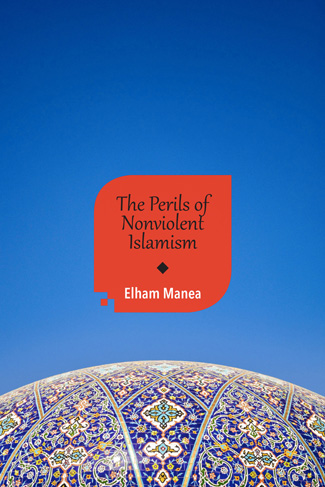
Writing in the Wall Street Journal, Tunku Varadarajan talks with Elham Manea about Switzerland’s recent decision to prohibit the wearing of full facial coverings in public, thereby restricting the burqa and the niqab. Manea’s new book The Perils of Nonviolent Islamism, which investigates the broader context of this decision in comprehensive detail, is now available from Telos Press in our online store for 20% off the list price.
An excerpt from the article:
 European democracies differ from America’s in notable ways, and many Americans have reservations about the Swiss prohibition: Aren’t burqa bans an illiberal curbing of religious and expressive freedom? By some reports, fewer than 100 women in Switzerland wear the burqa. Do they constitute so great a threat to the venerable Swiss nation that their constitution, which guarantees freedom of faith and conscience, has to be amended to alter their sartorial practice? European democracies differ from America’s in notable ways, and many Americans have reservations about the Swiss prohibition: Aren’t burqa bans an illiberal curbing of religious and expressive freedom? By some reports, fewer than 100 women in Switzerland wear the burqa. Do they constitute so great a threat to the venerable Swiss nation that their constitution, which guarantees freedom of faith and conscience, has to be amended to alter their sartorial practice?
Aware that judgments from afar can sometimes be glib, I put these questions to Elham Manea, author of a book published last month titled The Perils of Nonviolent Islamism. . . . Ms. Manea is quick to dismiss the argument that the ban curbs freedom. You can’t separate the burqa and niqab from their “religious and political contexts” and turn this into “a simple question of ‘choice.'” The burqa didn’t “come out of nowhere” and Muslim women haven’t “decided to embrace it on a whim.” Many Western feminists, she says, tend to “neutralize the context, as if it is of no consequence.” She urges those who are squeamish about the ban to ask which ideology teaches women to cover themselves completely. What are its theological features? What does it say about women?
Continue reading →
By Telos Press · Tuesday, January 5, 2021 In today’s episode of the Telos Press Podcast, Camelia Raghinaru talks with Takahiro Nakajima about his article “Constitutionalism and Sovereignty: On Constitutional Problems in Japan,” from Telos 189 (Winter 2019). An excerpt of the article appears here. If your university has an online subscription to Telos, you can read the full article at the Telos Online website. For non-subscribers, learn how your university can begin a subscription to Telos at our library recommendation page. Purchase a print copy of Telos 189 in our online store.
Listen to the podcast here.
Continue reading →
By Telos Press · Thursday, December 17, 2020 In today’s episode of the Telos Press Podcast, Camelia Raghinaru talks with Greg Melleuish about his article “Constitution and Culture: The Unusual Case of Australia,” from Telos 189 (Winter 2019). An excerpt of the article appears here. If your university has an online subscription to Telos, you can read the full article at the Telos Online website. For non-subscribers, learn how your university can begin a subscription to Telos at our library recommendation page. Purchase a print copy of Telos 189 in our online store.
Listen to the podcast here.
Continue reading →
By Erik Pomrenke · Tuesday, September 26, 2017 As an occasional feature on TELOSscope, we highlight a past Telos article whose critical insights continue to illuminate our thinking and challenge our assumptions. Today, Erik Pomrenke looks at Adam Kotsko’s “On Agamben’s Use of Benjamin’s ‘Critique of Violence'” from Telos 145 (Winter 2008).
“On Agamben’s Use of Benjamin’s ‘Critique of Violence'” represents an illuminating attempt by Adam Kotsko to reassert the primacy of Walter Benjamin over Carl Schmitt in Giorgio Agamben’s work. These two thinkers serve alongside Heidegger, Aristotle, Foucault, and Arendt as the center of Agamben’s genealogy of bare life; as such, configuring this constellation correctly is of signal importance to the reception of Agamben’s Homo Sacer project. Kotsko contends that Benjamin’s primacy is both a theoretical and chronological matter.
Continue reading →
By Beau Mullen · Friday, February 24, 2017
This paper focuses on the modern practice of using law, both national and international, to achieve policy goals and political ends that usually are the result of tactical military action. Lawfare, as this practice is referred to, is now a crucial tactic in the modern era of international relations, where war is largely carried out in a far from traditional manner. Lawfare, then, is a unique form of irregular warfare that can be employed by nations against one another and against insurgents in asymmetrical conflicts at home and abroad. This new reliance on irregular and asymmetrical warfare generally and lawfare specifically is reflective of Hegel’s view of the end of history, particularly as articulated by Alexandre Kojève. Basically, that as individuals gain equal recognition, the mode of satisfying desire will necessarily take the form of law and bureaucracy.
Continue reading →
|
|