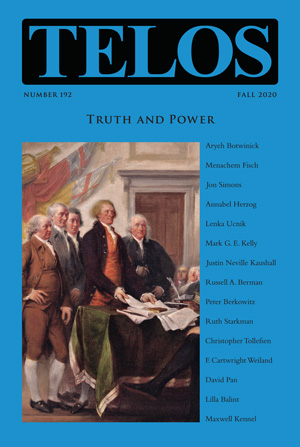
In today’s episode of the Telos Press Podcast, Camelia Raghinaru talks with Lenka Ucnik about her article “Conscience, Morality, Judgment: The Bond between Thinking and Political Action in Hannah Arendt,” from Telos 192 (Fall 2020). An excerpt of the article appears here. If your university has an online subscription to Telos, you can read the full article at the Telos Online website. For non-subscribers, learn how your university can begin a subscription to Telos at our library recommendation page. Purchase a print copy of Telos 192 in our online store.
|
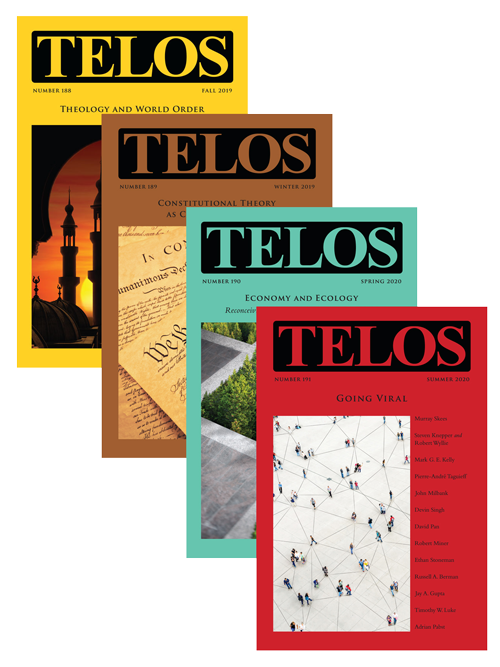
In today’s episode of the Telos Press Podcast, Camelia Raghinaru talks with Takahiro Nakajima about his article “Constitutionalism and Sovereignty: On Constitutional Problems in Japan,” from Telos 189 (Winter 2019). An excerpt of the article appears here. If your university has an online subscription to Telos, you can read the full article at the Telos Online website. For non-subscribers, learn how your university can begin a subscription to Telos at our library recommendation page. Purchase a print copy of Telos 189 in our online store. In today’s episode of the Telos Press Podcast, Camelia Raghinaru talks with David Pan about his article “State, Movement, People: Representation and Race in the Construction of Political Identity,” from Telos 189 (Winter 2019). An excerpt of the article appears here. If your university has an online subscription to Telos, you can read the full article at the Telos Online website. For non-subscribers, learn how your university can begin a subscription to Telos at our library recommendation page. Purchase a print copy of Telos 189 in our online store. In today’s episode of the Telos Press Podcast, Camelia Raghinaru talks with Qin Wang about his article “Constitution and Literariness: Takeuchi Yoshimi’s Critique of the Postwar Japanese Constitution,” from Telos 189 (Winter 2019). An excerpt of the article appears here. If your university has an online subscription to Telos, you can read the full article at the Telos Online website. For non-subscribers, learn how your university can begin a subscription to Telos at our library recommendation page. Purchase a print copy of Telos 189 in our online store. In today’s episode of the Telos Press Podcast, Camelia Raghinaru talks with Devin Singh about his article “Exceptional Economy: Sovereign Exchanges in Carl Schmitt and Giorgio Agamben,” from Telos 191 (Summer 2020). An excerpt of the article appears here. If your university has an online subscription to Telos, you can read the full article at the Telos Online website. For non-subscribers, learn how your university can begin a subscription to Telos at our library recommendation page. Purchase a print copy of Telos 191 in our online store. Aryeh Botwinick’s “Negative Theology, Power, and the Israeli–Palestinian Conflict” appears in Telos 192 (Fall 2020): Truth and Power. Read the full article at the Telos Online website, or purchase a print copy of the issue in our online store. Individual subscriptions to Telos are available in both print and online formats. |
   |
|||
|
Privacy Policy · Data Protection Copyright © 2026 Telos Press Publishing · All Rights Reserved |
||||