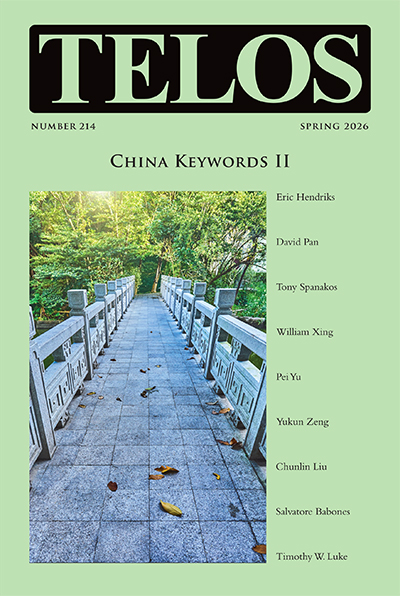
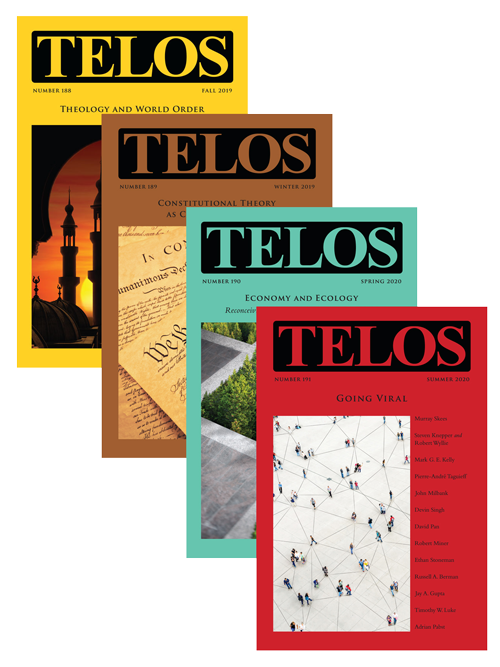
By Eric Hendriks and David Pan · Tuesday, December 30, 2025 Telos 213 (Winter 2025): China Keywords I is now available for purchase in our store. Individual subscriptions to Telos are also available in both print and online formats.
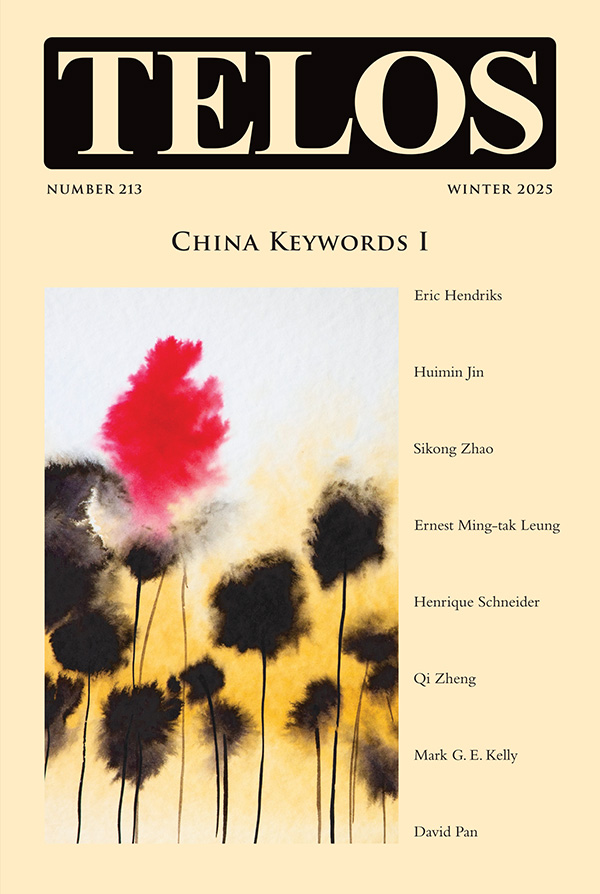 China saturates Western media and academic discourse, invoked incessantly as a force remaking the world, while the political and social-theoretical ideas through which China thinks, judges, and interprets that world remain largely unheard. Western discourses on China exhibit a persistent tendency toward objectification and reification. Chinese phenomena figure as objects of analysis, yet such analyses rarely delve into their subjective-interpretative depth. Were they to do so, they would encounter these “objects” as subjects who actively make sense of their worlds, carrying ideas, ideals, and self-conceptions embedded in distinct interpretive traditions. At the same time, Western media and academics are often unaware that their own views are actively influenced by the Chinese Communist Party (CCP), which spends $10 billion per year on international propaganda efforts that include advertising, news production, and social media campaigns. China saturates Western media and academic discourse, invoked incessantly as a force remaking the world, while the political and social-theoretical ideas through which China thinks, judges, and interprets that world remain largely unheard. Western discourses on China exhibit a persistent tendency toward objectification and reification. Chinese phenomena figure as objects of analysis, yet such analyses rarely delve into their subjective-interpretative depth. Were they to do so, they would encounter these “objects” as subjects who actively make sense of their worlds, carrying ideas, ideals, and self-conceptions embedded in distinct interpretive traditions. At the same time, Western media and academics are often unaware that their own views are actively influenced by the Chinese Communist Party (CCP), which spends $10 billion per year on international propaganda efforts that include advertising, news production, and social media campaigns.
Continue reading →
By Telos Press · Wednesday, November 26, 2025 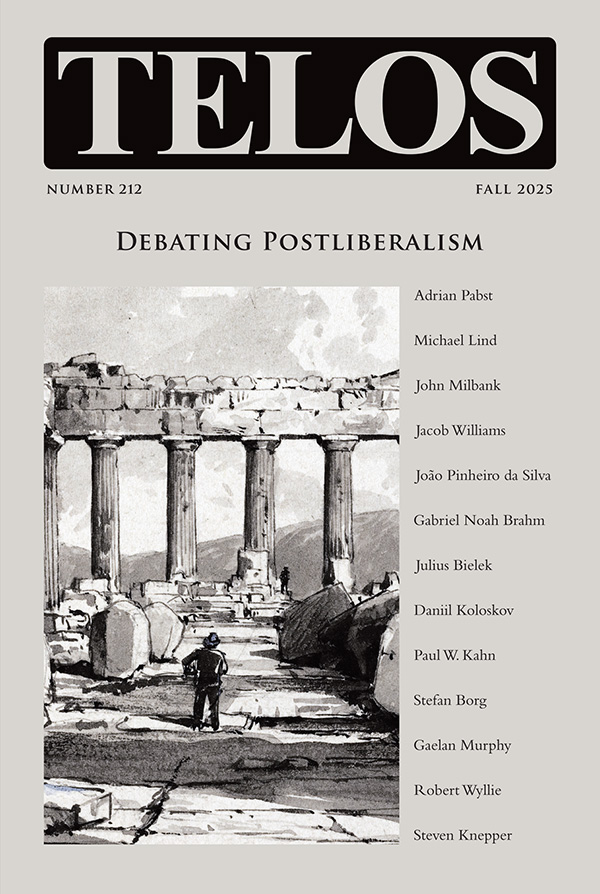 In today’s episode of the Telos Press Podcast, Adrian Pabst talks with Michael Lind and John Milbank about postliberalism, the topic of the current issue of Telos, “Debating Postliberalism.” Adrian Pabst’s “The New Era: What Comes After the Self-Erosion of Liberalism,” Michael Lind’s “After Liberalism,” and John Milbank’s “The Politics of Virtue” all appear in the issue. We have made the articles by Pabst and Lind available as open access publications, and they can be read for free at our website. To purchase a copy of the issue or to subscribe to Telos, visit our online store. In today’s episode of the Telos Press Podcast, Adrian Pabst talks with Michael Lind and John Milbank about postliberalism, the topic of the current issue of Telos, “Debating Postliberalism.” Adrian Pabst’s “The New Era: What Comes After the Self-Erosion of Liberalism,” Michael Lind’s “After Liberalism,” and John Milbank’s “The Politics of Virtue” all appear in the issue. We have made the articles by Pabst and Lind available as open access publications, and they can be read for free at our website. To purchase a copy of the issue or to subscribe to Telos, visit our online store.
Continue reading →
By Adrian Pabst · Friday, October 3, 2025 Telos 212 (Fall 2025): Debating Postliberalism is now available for purchase in our store. Individual subscriptions to Telos are also available in both print and online formats.
In 1998, Alan Wolfe remarked that “the right won the economic war, the left won the cultural war, and the center won the political war.” It was the age of triumphant liberalism, freed from the shackles of the Cold War confrontation between the capitalist West and the Communist East. Capitalism was now the uncontested model, as Western countries increasingly abandoned a more embedded social market economy in favor of the global market-state while emerging market economies embraced the state-market. In each case, society was the loser. Even as countries converged internationally and China morphed into an economic powerhouse, asset and income inequality increased within countries, and so did regional disparities—between the former heartlands of the Rust Belt and the new metropolitan hubs exemplified by Silicon Valley. Building on the writings of Paul Piccone and Christopher Lasch, critics of liberalism such as Christophe Guilluy, Nancy Fraser, Michael Lind, and Quinn Slobodian have highlighted the growing gulf between elite enclaves and peripheral wastelands, or hubs vs. heartlands, but their analysis has mostly been dismissed as nostalgic or downright reactionary. Something similar applies to politicians on both sides of the spectrum who have questioned liberal economics—whether Pat Buchanan in the past or JD Vance and Josh Hawley more recently on the Republican right, or Bernie Sanders, Ro Khanna, and Chris Murphy on the Democratic left.
Some political and policy differences notwithstanding, the mainstream left and right—in the United States, Europe, and other Western countries such as Japan, South Korea, Australia, and New Zealand—took a progressive turn and embraced untrammeled markets, hyper-individualism, and foreign military adventures. The ruling elites felt vindicated by the “end of history” utopia of a global convergence toward liberal market democracy and the inevitable forward march of globalization. Both liberal interventionists and neoconservative crusaders advanced the vision of America as a liberal Leviathan that secures the social contract at home and U.S. supremacy abroad.
Continue reading →
By Telos Press · Monday, September 12, 2022 In today’s episode of the Telos Press Podcast, David Pan talks with Brian Wolfel about his article “Thomas Carlyle’s Conception of Transcendentalism in Sartor Resartus and Its Application to Theorizing Postliberalism,” from Telos 199 (Summer 2022). An excerpt of the article appears here. In their conversation they discuss the problems of liberalism that transcendentalism tries to address; the basic characteristics of the transcendentalism that Thomas Carlyle describes in Sartor Resartus; how Carlyle’s transcendentalism embodies a kind of post-liberalism; how Carlyle’s transcendentalism can be understood as anti-dogmatic, or as a dogmatic anti-dogmatism; how Carlyle’s transcendentalism functions as a practical political philosophy; the relation of Carlyle’s transcendentalism to American transcendentalism and contemporary New Age philosophy; and the perilous status of liberalism in relation to current forms of authoritarianism. If your university has an online subscription to Telos, you can read the full article at the Telos Online website. For non-subscribers, learn how your university can begin a subscription to Telos at our library recommendation page. Print copies of Telos 199 are available for purchase in our online store.
Continue reading →
|
|