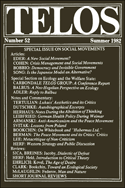
By Wes Tirey · Thursday, June 21, 2012 As an occasional feature on TELOSscope, we highlight a past Telos article whose critical insights continue to illuminate our thinking and challenge our assumptions. Today, Wes Tirey looks at Norberto Bobbio’s ” Democracy and Invisible Government,” from Telos 52 (Summer 1982).
 “Democracy,” writes Jacques Rancière in Hatred of Democracy, “first of all means this: ‘anarchic government,’ one based on nothing other than the absence of every title to govern.” He adds: “Democracy is . . . the primary limitation of the power of forms of authority that govern the social body.” While Rancière’s suggestion that democracy is ‘anarchic government’ indeed seems paradoxical, and by all means requires careful unpacking, one thing that can be taken from it is that democracy is to be seen. That is to say, a political regime that requires active citizen-participation in which the body politic is self-governing requires political activity to therefore be made public. “Democracy,” writes Jacques Rancière in Hatred of Democracy, “first of all means this: ‘anarchic government,’ one based on nothing other than the absence of every title to govern.” He adds: “Democracy is . . . the primary limitation of the power of forms of authority that govern the social body.” While Rancière’s suggestion that democracy is ‘anarchic government’ indeed seems paradoxical, and by all means requires careful unpacking, one thing that can be taken from it is that democracy is to be seen. That is to say, a political regime that requires active citizen-participation in which the body politic is self-governing requires political activity to therefore be made public.
Continue reading →
By Wes Tirey · Tuesday, June 19, 2012 The cover of the most recent issue of The Economist reads: “Morals and the machine: Teaching robots right from wrong.” A short piece in the magazine states: “As robots become more autonomous, the notion of computer-controlled machines facing ethical decisions is moving out of the realm of science fiction and into the real world. Society needs to find ways to ensure that they are better equipped to make moral judgments.” Moreover, as robots “become smarter and more widespread, autonomous machines are bound to end up making life-or-death decisions in unpredictable situations, thus assuming—or at least appearing to assume—moral agency.”
Continue reading →
By Emelie Whiting · Thursday, December 8, 2011 As an occasional feature on TELOSscope, we highlight a past Telos article whose critical insights continue to illuminate our thinking and challenge our assumptions. Today, Emelie Whiting looks at Mark W. Rectanus’s “Performing Knowledge: Cultural Discourses, Knowledge Communities, and Youth Culture,” from Telos 150 (Spring 2010).
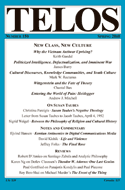 Academic discourse in the twenty-first century has undergone profound transformations. With new methods of knowledge production and consumption brought about by an increase in electronic resources and databases as well as the advent of social networking, there have been widespread changes in scholarly publishing, centers of knowledge, and knowledge communities. In his article “Performing Knowledge: Cultural Discourses, Knowledge Communities, and Youth Culture,” Mark W. Rectanus provides a compelling look at the shift in the significance and acquisition of knowledge resulting from changes in the publishing industry, literary reception, and access to different kinds of information as they stand in relation to a new “pedagogy of media”—a new way of teaching and learning in our technologically advanced age. Rectanus asserts that such developments require a revised conception of what it means to acquire knowledge as well as what constitutes scholarly knowledge. Academic discourse in the twenty-first century has undergone profound transformations. With new methods of knowledge production and consumption brought about by an increase in electronic resources and databases as well as the advent of social networking, there have been widespread changes in scholarly publishing, centers of knowledge, and knowledge communities. In his article “Performing Knowledge: Cultural Discourses, Knowledge Communities, and Youth Culture,” Mark W. Rectanus provides a compelling look at the shift in the significance and acquisition of knowledge resulting from changes in the publishing industry, literary reception, and access to different kinds of information as they stand in relation to a new “pedagogy of media”—a new way of teaching and learning in our technologically advanced age. Rectanus asserts that such developments require a revised conception of what it means to acquire knowledge as well as what constitutes scholarly knowledge.
Continue reading →
|
|