By Telos Press · Thursday, September 15, 2016 “If, in addition, one imagines not only that airplanes fly through the airspace over land and sea but also that radio waves from transmissions from all lands circle the globe uninterruptedly through the atmospheric space, then it would be easy to believe now not only that a new, third dimension has been achieved but also that even a third element has been added, the air, as a new elementary domain of human existence. To both the mythic beasts, Leviathan and Behemoth, a third would be added, a great bird. But we must not be overhasty with such consequential propositions. Indeed, if one thinks of the mechanized technical means and energies with which human power is exercised in airspace, and if one recognizes the explosive motors by means of which air machines are moved, then it appears that it is the fire that is the additional, genuinely new element of human activity.”
—Carl Schmitt, Land and Sea: A World-Historical Meditation
Continue reading →
By Lukas Szrot · Tuesday, July 7, 2015 The aftermath of the War on Terror rages on despite bipartisan assurances that “major combat operations are over” and that “the war is coming to a close.” This ongoing conflict has produced, and continues to produce, prodigious human casualties and economic hemorrhaging. Tim Luke’s words regarding September 11, 2001, are in many ways as timely today as they were nearly fourteen years ago.
Continue reading →
By Joseph van der Naald · Tuesday, November 18, 2014  Is humanity’s need to control nature ultimately working against us? Are the modern ecological crises we face today the inevitable result of the accelerating technologization of society? Can we conclude that what appears to be widespread anomie, as evidenced, for example, by the now almost monthly school shootings in the United States, and the genocidal totalitarian regimes of the twentieth century both have their “premises, dynamics, or preconditions” (169) in industrialization’s alienation of mankind from nature? In “Why Primitivism?” John Zerzan hopes to convince us that the answers to these questions are yes. Through a nuanced critique of both modernity and the thoughts of the twentieth and twenty-first centuries’ canonized intellectual Left, Zerzan draws the conclusion that we should look far back into human pre-history to find solutions to the problems that face humanity in the present. In this post, I will explore the primitivist position and provide a critique of Zerzan’s thought using Slavoj Žižek’s explorations into ecology’s ideological character. Is humanity’s need to control nature ultimately working against us? Are the modern ecological crises we face today the inevitable result of the accelerating technologization of society? Can we conclude that what appears to be widespread anomie, as evidenced, for example, by the now almost monthly school shootings in the United States, and the genocidal totalitarian regimes of the twentieth century both have their “premises, dynamics, or preconditions” (169) in industrialization’s alienation of mankind from nature? In “Why Primitivism?” John Zerzan hopes to convince us that the answers to these questions are yes. Through a nuanced critique of both modernity and the thoughts of the twentieth and twenty-first centuries’ canonized intellectual Left, Zerzan draws the conclusion that we should look far back into human pre-history to find solutions to the problems that face humanity in the present. In this post, I will explore the primitivist position and provide a critique of Zerzan’s thought using Slavoj Žižek’s explorations into ecology’s ideological character.
Continue reading →
By Telos Press · Wednesday, March 5, 2014 The Oligarchs of Silicon Valley
Author Joel Kotkin on How Tech Leaders are Driving National Debate
Who: Author Joel Kotkin (Forbes, Daily Beast)
What: The Oligarchs of Silicon Valley
Where: St. Francis College, Maroney Forum for Arts, Culture & Education, 180 Remsen Street, Brooklyn Heights, NY 11201
When: Thursday, March 20, 6:00pm to 8:00pm
This event is free and open to the public.
Continue reading →
By Juan Carlos Donado · Tuesday, January 22, 2013 As an occasional feature on TELOSscope, we highlight a past Telos article whose critical insights continue to illuminate our thinking and challenge our assumptions. Today, Juan Carlos Donado looks at Carl Schmitt’s “The Age of Neutralizations and Depoliticizations,” from Telos 96 (Summer 1993).
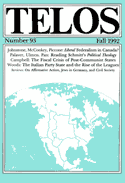 Perhaps Carl Schmitt would agree: more than ever before, we live today immersed within the spirit of technicity. Coined by Schmitt, the notion of the spirit of technicity serves the analytical purpose of allowing him to distinguish between the belief in technology and technology itself. Whereas technology signals the factual development of mechanistic progress and its link to natural science, the spirit of technicity, in Schmitt’s own words, is “perhaps an evil and demonic spirit, but not one which can be dismissed as mechanistic and attributed to technology” (141). Perhaps Carl Schmitt would agree: more than ever before, we live today immersed within the spirit of technicity. Coined by Schmitt, the notion of the spirit of technicity serves the analytical purpose of allowing him to distinguish between the belief in technology and technology itself. Whereas technology signals the factual development of mechanistic progress and its link to natural science, the spirit of technicity, in Schmitt’s own words, is “perhaps an evil and demonic spirit, but not one which can be dismissed as mechanistic and attributed to technology” (141).
Continue reading →
By James Santucci · Tuesday, December 18, 2012 As an occasional feature on TELOSscope, we highlight a past Telos article whose critical insights continue to illuminate our thinking and challenge our assumptions. Today, James Santucci looks at Karel Kosík’s “Our Present Crisis” from Telos 13 (Fall 1972).
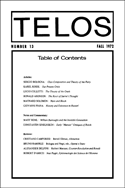 Karel Kosík’s story begins with the end of a statue. In 1962, a granite statue of Stalin that had been begun in 1955 was completed only to be torn down several months later. For Kosík, the statue, “designed to last forever,” perfectly represented the provisionalism and nihilism of modern times. It laid bare the inescapable tension between living peacefully in social life and the animal brutality that occasionally became necessary. When the statue was torn down, the base was left behind. In Kosík’s time, there were plans to transform the space into a garden restaurant. The restaurant’s relationship to its past would be complicated, but plans were scrapped, which saved any Prague tourists from the awkwardness of “Would you like to see our drink menu while you contemplate what it means to live under threat of random and instantaneous erasure?” Karel Kosík’s story begins with the end of a statue. In 1962, a granite statue of Stalin that had been begun in 1955 was completed only to be torn down several months later. For Kosík, the statue, “designed to last forever,” perfectly represented the provisionalism and nihilism of modern times. It laid bare the inescapable tension between living peacefully in social life and the animal brutality that occasionally became necessary. When the statue was torn down, the base was left behind. In Kosík’s time, there were plans to transform the space into a garden restaurant. The restaurant’s relationship to its past would be complicated, but plans were scrapped, which saved any Prague tourists from the awkwardness of “Would you like to see our drink menu while you contemplate what it means to live under threat of random and instantaneous erasure?”
Continue reading →
|
|