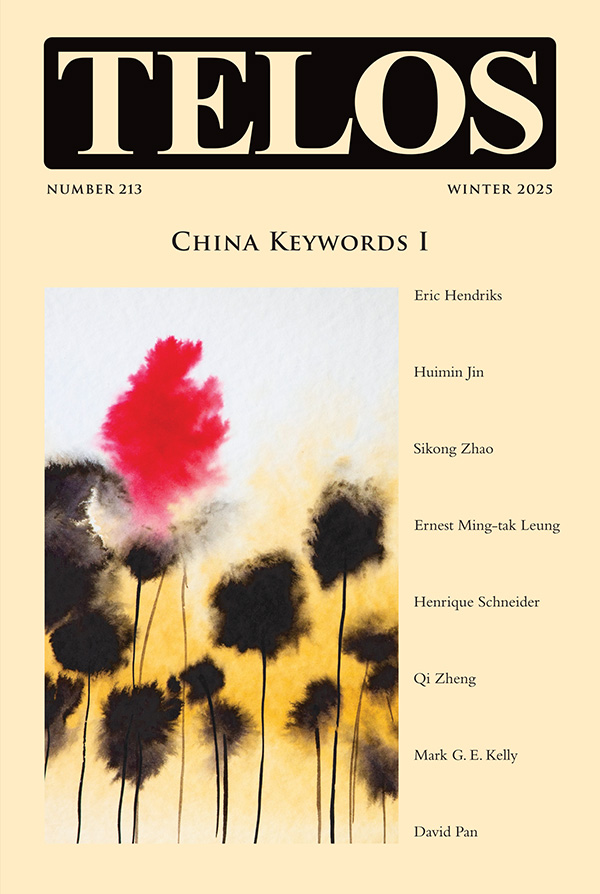
Telos 213 (Winter 2025): China Keywords I is now available for purchase in our store. Individual subscriptions to Telos are also available in both print and online formats.
 China saturates Western media and academic discourse, invoked incessantly as a force remaking the world, while the political and social-theoretical ideas through which China thinks, judges, and interprets that world remain largely unheard. Western discourses on China exhibit a persistent tendency toward objectification and reification. Chinese phenomena figure as objects of analysis, yet such analyses rarely delve into their subjective-interpretative depth. Were they to do so, they would encounter these “objects” as subjects who actively make sense of their worlds, carrying ideas, ideals, and self-conceptions embedded in distinct interpretive traditions. At the same time, Western media and academics are often unaware that their own views are actively influenced by the Chinese Communist Party (CCP), which spends $10 billion per year on international propaganda efforts that include advertising, news production, and social media campaigns.[1]
There are thus two different ways in which Western media fail to appreciate the subjectivity of Chinese perspectives. On the one hand, China and the Sinophone world more broadly continue to generate new ideas and practices. On the other hand, the CCP is engaging in an active propaganda effort to shape how the rest of the world perceives China. When engaging with Chinese academic discourse, it is thus necessary to maintain a kind of double vision, open to new ideas from China yet wary of how such ideas might function, even unbeknownst to their authors, as part of the CCP’s ideological program.
This treacherous terrain leads many to avoid it altogether, though that is ultimately unwise. It is striking how rarely the world of ideas figures in prevailing discourses on Chinese politics. How often do we encounter, in major newspapers, discussions of Chinese political terminology, of Chinese perspectives on Western phenomena (such as American foreign policy), or of Chinese interpretations of Western interpretations of China? Why are the BBC, the New York Times, and the Frankfurter Allgemeine Zeitung not engaging with concepts such as “socialism with Chinese characteristics” and the “community of common destiny,” given their centrality to Chinese political self-understandings and, by extension, to contemporary world politics? Even academic conferences often make China appear as a mindless block, with discussions rarely turning to Chinese intellectual life and the historically formed ideals and traditions of political thought that shape it.
One reason for that non-ideational approach is that, due to regime differences, Western observers tend to dismiss Chinese political ideals and concepts outright. Accustomed to the style and structure of Western public spheres, they are quick to conclude: “All that is merely CCP propaganda and hence not worth engaging.” That judgment, however, is only partly true.
To be sure, the CCP is, in China, the dominant actor in setting agendas and introducing interpretive frameworks, including in academic and public discussions of political thought. Yet even when a concept or perspective is introduced from the political leadership into universities and the media (often, the interactions between the Party leadership and Party-external discursive spaces are more complex than such a simple top-down imposition), it still draws on shared historical understandings and cultural resources. For if a concept truly emerged from nowhere and failed to connect to existing ideals and widely shared interpretive traditions, it could not resonate in a Chinese cultural context.
Moreover, even the most top-down introduced concepts and perspectives tend, at least initially, to retain a certain indeterminacy and semantic openness. The Party leadership does not immediately specify every implication or application. As a result, multiple interpretive variants and uses quickly emerge within Party ranks, the Chinese academy, and the broader intellectual field. In unexpected ways, critical thinkers mobilize official normative formulations emanating from the political center against elements of the status quo.
The second reason for an obscuring of Chinese discourse has been the disjunction between the Chinese and the Western public spheres. Due to the Great Firewall, the Chinese media world is essentially cut off from the Western one. Mainland China’s internet is a CCP creation, not just in terms of perspective but also in terms of the very historical facts that make up the CCP-dominated universe. Due to heavy-handed CCP information management, writers in China may be unaware of important details within Chinese history, especially that of the CCP. As Ian Johnson has documented, an entire underground history of modern China has developed through writers, journalists, and filmmakers, who can only distribute their work in the West.[2] Since this authentic history must remain underground in China, details of the Anti-Rightist Campaign, the Jianbiangou concentration camps, the Great Chinese Famine, the repression in Xinjiang, and the suppression of the Falun Gong cannot form the historical context for writers in China. The continual scrubbing of alternative perspectives, as well as historical events that reflect badly on the CCP, means that there is a foreshortening of their own experience that shapes Chinese discourse. The extent and intensity of this censorship vary, however, and it remains unclear how much, or how little, any given political theoretical text from China has been shaped by self-censorship.
David Pan, editor of Telos and one of the two authors of this introduction, argues that the problem of divergent public spheres is a consequence of the broader incompatibility between liberal democratic and authoritarian systems. The two authors disagree on this point, however.
Eric Hendriks, director of the China Initiative of the Telos-Paul Piccone Institute, views the strategic relationship with China very differently from Pan and does not regard the binary interpretive scheme of “liberal democracies versus authoritarianism” as helpful. He warns that liberalism’s habit of applying the generic label “authoritarianism” to practically all non-Western polities, including China, means applying a liberal-centric taxonomic scheme that trivializes—and dulls Western intellectual interest in—non-Western and non-liberal traditions of political thought. If this is the case, the liberal regime taxonomies themselves would be part of the reason for the non-ideational, flattening tendencies of Western and liberal discourses about China.
Hendriks argues that the generic label of “authoritarianism” trivializes China’s politico-interpretative subjecthood. It does so, he contends, by centering an idealized Western self-image and, in the process, obscuring the fact that the CCP and CCP-adjacent intellectual currents themselves articulate and reproduce culturally specific political and political-philosophical idealisms that diverge from Western ones. He notes that “authoritarianism” functions as an empty, residual category within liberal regime taxonomies;[3] it is defined negatively as the absence of a substantively articulated Western liberal-democratic rule-of-law state, conceived as a coherent normative and organizational package.
The self-centering one-dimensionality of such taxonomies, Hendriks insists, makes it tempting to imagine that only liberal democracies represent the realization, more or less successful, of genuine political ideals, such as equality, democracy, and the rule of law, while regimes labeled “authoritarian” are reduced to being merely corrupt, kleptocratic, and power-hungry. In this way, the West comes to picture itself as surrounded by an endless sea of mindless authoritarian deficiency—a posture that, Hendriks warns, causes it to close itself off intellectually.
However, Pan argues that Hendriks’s multiculturalism is in fact the worst kind of obscurantist conservatism, which affirms a cultural tradition for no other reason than that it exists, abandoning any ethical standards for judgment that would be the basis of any principled approach to culture. This multiculturalist tendency seeks to normalize the relationship with China, at the cost of giving up all principles. For example, the Universal Declaration of Human Rights lays out a set of principles for human rights that has been agreed upon by most of the world, and for which liberal freedoms and the rule of law are central. While China rejects such political freedoms in order to affirm “economic rights,” this approach again reinforces the authoritarian approach in which the rule of law is abrogated so that the government can maintain full control over people’s lives. In many ways, Pan contends, the CCP’s refusal to acknowledge critiques of its human rights record, as well as the absence of the rule of law in China,[4] indicates the way it is at war with the West to the same degree that it denies individual freedom to Chinese citizens.[5] But while there are many authoritarian governments in the world, the CCP is unique in the extent to which it seeks to remake the global order in its own image, Pan argues. According to him, discussions of China must therefore continually face the question of whether the CCP and the West are participating in a common global order or are already in a cold war over the future structure of this order.
This ambiguity makes it all the more essential to engage with Chinese thought. Often, a text from China will be written with the goal of supporting and strengthening the Chinese governance system. Even if we may not share this goal, such a text can provide insight into the present challenges the CCP faces, as well as the ways its strategies differ from those of other socialist governments, past and present. In any case, we will have a better chance of understanding future possibilities if we can gain insight into the limitations, nuances, and possibilities of political thought in China.
As we consider our own thinking about China and the CCP, we will have to keep in mind not only the crucial distinction between the two, but also the fact that Chinese phenomena are not inert objects, frozen in place for analysis and incapable even of “hearing” us as we interpret them. The Chinese realities these discourses describe do, in fact, have ears: they can listen to what is said about them and, on that basis, reinterpret things Western, themselves, and the broader situation. Thus, what is frequently missing in Western discourses is an awareness of the dialectical character of China interpretations: the fact that interpretations circulate, are perceived, responded to, and folded back into self-reflection and political practice. They are not simply sources of knowledge but sentinels in political dialectics and conflicts.
An example of this political character of discourse can be found in how Western journalists and academics have reported, over the past two decades, on China’s successive blocking of American social media platforms such as Facebook and YouTube. Rather than being a fully endogenous development, this series of blocks may have emerged in interaction with the extensive body of Western journalistic, communication-theoretical, and political science literature that explicitly framed each of these social media platforms as subversive of China’s political system. In many cases, the blocking of a platform followed months or years of Western publications enthusiastically asserting precisely this politically transformative potential. A recent case is Clubhouse. In late 2020 and early 2021, during COVID lockdowns, Western commentators expressed excitement at the prospect that Mainland Chinese users could discuss politically sensitive topics on Clubhouse, a then-new audio-based social media platform. The platform was subsequently blocked.
Finally, though, our discourse about China should not overlook the ways in which the Western world is itself shaped by the same kind of privileging of expert solutions over individual freedom that maintains its hold on China. The expansion of expert culture and the administrative state in the West have arisen from the same kind of rationalist belief in social engineering that gave rise to the CCP. CCP authoritarianism, or in Hendriks’s terminology, technocracy, was itself the result of Marxism, a Western import,[6] and, as Ernest Leung’s paper in this issue shows, Guomindang and German precedents.
We are in a period in which it is not yet clear to what extent the Chinese and the Western worlds are heading toward (1) a convergence in their forms of authoritarianism, (2) a common turn toward liberalism, (3) a definitive break and more open conflict, or (4) the “harmonious” type of multi-civilizational coexistence celebrated by the CCP via concepts such as the “community of common destiny for humanity” and presaged by Carl Schmitt in The Nomos of the Earth.[7]
For Pan, it will be essential to remain focused on the difference between freedom and authoritarianism in order to combat threats to freedom in both China and the West in the engagement with Chinese perspectives. It is fairly clear for Pan that the CCP is at present only interested in a rapprochement with the West based on the spread of authoritarianism, i.e., the erosion of the rule of law, and its strategy is focused on both the building of military power and a propaganda effort to undermine Western commitments to freedom. Meanwhile, Chinese intellectuals both inside and outside of China face as much uncertainty about the current situation as the rest of the world. Within this context, our task is to maintain as honest and open a discussion as possible, and Pan argues that we must champion freedom in both China and the West, while always distinguishing between the CCP and China more generally.
Hendriks agrees, but stresses that an essential manifestation of freedom’s international existence is the legitimate diversity of polities and political as well as intellectual traditions. He holds that the central task of the twenty-first century is to foster the flourishing coexistence of polities, world regions, and forms of modernity shaped by different civilizational backgrounds.
There is still an active intellectual life in China, which can alter both CCP strategies and overall attitudes toward the West. Rather than merely listening, our engagement with Chinese scholars can also foster intellectual and political cross-fertilization, generating new questions, conceptual innovations, and critical perspectives on both sides.
To the extent that we can provide a forum for voices both inside and outside China that do not deny historical truth, are committed to the goal of freedom, and are able to seriously debate all aspects of Chinese politics and society, we can perhaps bridge the gap between the two public spheres and create a discourse that engages with Chinese and Western problems in ways that may not be able to happen properly elsewhere. Wherever such a project might lead, it will be essential to keep alive a practice of real debate about Chinese issues and perspectives.
The Telos circle—including the journal Telos and the Telos–Paul Piccone Institute (TPPI)—has long been deeply engaged with China, publishing critical interventions on topics such as China’s emerging tianxia-inspired visions of world order. More recently, TPPI launched the China Initiative, a program that organizes a wide range of activities focused on contemporary Chinese political thought and that will even publish essays in Mandarin Chinese.
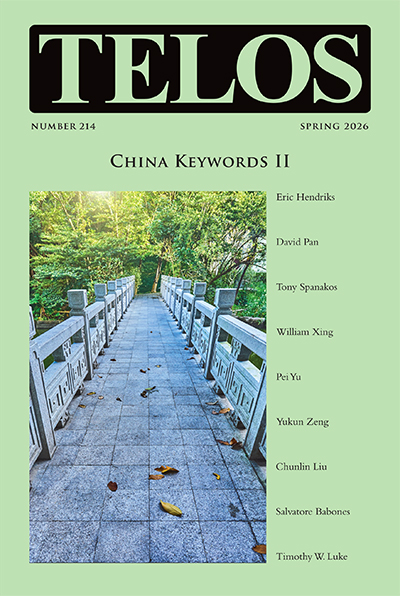
On March 21–22, 2025, the China Initiative convened its first conference at the John D. Calandra Italian American Institute at Queens College, CUNY. The conference was devoted to “China Keywords,” which also serves as the theme of this journal issue. Many of the contributions collected here are based on papers originally presented at the conference. A subsequent issue will likewise draw on conference presentations, but whereas that forthcoming volume will adopt a more cultural and societal focus, the present issue centers on keywords related to political philosophy and state governance.
Each essay in this issue addresses a specific keyword central to contemporary Chinese political thought and capable of serving as a critical vehicle for politico-social reflection. One exception is the contribution by Huimin Jin of Sichuan University, the keynote speaker at the New York conference, who engages not one but two closely related keywords: cultural self-confidence (文化自信) and cultural subjectivity (文化主体性). Both concepts form part of Xi Jinping Thought, the official state doctrine of the People’s Republic of China as of 2025. Jin, however, approaches these notions philosophically, uncovering beneath them a cultural self and a cultural subject, whose ontological substantiveness he mobilizes against the widespread assumption that cultural confidence and subjectivity necessarily imply defensive, reclusive, or chauvinistic nationalism. One need not become ultra-nationalist to be a full self, a full subject. On the contrary, Jin argues that genuine cultural confidence presupposes a robust self and subject—robust enough to remain open, to learn, and to engage in civilizational exchange. Strength, not closure, enables the absorption and transformation of external cultural resources.
Sikong Zhao reconstructs the conceptual genealogy of daobi (倒逼)—variously translated as “reverse force” or “reverse pressure”—as a distinctive feedback mechanism in the practice of Chinese party-state governance, as well as a category through which that system reflects on its interactions with society and the economy. Tracing its evolution from late-1980s academic debates to its incorporation into the official lexicon of the Chinese Communist Party, Zhao shows how daobi came to denote an immanent mode of critique and self-rectification. Rather than signifying mere obstruction or disgruntled pushback against policy, daobi, she explains, functions as a generative force that converts crisis into renewal. It thus marks a shift in China’s modernization strategy toward a proactive mode of governance that mobilizes internal feedback as an engine of positive transformation. General Secretary Xi Jinping even waxes lyrical about “the spirit of phoenix nirvana [凤凰涅槃].”
Ernest Ming-tak Leung reconstructs the historical and conceptual foundations of controls (統制) as a central category of modern Chinese technocracy. Rather than treating technocracy and economic planning as a Maoist aberration or a wholesale Soviet import, he directs attention to pre-1949 Guomindang debates, institutions, and personnel. Leung shows how a faith in design, expertise, and coordinated intervention already took shape in this earlier period and provided an institutional and intellectual groundwork that would later be carried forward, in different forms, in both the PRC’s socialist planning apparatus and Taiwan’s developmental state. Modern Chinese technocracy thus appears less as a post-1949 rupture than as the continuation of a longer project originating in the early twentieth century. This project is nothing less than “the rational organization of society through the planned reordering of the state.”
Henrique Schneider examines the evolution and persistence of state-owned enterprises (SOEs, 国有企业) as a defining feature of China’s contemporary economic order. Challenging the expectation that market reforms would marginalize state ownership, he shows how SOEs have instead adapted and consolidated their role, particularly under General Secretary Xi Jinping. Drawing on the framework of embedded agency, Schneider argues that Chinese SOEs are neither mere bureaucratic instruments nor simple market actors, but hybrid institutions that combine state control with strategic autonomy. Their persistence reflects a deliberate model of state capitalism in which market mechanisms are selectively deployed to sustain state authority over key economic levers, with implications reaching far beyond China itself.
Qi Zheng offers a critical anatomy of contemporary Chinese liberalism (中国自由主义) by examining its internal divisions and political ineffectiveness. Distinguishing among right-wing, Christian, and left-wing liberal intellectuals, she argues that none have succeeded in mounting a persuasive challenge to China’s authoritarian state. Right-wing and Christian liberals, she shows, tend to idealize American liberal democracy while misreading its internal crises, thereby inadvertently reinforcing official Chinese narratives of Western decline. Left-wing liberals, although more aware of America’s social problems, have proved unable to reshape public discourse in any sustained or meaningful way. The result, Zheng concludes, is a “failed fight”: a liberalism whose internal contradictions and external misperceptions have eroded its critical and political force.
This issue also includes two essays written in response to the special issue on postliberalism in Telos 212. Mark Kelly agrees with the postliberal critique of liberalism but argues that postliberalism does not present a significant departure from liberalism itself. Its main policy recommendation of promoting pluralism through neo-corporatism overestimates the ability of political programs to establish their intended outcomes. Though Kelly commends the postliberal project of creating a new orientation toward virtue that would limit unbridled desire, he argues that this goal can only make sense as an ethical stance rather than a political platform.
While also agreeing with the postliberal attempt to orient people’s lives around virtue and values, David Pan defends classical liberalism’s concentration on the rule of law and individual freedom as the best means of promoting this goal. In his view, the corporatist solutions offered by postliberals will tend to reinforce the oppressive aspects of existing institutions by preventing their dissolution and replacement by new organizations when they fail. The liberal solution would be to dismantle the administrative state that undermines the rule of law and limits the ability of individuals to make the decisions that would shape their lives.
Eric Hendriks reviews two polemical books on Chinese cosmopolitanism (世界主义): Ban Wang’s China in the World and Shuchen Xiang’s Chinese Cosmopolitanism. Both works challenge exclusivist Western claims to universality and the category of “world,” but they do so in sharply divergent ways. Hendriks contrasts Wang’s historically grounded reconstruction of Sino-socialist internationalism with Xiang’s essentialist, civilizational framing that rigidly opposes China and the West. “Academically and intellectually, Wang’s book is far superior.” Still, the review argues that both works are intellectually unsettling interventions that are worth your time.
Eric Hendriks, a Dutch sociologist and essayist, is Director of the China Initiative of the Telos–Paul Piccone Institute and a Visiting Fellow at the Danube Institute. He studies conceptions of globalization and world order from a cross-cultural perspective, with a particular focus on China’s relationship to the category “world.” He previously held research positions at the University of Bonn and Peking University.
David Pan is Professor of European Languages and Studies at the University of California, Irvine, and has previously held positions at Washington University in St. Louis, Stanford University, Penn State University, and McKinsey and Company. He is the author of Primitive Renaissance: Rethinking German Expressionism (2001) and Sacrifice in the Modern World: On the Particularity and Generality of Nazi Myth (2012). He has also published on J. G. Herder, Heinrich von Kleist, Friedrich Nietzsche, Franz Kafka, Walter Benjamin, Ernst Jünger, Bertolt Brecht, Carl Schmitt, and Theodor Adorno. He is the Editor of Telos.
1. For details, see Shaomin Li, The Rise of China, Inc.: How the Chinese Communist Party Transformed China into a Giant Corporation (Cambridge: Cambridge Univ. Press, 2022), pp. 202–18. For a summary of Li’s argument, see David Pan, “The Invisible Hand of the Chinese Communist Party,” Telos 199 (Summer 2022): 104.
2. Ian Johnson, Sparks: China’s Underground Historians and Their Battle for the Future (New York: Oxford Univ. Press, 2023).
3. Clear manifestations of this Western liberalism-centric imaginary of world politics can be found, for example, in the annual democracy indices produced by V-Dem (more left-liberal and social democratic in orientation) and the Economist Intelligence Unit (more right-liberal).
4. Li, The Rise of China, Inc., pp. 49–92.
5. Ibid., pp. 254–61.
6. For a description of this global phenomenon, see Adam K. Webb, “‘Oriental Despotism,’ Meritocracy, and the Fate of the Global New Class,” Telos 211 (Summer 2025): 9–31.
7. Carl Schmitt, The Nomos of the Earth in the International Law of the Jus Publicum Europaeum, trans. G. L. Ulmen (New York: Telos Press, 2006), pp. 351–55.