By Joseph van der Naald · Wednesday, December 3, 2014 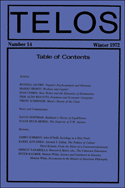 Mario Tronti’s postscript to the second edition of his publication Operai e Capitale, published in Telos in 1972 as “Workers and Capital,” provides the reader with a summation of his thought on the development of the “mass worker,” presented through an analysis of notable labor struggles across the Western world. Tronti’s methodology, which he briefly explicates at the beginning of the piece, delineates certain historical workers’ struggles in order to examine “macroscopic groups of facts yet untouched by the critical consciousness of labor thought” (25). His purpose is to yield “an historical model, a privileged period of research” (25) so as to better analyze the emergence of the autonomy of the working class engaged in a dialectical struggle with capital. Mario Tronti’s postscript to the second edition of his publication Operai e Capitale, published in Telos in 1972 as “Workers and Capital,” provides the reader with a summation of his thought on the development of the “mass worker,” presented through an analysis of notable labor struggles across the Western world. Tronti’s methodology, which he briefly explicates at the beginning of the piece, delineates certain historical workers’ struggles in order to examine “macroscopic groups of facts yet untouched by the critical consciousness of labor thought” (25). His purpose is to yield “an historical model, a privileged period of research” (25) so as to better analyze the emergence of the autonomy of the working class engaged in a dialectical struggle with capital.
Continue reading →
By Patrícia Vieira · Monday, December 1, 2014 Christopher Nolan’s Interstellar paints the portrait of a brave new time in the future when we will finally cut the shackles attaching us to our dying home planet and embrace our nomadic nature. Having turned the earth into a gigantic dust bowl, where the soil is increasingly barren and the air unbreathable, we will move on to greener pastures, in the shape of as yet unpolluted planets in faraway galaxies. After all, why shouldn’t planets be more like paper tissues—one soiled and tossed, another one already on the way?
Continue reading →
By Telos Press · Monday, December 1, 2014 For the month of December, save 20% on all Telos Press books purchased at our website. Now is a great time to pick up copies of some of our newest publications, including Matthias Küntzel’s Germany and Iran: From the Aryan Axis to the Nuclear Threshold and Joel Kotkin’s The New Class Conflict. In our online store you’ll also find key works by Ernst Jünger, such as On Pain and The Forest Passage, as well as Carl Schmitt’s Theory of the Partisan and The Nomos of the Earth. You can browse our full selection of books here.
Continue reading →
By Lukas Szrot · Tuesday, November 25, 2014 As Popper has written in several articles and his autobiography, he encountered Marxism as a young man in Austria around 1919. For two or three months he called himself a communist, but soon turned against the doctrine after the deaths of pro-communist demonstrators was justified with what Popper considered pseudo-scientific jargon. These events made him a fallibilist acutely aware of the distinction between dogmatic and critical thinking. (34)
 This emotionally powerful and philosophically significant experience colored Popper’s views of Marxism, the call for revolutionary social change, and the utopianism that foments it. In light of this, it is not difficult to see why Popper and (in particular early) Critical Theorists might have found much about which to disagree. Robert D’Amico discusses myriad points of contrast between Karl Popper and the Frankfurt School, though from the outset he acknowledges that the “infamous ‘methodology dispute’ in German sociology that occurred primarily between Popper and Adorno . . . is best described as a misfire” (33). Despite this alleged “misfire,” D’Amico’s analysis raises profound questions that continue to gain attention and prod ongoing debate in terms of the philosophy, theory, and methodology of the social sciences. This emotionally powerful and philosophically significant experience colored Popper’s views of Marxism, the call for revolutionary social change, and the utopianism that foments it. In light of this, it is not difficult to see why Popper and (in particular early) Critical Theorists might have found much about which to disagree. Robert D’Amico discusses myriad points of contrast between Karl Popper and the Frankfurt School, though from the outset he acknowledges that the “infamous ‘methodology dispute’ in German sociology that occurred primarily between Popper and Adorno . . . is best described as a misfire” (33). Despite this alleged “misfire,” D’Amico’s analysis raises profound questions that continue to gain attention and prod ongoing debate in terms of the philosophy, theory, and methodology of the social sciences.
Continue reading →
By Joseph van der Naald · Tuesday, November 18, 2014  Is humanity’s need to control nature ultimately working against us? Are the modern ecological crises we face today the inevitable result of the accelerating technologization of society? Can we conclude that what appears to be widespread anomie, as evidenced, for example, by the now almost monthly school shootings in the United States, and the genocidal totalitarian regimes of the twentieth century both have their “premises, dynamics, or preconditions” (169) in industrialization’s alienation of mankind from nature? In “Why Primitivism?” John Zerzan hopes to convince us that the answers to these questions are yes. Through a nuanced critique of both modernity and the thoughts of the twentieth and twenty-first centuries’ canonized intellectual Left, Zerzan draws the conclusion that we should look far back into human pre-history to find solutions to the problems that face humanity in the present. In this post, I will explore the primitivist position and provide a critique of Zerzan’s thought using Slavoj Žižek’s explorations into ecology’s ideological character. Is humanity’s need to control nature ultimately working against us? Are the modern ecological crises we face today the inevitable result of the accelerating technologization of society? Can we conclude that what appears to be widespread anomie, as evidenced, for example, by the now almost monthly school shootings in the United States, and the genocidal totalitarian regimes of the twentieth century both have their “premises, dynamics, or preconditions” (169) in industrialization’s alienation of mankind from nature? In “Why Primitivism?” John Zerzan hopes to convince us that the answers to these questions are yes. Through a nuanced critique of both modernity and the thoughts of the twentieth and twenty-first centuries’ canonized intellectual Left, Zerzan draws the conclusion that we should look far back into human pre-history to find solutions to the problems that face humanity in the present. In this post, I will explore the primitivist position and provide a critique of Zerzan’s thought using Slavoj Žižek’s explorations into ecology’s ideological character.
Continue reading →
By Telos Press · Monday, November 17, 2014 On The Agenda with Steve Paikin, Telos Associate Editor Adrian Pabst and others discuss the transformation of Germany since the Fall of the Berlin Wall, which took place twenty-five years ago this month, as well as Germany’s future as a dominant political and economic force in Europe.
Continue reading →
|
|