By Johanna K. Schenner · Wednesday, September 17, 2014  In “Franz Kafka in Eastern Europe,” Antonin J. Liehm addresses the impact of Kafka on both the communist literary sphere and the regime following the May 1963 Liblice Conference, an international symposium dealing with Kafka’s life and work. At first glance, this symposium does not appear to be remarkable: Kafka, known for such works as “The Metamorphosis” (1915) and “The Castle” (1926), was born in Prague in 1883, and he worked there as a lawyer before dying in 1924 in the sanatorium at Kierling, located in Klosterneuburg, Austria. Nonetheless, the symposium revealed that the socialist regimes were less totalitarian than supposed, if only for a short time, and it also attributed to Kafka a significant role in the beginning of cultural democratization, which then spread to other spheres. In “Franz Kafka in Eastern Europe,” Antonin J. Liehm addresses the impact of Kafka on both the communist literary sphere and the regime following the May 1963 Liblice Conference, an international symposium dealing with Kafka’s life and work. At first glance, this symposium does not appear to be remarkable: Kafka, known for such works as “The Metamorphosis” (1915) and “The Castle” (1926), was born in Prague in 1883, and he worked there as a lawyer before dying in 1924 in the sanatorium at Kierling, located in Klosterneuburg, Austria. Nonetheless, the symposium revealed that the socialist regimes were less totalitarian than supposed, if only for a short time, and it also attributed to Kafka a significant role in the beginning of cultural democratization, which then spread to other spheres.
Continue reading →
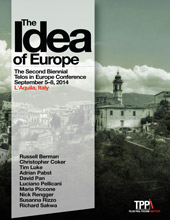
By Richard Sakwa · Monday, September 15, 2014 The following paper was presented at the recent Telos in Europe conference on “The Idea of Europe,” held in L’Aquila, Italy, on September 5–8, 2014.
 The Ukraine crisis reflected the continuation in new forms of what used to be called the East-West conflict. After the end of the Cold War in 1989–91, as a result of Mikhail Gorbachev’s attempt to reform the Soviet Union based on the ideas of the “new political thinking,” no inclusive and equitable peace system was established. Instead, an asymmetrical peace was imposed on Russia. The Soviet Union disintegrated in December 1991, and Russia emerged as the “continuer state,” assuming the burdens, treaty obligations, and nuclear responsibilities of the former USSR. As far as Russia was concerned, the end of the Cold War had been a shared victory: everyone stood to gain from the end of the division of Europe, symbolized by the fall of the Berlin Wall in November 1989. The institutions of the Cold War in the East were dismantled, above all the Warsaw Treaty Organization (the Warsaw Pact), but on the other side the organizations of the Cold War were extended, above all in the form of the North Atlantic Treaty Organization (NATO). The Ukraine crisis reflected the continuation in new forms of what used to be called the East-West conflict. After the end of the Cold War in 1989–91, as a result of Mikhail Gorbachev’s attempt to reform the Soviet Union based on the ideas of the “new political thinking,” no inclusive and equitable peace system was established. Instead, an asymmetrical peace was imposed on Russia. The Soviet Union disintegrated in December 1991, and Russia emerged as the “continuer state,” assuming the burdens, treaty obligations, and nuclear responsibilities of the former USSR. As far as Russia was concerned, the end of the Cold War had been a shared victory: everyone stood to gain from the end of the division of Europe, symbolized by the fall of the Berlin Wall in November 1989. The institutions of the Cold War in the East were dismantled, above all the Warsaw Treaty Organization (the Warsaw Pact), but on the other side the organizations of the Cold War were extended, above all in the form of the North Atlantic Treaty Organization (NATO).
Continue reading →
By Russell A. Berman · Monday, September 15, 2014 Telos 168 (Fall 2014) is now available for purchase in our store.
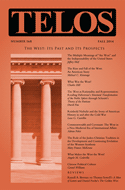 This special issue of Telos investigates the concept of the West. Far more than a geographical term, in intellectual, philosophical, and cultural history, it has been common to speak of a Western tradition in order to name lineages of thought from antiquity to the modern world. In cultural and political debates, Western values are invoked that are linked historically to a deep tradition specifically dedicated to desiderata such as freedom and individual dignity: at stake is the general possibility of any long-term tradition, the durability of culture over time, but also this very specific, distinctively Western tradition as the carrier of particular values. Politically this usage explains the reference to Western democracies (as opposed to the “peoples’ democracies” of the Soviet era) with the suggestion that democratic political forms and norms have emerged from the “Western tradition” and have generated the institutions of both liberal democracy, i.e., democratic procedures that assert popular sovereignty, while simultaneously protecting individual rights, and market economies shaped by the rule of law and the protection of private property. This special issue of Telos investigates the concept of the West. Far more than a geographical term, in intellectual, philosophical, and cultural history, it has been common to speak of a Western tradition in order to name lineages of thought from antiquity to the modern world. In cultural and political debates, Western values are invoked that are linked historically to a deep tradition specifically dedicated to desiderata such as freedom and individual dignity: at stake is the general possibility of any long-term tradition, the durability of culture over time, but also this very specific, distinctively Western tradition as the carrier of particular values. Politically this usage explains the reference to Western democracies (as opposed to the “peoples’ democracies” of the Soviet era) with the suggestion that democratic political forms and norms have emerged from the “Western tradition” and have generated the institutions of both liberal democracy, i.e., democratic procedures that assert popular sovereignty, while simultaneously protecting individual rights, and market economies shaped by the rule of law and the protection of private property.
Continue reading →
By Adrian Pabst · Thursday, September 11, 2014 The following paper was presented at the recent Telos in Europe conference on “The Idea of Europe,” held in L’Aquila, Italy, on September 5–8, 2014.
The continual crisis in Ukraine is perpetuating an East-West schism that was never overcome after the end of the Cold War. Even if there is no all-out war between the major powers involved in the Ukrainian conflict, Europe faces the distinct prospect of a permanent divide at its very heart. The EU increasingly looks like an annex to the United States, which oscillates between isolationism and interventionism. Meanwhile Russia is fast becoming a vassal state that supplies cheap resources to China. After more than 500 years at the center of international affairs, the whole of Europe is bereft of ideas and incapable of acting as a force for good.
Continue reading →
By Telos Press · Tuesday, September 9, 2014 Writing in today’s USA Today, Glenn Harlan Reynolds (aka Instapundit) reviews Joel Kotkin’s The New Class Conflict, just published by Telos Press. Order your copy in our online store.
 We’ve heard a lot of election-year class warfare talk, from makers vs. takers to the 1% vs. the 99%. But Joel Kotkin’s important new book, The New Class Conflict, suggests that America’s real class problems are deeper, and more damaging, than election rhetoric. We’ve heard a lot of election-year class warfare talk, from makers vs. takers to the 1% vs. the 99%. But Joel Kotkin’s important new book, The New Class Conflict, suggests that America’s real class problems are deeper, and more damaging, than election rhetoric.
Traditionally, America has been thought of as a place of great mobility—one where anyone can conceivably grow up to be president, regardless of background. This has never been entirely true, of course. Most of our presidents have come from reasonably well-off backgrounds, and even Barack Obama, a barrier-breaker in some ways, came from an affluent background and enjoyed an expensive private-school upbringing. But the problem Kotkin describes goes beyond shots at the White House. . . .
Continue reading →
By Telos Press · Tuesday, September 2, 2014 On the Liberty Law Talk podcast today, Joel Kotkin talks with host Richard Reinsch about The New Class Conflict, now available from Telos Press. It’s a smart, wide-ranging interview that covers many of the central issues Kotkin raises in his new book: the way that today’s high-tech oligarchy, unlike the early twenty-century industrial magnates, have amassed both financial and cultural power; the exacerbation of wealth inequality in places like California as a result of government bureaucratization; the consolidation of the media by coastal urban elites and the consequent effect on cultural perceptions; the control over both U.S. political parties by the wealthy and the resulting distortion of the democratic process; and a whole lot more.
Continue reading →
|
|