By Russell A. Berman · Wednesday, March 19, 2014 Telos 166 (Spring 2014) is now available for purchase in our store.
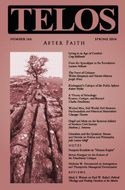 According to the secularization thesis, religious faith should have long ago disappeared, overwhelmed by the forces of progress. Yet while explicit membership in denominational communities is certainly less an obligatory feature of contemporary culture than it was a generation or two ago, modes of religion still play important roles in aspects of social life. This issue of Telos explores some of the ramifications of this afterlife of faith. According to the secularization thesis, religious faith should have long ago disappeared, overwhelmed by the forces of progress. Yet while explicit membership in denominational communities is certainly less an obligatory feature of contemporary culture than it was a generation or two ago, modes of religion still play important roles in aspects of social life. This issue of Telos explores some of the ramifications of this afterlife of faith.
Continue reading →
By Pablo Bustinduy · Tuesday, March 18, 2014 The following paper was presented at the Eighth Annual Telos Conference, held on February 15–16, 2014, in New York City.
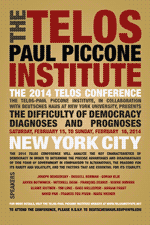 Two french communist authors recently devoted a book to an attempt at the systematic demolishment of the logic of democracy. What makes their gesture interesting is that their critique of democracy is made in the very name of autonomy, equality, and emancipation, that is, of the very principles that democracy is supposed to promote and uphold. One usually knows how to react to attacks on democracy coming from the other side, from those who ground their arguments in a celebration of some sort of hierarchy principle, those who deduce the political from an ontology of violence, or aim at naturalizing orders and political differences. In those cases there is usually not much to be said at all, because anti-democratic arguments are usually not recognized as belonging to the same conversation as democratic ones: when they are actually heard, anti-democratic arguments are usually subject to different logics of validation, enunciation and justification than democratic ones. This is for instance what the notion of extremism generally does: to locate a voice or an argument outside of the recognized universe of discourse, and hence somehow deprived of an equal standing, possibly subject to some version of the old Jacobin motto: “there shall be no freedom for the enemies of freedom.” The paradox is interesting in itself, because it betrays the presence of a certain politics of thought and speech that is already at work way before we get to discuss in a rational process the truths of political forms, and yet has substantial effects on what is heard (and not heard) in the supposedly transparent sphere of public discourse. It also forces us to recognize the recurring, foundational role of the limit, of the gesture that at the same time opens up and delimits the space of what is possible and what is acceptable, which is often overlooked or simplified in the context of democratic theory. Two french communist authors recently devoted a book to an attempt at the systematic demolishment of the logic of democracy. What makes their gesture interesting is that their critique of democracy is made in the very name of autonomy, equality, and emancipation, that is, of the very principles that democracy is supposed to promote and uphold. One usually knows how to react to attacks on democracy coming from the other side, from those who ground their arguments in a celebration of some sort of hierarchy principle, those who deduce the political from an ontology of violence, or aim at naturalizing orders and political differences. In those cases there is usually not much to be said at all, because anti-democratic arguments are usually not recognized as belonging to the same conversation as democratic ones: when they are actually heard, anti-democratic arguments are usually subject to different logics of validation, enunciation and justification than democratic ones. This is for instance what the notion of extremism generally does: to locate a voice or an argument outside of the recognized universe of discourse, and hence somehow deprived of an equal standing, possibly subject to some version of the old Jacobin motto: “there shall be no freedom for the enemies of freedom.” The paradox is interesting in itself, because it betrays the presence of a certain politics of thought and speech that is already at work way before we get to discuss in a rational process the truths of political forms, and yet has substantial effects on what is heard (and not heard) in the supposedly transparent sphere of public discourse. It also forces us to recognize the recurring, foundational role of the limit, of the gesture that at the same time opens up and delimits the space of what is possible and what is acceptable, which is often overlooked or simplified in the context of democratic theory.
Continue reading →
By Matt Applegate · Thursday, March 13, 2014 As an occasional feature on TELOSscope, we highlight a past Telos article whose critical insights continue to illuminate our thinking and challenge our assumptions. Today, Matt Applegate looks at Paul Piccone’s “Students’ Protest, Class-Structure, and Ideology” from Telos 3 (Spring 1969).
 Paul Piccone’s 1969 essay “Students’ Protest, Class-Structure, and Ideology” captures the revolutionary ethos of that time in the United States. Hippies, student politics, Black Power, as well as the work of such figures as Régis Debray and Herbert Marcuse all come under Piccone’s earnest critical consideration. His primary concern, however, is the link between these student revolts and the state of education in the United States. On the one hand, Piccone is intent on charting the means by which hyper-industrialization and the technologization of work lead to open student rebellion. On the other, he is interested in understanding why student rebellion is effective in relation to other forms of revolutionary organization that appear alongside it. Paul Piccone’s 1969 essay “Students’ Protest, Class-Structure, and Ideology” captures the revolutionary ethos of that time in the United States. Hippies, student politics, Black Power, as well as the work of such figures as Régis Debray and Herbert Marcuse all come under Piccone’s earnest critical consideration. His primary concern, however, is the link between these student revolts and the state of education in the United States. On the one hand, Piccone is intent on charting the means by which hyper-industrialization and the technologization of work lead to open student rebellion. On the other, he is interested in understanding why student rebellion is effective in relation to other forms of revolutionary organization that appear alongside it.
Continue reading →
By Artemy Magun · Tuesday, March 11, 2014 The ongoing take over of Crimea by Russia, and its intense political campaigning to annul the results of the Kiev revolution, took most observers of international politics by surprise. Normally, one has not been considering Russia as a serious contender of the United States for hegemony, as a country with serious economic or military resources, or even as a country with a particularly serious ideology. American and European political science has for decades been busy with “transitions to democracy” and the evaluation of their relative successes (even though there is a recent shift toward the study of authoritarianism), and in International Relations, China seemed to be the only possible opponent to U.S. unilateral hegemony. European Studies examines the various neighborhood policies of the European Union, measuring their relative success in “democratization.” The U.S. and European leaders therefore reacted to the events in Russia and Ukraine with surprise: John Kerry spoke of Russia’s “nineteenth-century behavior,” and Angela Merkel described Putin as being delusional, living “in another world.” This correctly describes the huge discrepancies in worldviews and values, but the views and values of Russian leadership, whether delusional or not, have very real effects, and therefore represent a repressed part of the reality about which the Western leaders do not want to think.
Continue reading →
By Telos Press · Sunday, March 9, 2014 Renewing the West by Renewing Common Sense
July 17–20, 2014
Huntington, Long Island, New York
Announcing a call for papers and plenary session panelists for an international congress to discuss the revolutionary proposal “Renewing the West by Renewing Common Sense”
Location: Seminary of the Immaculate Conception, 440 West Neck Road, Huntington, Long Island, NY 11743
Dates: Thursday afternoon July 17, 2014, to Sunday morning July 20, 2014
Continue reading →
By Beau Mullen · Friday, March 7, 2014 As an occasional feature on TELOSscope, we highlight a past Telos article whose critical insights continue to illuminate our thinking and challenge our assumptions. Today, Beau Mullen looks at Gabriella Slomp’s “Thomas Hobbes, Carl Schmitt, and the Event of Conscription” from Telos 147 (Summer 2009).
 As Gabriella Slomp points out in the opening of her article “Thomas Hobbes, Carl Schmitt, and the Event of Conscription,” scholars are split on how to view the relationship between Hobbes and Schmitt. Some see Schmitt as Hobbes’s heir apparent, while others think that Schmitt’s thinking is in fact a rejection of much of Hobbes’s work. Both thinkers emphasize man’s warlike nature, they hold that the state exists to protect men from violent death at the hands of other men, and they maintain that a strong state with unlimited power is best suited to this aim. Both agree that man has an obligation to the state that is reciprocal to the duty of the state to provide security. In this piece, Slomp examines both Schmitt’s and Hobbes’s views of the extent of this obligation and comes to the conclusion that the two are in fact in disagreement. Using their writings on conscription, Slomp reveals that Hobbes has much more concern for the sovereignty of the individual whereas Schmitt never wavers in his affording primacy to the group or state. As Gabriella Slomp points out in the opening of her article “Thomas Hobbes, Carl Schmitt, and the Event of Conscription,” scholars are split on how to view the relationship between Hobbes and Schmitt. Some see Schmitt as Hobbes’s heir apparent, while others think that Schmitt’s thinking is in fact a rejection of much of Hobbes’s work. Both thinkers emphasize man’s warlike nature, they hold that the state exists to protect men from violent death at the hands of other men, and they maintain that a strong state with unlimited power is best suited to this aim. Both agree that man has an obligation to the state that is reciprocal to the duty of the state to provide security. In this piece, Slomp examines both Schmitt’s and Hobbes’s views of the extent of this obligation and comes to the conclusion that the two are in fact in disagreement. Using their writings on conscription, Slomp reveals that Hobbes has much more concern for the sovereignty of the individual whereas Schmitt never wavers in his affording primacy to the group or state.
Continue reading →
|
|