By Telos Press · Monday, March 3, 2014 In celebration of Small Press Month, Telos Press is now offering a 20% discount on all books and all back issues of Telos purchased at our website during the month of March. It’s a great chance for you to catch up on our latest books, including Ernst Jünger’s The Forest Passage and The Adventurous Heart, as well our recent special issues on Italian Jews and Fascism, Politics After Metaphysics, and Hans Blumenberg.
Continue reading →
By Linas Jokubaitis · Tuesday, February 18, 2014 As an occasional feature on TELOSscope, we highlight a past Telos article whose critical insights continue to illuminate our thinking and challenge our assumptions. Today, Linas Jokubaitis looks at Paul Piccone and Gary Ulmen’s “Schmitt’s ‘Testament’ and the Future of Europe” from Telos 83 (Spring 1990).
 When Schmitt drafted his lecture “The Plight of European Jurisprudence” in 1944, he had reasons to believe that it would be his last lecture. After a failed assassination attempt on Hitler, his friend Johannes Popitz was arrested as an important conspirator in the plot and was later put to death. This is why the article by Paul Piccone and Gary Ulmen on this lecture is called “Schmitt’s ‘Testament’ and the Future of Europe.” The lecture did not prove to be Schmitt’s last. The irony is that what Schmitt wrote as his own testament can today be read as a testament of Europe. The validity of this claim depends only on how one views the current state of Europe. When Schmitt drafted his lecture “The Plight of European Jurisprudence” in 1944, he had reasons to believe that it would be his last lecture. After a failed assassination attempt on Hitler, his friend Johannes Popitz was arrested as an important conspirator in the plot and was later put to death. This is why the article by Paul Piccone and Gary Ulmen on this lecture is called “Schmitt’s ‘Testament’ and the Future of Europe.” The lecture did not prove to be Schmitt’s last. The irony is that what Schmitt wrote as his own testament can today be read as a testament of Europe. The validity of this claim depends only on how one views the current state of Europe.
Continue reading →
By Vincent Lloyd · Thursday, February 13, 2014 Vincent Lloyd’s “Marcuse the Lover” appears in Telos 165 (Winter 2013). Read the full version online at the Telos Online website, or purchase a print copy of the issue in our store.
 Why has Marcuse’s fame faded? I argue that the answer has to do with the way secularism and critical theory do and do not interact in the contemporary academy. We can read Marcuse as a critic of secularism, when secularism is understood as one of the ideas of the ruling class, taking its current form with the rise of identity politics in the 1960s and 70s. Marcuse criticizes the secularizing features of the Protestant Reformation, much like other recent critics of secularism. Further, he seeks to recover a deeper sense of freedom—what might be called a post-secular sense of freedom. In doing so, he appeals to the good, the true, the beautiful, and, in a way, to rightly ordered love. I read Marcuse fundamentally as a critic of idolatry, as a negative political theologian. His work suggests a promising path for conversations about critical theory and secularism to come together. Why has Marcuse’s fame faded? I argue that the answer has to do with the way secularism and critical theory do and do not interact in the contemporary academy. We can read Marcuse as a critic of secularism, when secularism is understood as one of the ideas of the ruling class, taking its current form with the rise of identity politics in the 1960s and 70s. Marcuse criticizes the secularizing features of the Protestant Reformation, much like other recent critics of secularism. Further, he seeks to recover a deeper sense of freedom—what might be called a post-secular sense of freedom. In doing so, he appeals to the good, the true, the beautiful, and, in a way, to rightly ordered love. I read Marcuse fundamentally as a critic of idolatry, as a negative political theologian. His work suggests a promising path for conversations about critical theory and secularism to come together.
Continue reading →
By Matt Applegate · Tuesday, February 11, 2014 As an occasional feature on TELOSscope, we highlight a past Telos article whose critical insights continue to illuminate our thinking and challenge our assumptions. Today, Matt Applegate looks at André Gorz’s “The Tyranny of the Factory: Today and Tomorrow” from Telos 16 (Summer 1973).
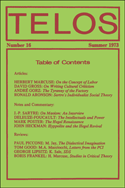 “There is a link between the crisis of School (school instruction) and the crisis of tyranny in the factory,” André Gorz proclaims in his 1973 article “The Tyranny of the Factory: Today and Tomorrow” (64). An Austrian-born social theorist, Gorz is known primarily for his interventions in political ecology and social analysis of capitalism. His focus on capital and education is not unrelated here, however. Substantively more than an abstract analysis of working conditions in the contemporary factory or a sweeping statement concerning the state of education in France, Gorz links the culture of factory labor to the imperatives of discipline and command in educational settings. The underlying claim here is that the logic of capitalism and the raison d’être of state-run education have become synonymous, resulting in both an auto-social response to capital’s hegemony in all forms of life and the elimination of pedagogical forms that inspire critical thought and practice. With this claim, at least three points of focus must be highlighted. “There is a link between the crisis of School (school instruction) and the crisis of tyranny in the factory,” André Gorz proclaims in his 1973 article “The Tyranny of the Factory: Today and Tomorrow” (64). An Austrian-born social theorist, Gorz is known primarily for his interventions in political ecology and social analysis of capitalism. His focus on capital and education is not unrelated here, however. Substantively more than an abstract analysis of working conditions in the contemporary factory or a sweeping statement concerning the state of education in France, Gorz links the culture of factory labor to the imperatives of discipline and command in educational settings. The underlying claim here is that the logic of capitalism and the raison d’être of state-run education have become synonymous, resulting in both an auto-social response to capital’s hegemony in all forms of life and the elimination of pedagogical forms that inspire critical thought and practice. With this claim, at least three points of focus must be highlighted.
Continue reading →
By Telos Press · Monday, February 10, 2014 Don’t forget: the Eighth Annual Telos Conference will be held this upcoming weekend, February 15–16, 2014, in New York City. Registration is now closed, but if you are still interested in attending the conference, please RSVP to deutscheshaus.rsvp@nyu.edu. Please note that some of the talks are limited to registered attendees only.
Additional details about the conference, as well as the complete conference program, are available at the Telos-Paul Piccone Institute website.
We look forward to seeing you this weekend!
Continue reading →
By Caroline Edwards · Thursday, February 6, 2014 Caroline Edwards’s “From Eros to Eschaton: Herbert Marcuse’s Liberation of Time” appears in Telos 165 (Winter 2013). Read the full version online at the Telos Online website, or purchase a print copy of the issue in our store.
This article explores what Gershom Scholem has called Herbert Marcuse’s “unacknowledged ties to [his] Jewish heritage.” At the core of Marcuse’s vision of transformed, non-repressive social relations, I argue, is a struggle over time, which rests upon a distinctly Jewish approach to the twin questions of remembrance and redemption. One example of this approach is the temporal dialectic between alienated labor time and the timelessness of pleasure’s desire for eternity, which underpins Marcuse’s analysis in Eros and Civilization (1956). This dialectic rests upon Marcuse’s reading of the Freudian Eros-Todestrieb dualism, whose phylogenetic reading of patricide has been read by critics as reformulating the biblical rebellion against an authoritarian Yahweh.
Continue reading →
|
|