By Christian Kronsted · Tuesday, August 13, 2013 As an occasional feature on TELOSscope, we highlight a past Telos article whose critical insights continue to illuminate our thinking and challenge our assumptions. Today, Christian Kronsted looks at Lowell A. Dunlap’s “Hume, James, and Husserl on the Self,” from Telos 2 (Fall 1968).
 With the publication of A Treatise Of Human Nature, David Hume turned the philosophical community of his time upside down with his provocative skepticism and denial of a cohesive self. Since its initial publication, Hume’s claim that the self is nothing but a bundle of perceptions has plagued philosophers and psychologists alike, and has inspired many to completely abandon the idea of a coherent self. Yet a central question remains largely unanswered: if there is not a self, what is doing the thinking, and how is it done? If a person does not have a “self,” how come human beings think of themselves as unique and separate entities that have subjective experiences? Lowell A. Dunlap’s article “Hume, James, and Husserl on the Self” investigates how William James and Edmund Husserl tackled the notion of personal identity in the aftermath of Hume’s philosophy. With the publication of A Treatise Of Human Nature, David Hume turned the philosophical community of his time upside down with his provocative skepticism and denial of a cohesive self. Since its initial publication, Hume’s claim that the self is nothing but a bundle of perceptions has plagued philosophers and psychologists alike, and has inspired many to completely abandon the idea of a coherent self. Yet a central question remains largely unanswered: if there is not a self, what is doing the thinking, and how is it done? If a person does not have a “self,” how come human beings think of themselves as unique and separate entities that have subjective experiences? Lowell A. Dunlap’s article “Hume, James, and Husserl on the Self” investigates how William James and Edmund Husserl tackled the notion of personal identity in the aftermath of Hume’s philosophy.
Continue reading →
By Jörg Friedrichs · Thursday, August 8, 2013 Jörg Friedrichs’s “Global Islamism and World Society” appears in Telos 163 (Summer 2013). Read the full version online at the Telos Online website, or purchase a print copy of the issue in our store.
 The piece is an eye-opener on contestation between global Islamism and cosmopolitan world society. It develops a comprehensive understanding of the former as the communitarian mirror image of the latter. Global Islamism and cosmopolitan world society are presented as varieties of globalization. The objective is to understand global Islamism as a political project and to assess its chances of successfully competing against cosmopolitan world society. This is accomplished by a comparative assessment of the degree to which either of them can achieve social integration, which is a prerequisite for the success of any political project. World society thrives on established forms of political and legal integration, and is buttressed by integration via functional subsystems. Global Islamism relies on the expectation of strong communal engagement and the unapologetic exclusion of dissidents and outsiders. It turns out that global Islamism’s bolder discriminatory practices are a two-edged sword because they also lead to internal divisions, and that global Islamism is not stronger than world society with regard to sociability. Insofar as the integration of Muslims into a universal community of believers is even more utopian than the realization of cosmopolitan world society, global Islamism is at a serious competitive disadvantage and thus bound to be frustrated. Until that happens, conflict between global Islamism and world society will continue to pose significant challenges. It is hoped that these challenges may be better managed when both are recognized as rival globalization projects, and when their mutual incompatibilities are acknowledged. The piece is an eye-opener on contestation between global Islamism and cosmopolitan world society. It develops a comprehensive understanding of the former as the communitarian mirror image of the latter. Global Islamism and cosmopolitan world society are presented as varieties of globalization. The objective is to understand global Islamism as a political project and to assess its chances of successfully competing against cosmopolitan world society. This is accomplished by a comparative assessment of the degree to which either of them can achieve social integration, which is a prerequisite for the success of any political project. World society thrives on established forms of political and legal integration, and is buttressed by integration via functional subsystems. Global Islamism relies on the expectation of strong communal engagement and the unapologetic exclusion of dissidents and outsiders. It turns out that global Islamism’s bolder discriminatory practices are a two-edged sword because they also lead to internal divisions, and that global Islamism is not stronger than world society with regard to sociability. Insofar as the integration of Muslims into a universal community of believers is even more utopian than the realization of cosmopolitan world society, global Islamism is at a serious competitive disadvantage and thus bound to be frustrated. Until that happens, conflict between global Islamism and world society will continue to pose significant challenges. It is hoped that these challenges may be better managed when both are recognized as rival globalization projects, and when their mutual incompatibilities are acknowledged.
Continue reading →
By Robert Wyllie · Tuesday, July 30, 2013 As an occasional feature on TELOSscope, we highlight a past Telos article whose critical insights continue to illuminate our thinking and challenge our assumptions. Today, Robert Wyllie looks at Richard Faber’s “The Rejection of Political Theology: A Critique of Hans Blumenberg,” from Telos 72 (Summer 1987).
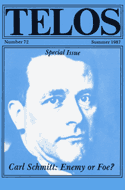 In “The Rejection of Political Theology: A Critique of Hans Blumenberg,” Richard Faber reconstructs two alternatives to Carl Schmitt’s political theology. Faber draws the first alternative from Hans Blumenberg. Blumenberg, whose later work explores how metaphor orients thought, proposes a “polytheistic” alternative to “monotheistic” political theology. Polytheism is an early modern metaphor for plural sovereignty, underlying the checks and balances of liberalism. Sympathetically, Blumenberg believes a polytheistic political theology turns away from Schmitt’s “monotheistic” picture of sovereignty where one sovereign decides the state of exception. After expositing Blumenberg’s polytheistic political theology, Faber rejects it. Instead, he turns to Walter Benjamin’s eschatological political theology. Monotheists have been promised an apocalypse, a violent divine intervention, to restore justice in the future. Unlike the Schmittian state of exception, this hoped-for intervention would ground no new legal constitution. Benjamin radicalizes the state of exception into the “pure violence” of a Marxist revolution aimed at destroying the political state altogether. In “The Rejection of Political Theology: A Critique of Hans Blumenberg,” Richard Faber reconstructs two alternatives to Carl Schmitt’s political theology. Faber draws the first alternative from Hans Blumenberg. Blumenberg, whose later work explores how metaphor orients thought, proposes a “polytheistic” alternative to “monotheistic” political theology. Polytheism is an early modern metaphor for plural sovereignty, underlying the checks and balances of liberalism. Sympathetically, Blumenberg believes a polytheistic political theology turns away from Schmitt’s “monotheistic” picture of sovereignty where one sovereign decides the state of exception. After expositing Blumenberg’s polytheistic political theology, Faber rejects it. Instead, he turns to Walter Benjamin’s eschatological political theology. Monotheists have been promised an apocalypse, a violent divine intervention, to restore justice in the future. Unlike the Schmittian state of exception, this hoped-for intervention would ground no new legal constitution. Benjamin radicalizes the state of exception into the “pure violence” of a Marxist revolution aimed at destroying the political state altogether.
Continue reading →
By Danilo Breschi · Thursday, July 25, 2013 Danilo Breschi’s “From Politics to Lifestyle and/or Anti-Politics: Political Culture and the Sense for the State in Post-Communist Italy” appears in Telos 163 (Summer 2013). Read the full version online at the Telos Online website, or purchase a print copy of the issue in our store.
In Italy, the transition from communism to post-communism, from the PCI to today’s Democratic Party, has been determined and strongly influenced not only by the collapse of ideologies and by the changes in the international political scene after 1989, but also by the profound changes that have invested the customs, lifestyles, and collective mentality from the end of the 1960s and, ever more rapidly, from the 1970s. Mass individualism and consumer society are the factors that more than others have undermined the myth of the anthropological “diversity” and the claim to moral superiority cultivated for decades by the Italian communists. Moreover, they help explain the passage of many of them from the utopia revolutionary and the dream of a “new world” to the liberal-bourgeois radicalism that seems to characterize today’s Italian left. Is there anything left of the communist tradition in today’s Italian political and cultural scenario? There is probably one attitude shared by many Communist militants but that belongs to the entire Italian political tradition, i.e., the deeply rooted aversion to public institutions and a poor sense of the state as embodying the rule of law. The greatest and most negative legacy of the long hegemony, on the left, of a communist party narrowly loyal to the Soviet Union was and still is the lack of legitimacy of the state and its institutions. The Soviet experiment having failed, there remains a populist cultural capital that has passed on to the Lega Nord in the 1990s and that has recently migrated to the Five Stars Movement of Beppe Grillo.
Continue reading →
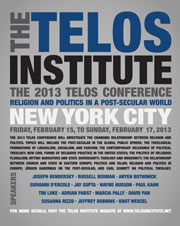
By Geneviève Pigeon · Friday, July 19, 2013 The following paper was presented at the Seventh Annual Telos Conference, held on February 15–17, 2013, in New York City.
 Province of Québec’s territory is vast, and much of it has been left in what could be considered a “natural” state. Today’s paper will focus on one particular region called Abitibi-Témiscamingue, located on the west side of the province, but north of Montreal (which is why we usually refer to it as a northern area). Province of Québec’s territory is vast, and much of it has been left in what could be considered a “natural” state. Today’s paper will focus on one particular region called Abitibi-Témiscamingue, located on the west side of the province, but north of Montreal (which is why we usually refer to it as a northern area).
Abitibi-Témiscamingue has been occupied for more than 8000 years, with the latest occupants being the Algonquins (the Abitibi and the Témiscamingue being the two main groups of Natives living there when Europeans arrived). While their presence has been known since the first French merchants came in the 1700s to trade fur, it is only around 1837–38 that Montreal’s Bishop decided to “take care” of these poor souls and sent missionaries to convert them. In 1863, the Oblate missionaries founded a permanent mission and from there, travelled the entire territory.
Continue reading →
By Jens-Martin Eriksen · Thursday, July 18, 2013 Jens-Martin Eriksen’s “Culturalism: When the Culture becomes Political Ideology” appears in Telos 163 (Summer 2013). Read the full version online at the Telos Online website, or purchase a print copy of the issue in our store. Eriksen and Stjernfelt’s The Democratic Contradictions of Multiculturalism is also available here.
The political critique of modernity has gained momentum in Europe in recent years. It is a diverse movement, encompassing populist nationalist and national-conservative parties in Western Europe, a fascistoid Christian-nationalist revival—and on the opposite side: Islamism and the people they instrumentalize, the multiculturalists. They all agree that politics should focus primarily on culture and religion, and all other fields of operation depend on these aspects being stable and undisturbed and not influenced by other trends in society. The dogma that individuals from different groups should not mix is widely accepted and a de facto apartheid is more or less implemented in Western Europe by the civil society. The physical segregation in the cities and in public schools is a fact. The political power play is for the moment over signs and political symbols—e.g., the referendum in Switzerland about the prohibition of minarets, the ban on religions symbols in public schools in France, and other initiatives. The Left seems dazed and confused in this battle and unable to calibrate how to meet the challenge.
Continue reading →
|
|