By Michael Millerman · Tuesday, July 16, 2013 As an occasional feature on TELOSscope, we highlight a past Telos article whose critical insights continue to illuminate our thinking and challenge our assumptions. Today, Michael Millerman looks at Luigi Marco Bassani’s “The Bankruptcy of the Republican School,” from Telos 124 (Summer 2002).
 Luigi Marco Bassani’s essay “The Bankruptcy of the Republican School” (2002) consists of an overview of the conflict in American historiography between two schools of thought. The first—Lockean liberalism—insists that America was founded on principles that recognize an abstract, natural right to life, liberty, property, and the pursuit of one’s private happiness. These natural rights are liberties that define a private sphere, to be protected from government interference. By contrast, the second school proclaims that not Lockean liberalism, but rather republicanism informed the Founders’ vision of what America is and should be. Republicanism elevates such notions as “the common good” and “the public sphere” above those of “individual liberties” and “private happiness.” Indeed, it can justify infringing on the latter for the sake of the former. Hence, it is in conflict with Lockean liberalism. Luigi Marco Bassani’s essay “The Bankruptcy of the Republican School” (2002) consists of an overview of the conflict in American historiography between two schools of thought. The first—Lockean liberalism—insists that America was founded on principles that recognize an abstract, natural right to life, liberty, property, and the pursuit of one’s private happiness. These natural rights are liberties that define a private sphere, to be protected from government interference. By contrast, the second school proclaims that not Lockean liberalism, but rather republicanism informed the Founders’ vision of what America is and should be. Republicanism elevates such notions as “the common good” and “the public sphere” above those of “individual liberties” and “private happiness.” Indeed, it can justify infringing on the latter for the sake of the former. Hence, it is in conflict with Lockean liberalism.
Continue reading →
By Reem Bassiouney · Thursday, July 11, 2013 Reem Bassiouney’s “Language and Revolution in Egypt” appears in Telos 163 (Summer 2013). Read the full version online at the Telos Online website, or purchase a print copy of the issue in our store.
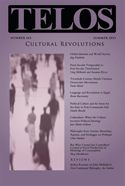 Based on the assumption that language is a social resource, this article contends that during political conflicts, issues of linguistic resources and access to them are disputed. Issues of inclusion and exclusion are predominant. Note that Egypt is a diglossic community, a community in which two language varieties exist each with a different function. Examples are drawn from Egyptian media directly before, during, and after the revolution of January 25, 2011. Two newspaper articles are analyzed in detail, as well as additional material from TV talk shows, films, Facebook pages, and poetry. The first section in this article outlines how linguists in the Arab world at large, and in Egypt in particular, have referred to the diglossic situation to explain and justify negative social and political phenomena, especially the lack of democracy. Section two discusses examples of linguistic manipulation that took place during the revolution and in which the Egyptian state media attempted to cast doubt on the identity and motivations of the protestors in Tahrir Square. The conflict was not one sided, and the Tahrir Square protestors counterattacked the state media through poetry and other means. The main contribution of this section is to show how the diglossic situation is used after the revolution to lay claims on political legitimacy and credibility of the revolutionaries rather than the pro-Mubarak group. In a final section, the concept of linguistic unrest is introduced and defined. Based on the assumption that language is a social resource, this article contends that during political conflicts, issues of linguistic resources and access to them are disputed. Issues of inclusion and exclusion are predominant. Note that Egypt is a diglossic community, a community in which two language varieties exist each with a different function. Examples are drawn from Egyptian media directly before, during, and after the revolution of January 25, 2011. Two newspaper articles are analyzed in detail, as well as additional material from TV talk shows, films, Facebook pages, and poetry. The first section in this article outlines how linguists in the Arab world at large, and in Egypt in particular, have referred to the diglossic situation to explain and justify negative social and political phenomena, especially the lack of democracy. Section two discusses examples of linguistic manipulation that took place during the revolution and in which the Egyptian state media attempted to cast doubt on the identity and motivations of the protestors in Tahrir Square. The conflict was not one sided, and the Tahrir Square protestors counterattacked the state media through poetry and other means. The main contribution of this section is to show how the diglossic situation is used after the revolution to lay claims on political legitimacy and credibility of the revolutionaries rather than the pro-Mubarak group. In a final section, the concept of linguistic unrest is introduced and defined.
Continue reading →
By Johanna K. Schenner · Tuesday, July 2, 2013 As an occasional feature on TELOSscope, we highlight a past Telos article whose critical insights continue to illuminate our thinking and challenge our assumptions. Today, Johanna Schenner looks at Federico Stame’s “The Crisis of the Left and New Social Identities,” from Telos 60 (Summer 1984).
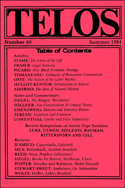 In “The Crisis of the Left and New Social Identities” (1984), Federico Stame addresses the problems encountered by left-wing ideologies and political parties, such as the banality of their demands, as well as deeper underlying issues, such as the falling away of the friend-foe nexus in politics. He also provides hope for improvement by invoking the leading role of new social identities in renewing the tradition of the political Left. In “The Crisis of the Left and New Social Identities” (1984), Federico Stame addresses the problems encountered by left-wing ideologies and political parties, such as the banality of their demands, as well as deeper underlying issues, such as the falling away of the friend-foe nexus in politics. He also provides hope for improvement by invoking the leading role of new social identities in renewing the tradition of the political Left.
Continue reading →
By Russell A. Berman · Monday, June 24, 2013 Telos 163 (Summer 2013) is now available for purchase in our store.
Profound change in society may involve shifting control of political power, the character of economic systems, or access to resources, but it can also have to do with the structures of meaning we bundle together in various understandings of culture. This issue of Telos looks at the explosive forces located specifically in the intangible dimensions of culture and how they may play out in revolutionary or counter-revolutionary processes.
Continue reading →
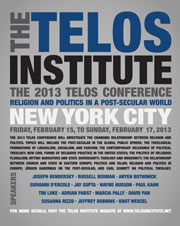
By Daniel Wong · Friday, June 21, 2013 The following paper was presented at the Seventh Annual Telos Conference, held on February 15–17, 2013, in New York City.
 Flush with optimism following the end of the Cold War, many American and European scholars openly speculated about the possibilities of a Kantian perpetual peace, returning with renewed vigor to theories of cosmopolitanism. As Amanda Anderson has put it, such cosmopolitanism “endorses reflective distance from one’s cultural affiliations, a broad understanding of other cultures and customs, and a belief in universal humanity.” Indeed, recent developments in communication technology, combined with a proliferation of transnational migrations, have made it possible to truly imagine and experience “navigating beyond one’s state.” Flush with optimism following the end of the Cold War, many American and European scholars openly speculated about the possibilities of a Kantian perpetual peace, returning with renewed vigor to theories of cosmopolitanism. As Amanda Anderson has put it, such cosmopolitanism “endorses reflective distance from one’s cultural affiliations, a broad understanding of other cultures and customs, and a belief in universal humanity.” Indeed, recent developments in communication technology, combined with a proliferation of transnational migrations, have made it possible to truly imagine and experience “navigating beyond one’s state.”
Continue reading →
By Telos Press · Monday, June 17, 2013 The Difficulty of Democracy: Diagnoses and Prognoses
February 14–16, 2014
New York
In spite of its advantages as an ideal form of government, democracy has proven to be remarkably difficult to establish and to maintain in reality. While it remained a rare exception for much of human history, its spread in the modern world has not had the character of a triumphant march but rather of a tortured path dominated by failed attempts, transformations into dictatorship, and degenerations into civil war. Even the most successful cases, Great Britain, France, and the United States, were marked by a concurrence of the rise of democratic institutions with an imperialist expansion that created a de facto hierarchy of citizens and non-citizens familiar also in ancient Athens. The purpose of the Eighth Annual Telos conference will be to analyze the key characteristics of democracy in order to determine, first, the precise advantages and disadvantages of this form of government in comparison to alternatives, second, the reasons for its rarity and volatility, and, third, the factors that are essential for its stability. We welcome paper submissions that address issues such as classical and modern theories of democracy, case studies of successful or failed democracies around the world, antinomies and conflicts within established democracies, revolutionary movements as progenitors of democracy, degeneration of democracies into other forms of government, the importance of culture and representation for founding and maintaining democracy, and the economic requirements and consequences of democracy. Please send an abstract and short c.v. to dtpan@uci.edu by August 31, 2013.
Continue reading →
|
|