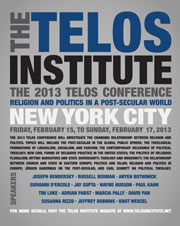
By Michael Barnes Norton · Friday, June 14, 2013 The following paper was presented at the Seventh Annual Telos Conference, held on February 15–17, 2013, in New York City.
 Despite the modern investment in the secularization of the political realm, religious discourse and concepts continue to inhabit it both explicitly and implicitly. Indeed, it should perhaps by now go without saying that the very idea of secularization or secularity has itself never been free of certain religious or theological determinations. This fact continues to present one of the most striking challenges to the very project of secularization, but alongside this, and of a piece with it, there have recently emerged with ever greater frequency and visibility examples of what we can understand as a breakdown in the basic functionality of religious discourse itself. On the one hand, those of us who wish to remain “tolerant” often experience nearly paralyzing reservations about speaking religiously in public contexts; on the other hand, there are those who exhibit a rash willingness to bring religious vocabulary into any discussion and even to oppose speech that does not employ such vocabulary solely based on this lack. Despite the modern investment in the secularization of the political realm, religious discourse and concepts continue to inhabit it both explicitly and implicitly. Indeed, it should perhaps by now go without saying that the very idea of secularization or secularity has itself never been free of certain religious or theological determinations. This fact continues to present one of the most striking challenges to the very project of secularization, but alongside this, and of a piece with it, there have recently emerged with ever greater frequency and visibility examples of what we can understand as a breakdown in the basic functionality of religious discourse itself. On the one hand, those of us who wish to remain “tolerant” often experience nearly paralyzing reservations about speaking religiously in public contexts; on the other hand, there are those who exhibit a rash willingness to bring religious vocabulary into any discussion and even to oppose speech that does not employ such vocabulary solely based on this lack.
Continue reading →
By Robert Wyllie · Tuesday, June 11, 2013 As an occasional feature on TELOSscope, we highlight a past Telos article whose critical insights continue to illuminate our thinking and challenge our assumptions. Today, Robert Wyllie looks at Luciano Pellicani’s “Weber and the Myth of Calvinism,” from Telos 75 (Spring 1988).
 In his exchange with Adrian Pabst in Telos 162, Luciano Pellicani argues that the United States’ constitutional founding comes “in clear opposition to the theocratic model of the Puritan Fathers” (160). The Founding Fathers’ radical commitment to the Enlightenment, Pellicani claims, was the opening salvo in the contemporary culture war still raging in America. On one side there has always been the “commercial society ruled by a wealthy bourgeoisie” (155) aligned with the Enlightenment critique of religion (the deism of Paine and Jefferson) behind a secular constitution. On the other side is a populist religious opposition to the Constitution. The medieval and theocratic spirit of the Puritans, Pellicani explains, runs through the eighteenth-century Great Awakening all the way to the modern Christian Coalition. Pabst’s counter-argument proposes that Pellicani’s argument “is all too Protestant in its divorce of rationality from belief” (171). According to Pabst, Calvinism contributed decisively to the secularization of European society and the growth of North American capitalism (166). Pellicani’s hostility to this thesis has a long history in the pages of Telos. In his exchange with Adrian Pabst in Telos 162, Luciano Pellicani argues that the United States’ constitutional founding comes “in clear opposition to the theocratic model of the Puritan Fathers” (160). The Founding Fathers’ radical commitment to the Enlightenment, Pellicani claims, was the opening salvo in the contemporary culture war still raging in America. On one side there has always been the “commercial society ruled by a wealthy bourgeoisie” (155) aligned with the Enlightenment critique of religion (the deism of Paine and Jefferson) behind a secular constitution. On the other side is a populist religious opposition to the Constitution. The medieval and theocratic spirit of the Puritans, Pellicani explains, runs through the eighteenth-century Great Awakening all the way to the modern Christian Coalition. Pabst’s counter-argument proposes that Pellicani’s argument “is all too Protestant in its divorce of rationality from belief” (171). According to Pabst, Calvinism contributed decisively to the secularization of European society and the growth of North American capitalism (166). Pellicani’s hostility to this thesis has a long history in the pages of Telos.
Continue reading →
By Telos Press · Monday, June 10, 2013 Telos editor Russell A. Berman has received the Lloyd W. Dinkelspiel Award for Distinctive Contributions to Undergraduate Education at Stanford University. This award, named after the president of the Board of Trustees who served from 1953 to 1958, recognizes distinctive contributions to undergraduate education or to the quality of student life.
Berman is the Walter A. Haas Professor in the Humanities at Stanford University, a professor of comparative literature and German Studies, and a senior fellow at the Hoover Institution. He was honored “for more than three decades of excellence as a teacher and scholar at Stanford and as a national voice, working to re-envision humanities education in this time of transition.”
Continue reading →
By Adrian Pabst · Wednesday, May 29, 2013 Adrian Pabst’s “Athens, Jerusalem, and Rome: A Reply to Luciano Pellicani” appears in Telos 162 (Spring 2013). Read the full version online at the Telos Online website, or purchase a print copy of the issue in our store.
 According to Luciano Pellicani, the U.S. culture wars are grounded in a perpetual struggle between the enlightening forces of reason and democracy, on the one hand, and the dark forces of faith and theocracy, on the other hand. Accordingly, he claims that the Puritans sought to establish a medieval collectivist theocracy, not a modern market democracy, and that the U.S. “culture war” between enlightened secular liberalism and reactionary religious conservatism ultimately rests on the perpetual battle between Athenian reason and the faith of Jerusalem. According to Luciano Pellicani, the U.S. culture wars are grounded in a perpetual struggle between the enlightening forces of reason and democracy, on the one hand, and the dark forces of faith and theocracy, on the other hand. Accordingly, he claims that the Puritans sought to establish a medieval collectivist theocracy, not a modern market democracy, and that the U.S. “culture war” between enlightened secular liberalism and reactionary religious conservatism ultimately rests on the perpetual battle between Athenian reason and the faith of Jerusalem.
Continue reading →
By Maria Piccone · Friday, May 24, 2013 Happy 45th anniversary Telos! It’s been a long road, and we’re still going strong, thanks to the loyalty of our Telos readers. For our institutional subscribers, we want to offer you a 30% discount on our backfiles: your institution can have online access to decades of Telos discussions and debates. Ask your library to carry the online archive, a great way for readers to explore intellectual life since 1968.
Continue reading →
By Steven Knepper · Wednesday, May 22, 2013 Steven Knepper’s “Seeing the Countryside: Behind the Pastoral and Progressivist Veils” appears in Telos 162 (Spring 2013). Read the full version online at the Telos Online website, or purchase a print copy of the issue in our store.
Building upon the work of Raymond Williams, this essay questions the lack of critical scrutiny given to the countryside and its cash crop monocultures. It holds that simple narratives of decline and progress contribute to this strange invisibility. Simple narratives of decline often contrast an idealized countryside and an insidious city, drawing a pastoral veil over the problems and economics of the actual working countryside. Simple narratives of progress often suggest that we have left the countryside behind entirely. When they do acknowledge continuing agricultural realities, they display what Vandana Shiva calls a “monoculture of the mind.” They present contemporary agribusiness as the only way to feed the world, thereby deflecting critical attention. In order to truly see the countryside and its centrality to modernity, this essay suggests we must draw back the pastoral and progressivist veils.
Continue reading →
|
|