By Telos Press · Monday, June 10, 2013 Telos editor Russell A. Berman has received the Lloyd W. Dinkelspiel Award for Distinctive Contributions to Undergraduate Education at Stanford University. This award, named after the president of the Board of Trustees who served from 1953 to 1958, recognizes distinctive contributions to undergraduate education or to the quality of student life.
Berman is the Walter A. Haas Professor in the Humanities at Stanford University, a professor of comparative literature and German Studies, and a senior fellow at the Hoover Institution. He was honored “for more than three decades of excellence as a teacher and scholar at Stanford and as a national voice, working to re-envision humanities education in this time of transition.”
Continue reading →
By Adrian Pabst · Wednesday, May 29, 2013 Adrian Pabst’s “Athens, Jerusalem, and Rome: A Reply to Luciano Pellicani” appears in Telos 162 (Spring 2013). Read the full version online at the Telos Online website, or purchase a print copy of the issue in our store.
 According to Luciano Pellicani, the U.S. culture wars are grounded in a perpetual struggle between the enlightening forces of reason and democracy, on the one hand, and the dark forces of faith and theocracy, on the other hand. Accordingly, he claims that the Puritans sought to establish a medieval collectivist theocracy, not a modern market democracy, and that the U.S. “culture war” between enlightened secular liberalism and reactionary religious conservatism ultimately rests on the perpetual battle between Athenian reason and the faith of Jerusalem. According to Luciano Pellicani, the U.S. culture wars are grounded in a perpetual struggle between the enlightening forces of reason and democracy, on the one hand, and the dark forces of faith and theocracy, on the other hand. Accordingly, he claims that the Puritans sought to establish a medieval collectivist theocracy, not a modern market democracy, and that the U.S. “culture war” between enlightened secular liberalism and reactionary religious conservatism ultimately rests on the perpetual battle between Athenian reason and the faith of Jerusalem.
Continue reading →
By Maria Piccone · Friday, May 24, 2013 Happy 45th anniversary Telos! It’s been a long road, and we’re still going strong, thanks to the loyalty of our Telos readers. For our institutional subscribers, we want to offer you a 30% discount on our backfiles: your institution can have online access to decades of Telos discussions and debates. Ask your library to carry the online archive, a great way for readers to explore intellectual life since 1968.
Continue reading →
By Steven Knepper · Wednesday, May 22, 2013 Steven Knepper’s “Seeing the Countryside: Behind the Pastoral and Progressivist Veils” appears in Telos 162 (Spring 2013). Read the full version online at the Telos Online website, or purchase a print copy of the issue in our store.
Building upon the work of Raymond Williams, this essay questions the lack of critical scrutiny given to the countryside and its cash crop monocultures. It holds that simple narratives of decline and progress contribute to this strange invisibility. Simple narratives of decline often contrast an idealized countryside and an insidious city, drawing a pastoral veil over the problems and economics of the actual working countryside. Simple narratives of progress often suggest that we have left the countryside behind entirely. When they do acknowledge continuing agricultural realities, they display what Vandana Shiva calls a “monoculture of the mind.” They present contemporary agribusiness as the only way to feed the world, thereby deflecting critical attention. In order to truly see the countryside and its centrality to modernity, this essay suggests we must draw back the pastoral and progressivist veils.
Continue reading →
By J. F. Dorahy · Tuesday, May 14, 2013 As an occasional feature on TELOSscope, we highlight a past Telos article whose critical insights continue to illuminate our thinking and challenge our assumptions. Today, J. F. Dorahy looks at Seyla Benhabib’s “Modernity and the Aporias of Critical Theory,” from Telos 49 (Fall 1981).
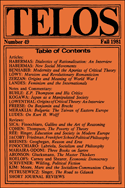 The critical theory of the Frankfurt School begins with Max Weber. With this claim I do not mean to suggest that Weber was the first critical theorist—as is well known, Hegel, Marx, and Nietzsche, each of whom wrote before Weber and had enormous influence on the Frankfurt School, are, to a greater or lesser extent, critical theorists. Rather, what this assertion draws attention to is the perspectival significance that Weber’s analysis of modernity holds for not only the first generation of the Frankfurt School—Adorno, Horkheimer, and Marcuse—but also for Habermas. In the last few decades, particularly in the highly influential and groundbreaking work of Axel Honneth, the Weberian diagnosis of modernity has lost its orientating position for critical theory. In its place stands the Hegelian notion of intersubjective recognition; subsequently, the once decisive notions of “rationalization” and “disenchantment” have given way, in contemporary critical theory, to the notions of “paradoxical development” and “disrespect.” Certainly, the socio-historical developments of the late twentieth and early twenty-first centuries bring into question the project and function of critical theory. So, too, the reflexive nature of the discourse necessitates the re-evaluation of its guiding concepts. Yet, many theorists have expressed significant reservations about the trajectory of contemporary critical theory, a trajectory that, in the words of Nikolas Kompridis, has veered “from reason to self-realization.” Perhaps, then, given the contemporary debate regarding the future directions of critical theory, the time is appropriate to revisit the history of critical theory and examine its variegated responses to the irrationality of modern reason. The critical theory of the Frankfurt School begins with Max Weber. With this claim I do not mean to suggest that Weber was the first critical theorist—as is well known, Hegel, Marx, and Nietzsche, each of whom wrote before Weber and had enormous influence on the Frankfurt School, are, to a greater or lesser extent, critical theorists. Rather, what this assertion draws attention to is the perspectival significance that Weber’s analysis of modernity holds for not only the first generation of the Frankfurt School—Adorno, Horkheimer, and Marcuse—but also for Habermas. In the last few decades, particularly in the highly influential and groundbreaking work of Axel Honneth, the Weberian diagnosis of modernity has lost its orientating position for critical theory. In its place stands the Hegelian notion of intersubjective recognition; subsequently, the once decisive notions of “rationalization” and “disenchantment” have given way, in contemporary critical theory, to the notions of “paradoxical development” and “disrespect.” Certainly, the socio-historical developments of the late twentieth and early twenty-first centuries bring into question the project and function of critical theory. So, too, the reflexive nature of the discourse necessitates the re-evaluation of its guiding concepts. Yet, many theorists have expressed significant reservations about the trajectory of contemporary critical theory, a trajectory that, in the words of Nikolas Kompridis, has veered “from reason to self-realization.” Perhaps, then, given the contemporary debate regarding the future directions of critical theory, the time is appropriate to revisit the history of critical theory and examine its variegated responses to the irrationality of modern reason.
Continue reading →
By Telos Press · Monday, May 6, 2013 Save 20% when you purchase at telospress.com
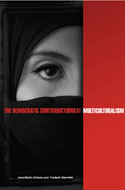 The Democratic Contradictions of Multiculturalism, by Jens-Martin Eriksen and Frederik Stjernfelt, is now on sale in the Telos Press store. Purchase it here and save 20% off the list price! The Democratic Contradictions of Multiculturalism, by Jens-Martin Eriksen and Frederik Stjernfelt, is now on sale in the Telos Press store. Purchase it here and save 20% off the list price!
What is multiculturalism? Is it every person’s right in a democratic society to choose his or her religion and culture and to express criticism regardless of taboos and moralistic norms? Or is it the right of cultures and religions to be protected from insult and to preserve themselves against change? Jens-Martin Eriksen and Frederik Stjernfelt examine the ideology and the reality of multiculturalism, including the Muhammad cartoons, laws against blasphemy, hijab, the Islamic ban on apostasy, and the limits of the freedom of religion.
Continue reading →
|
|