By Paul di Georgio · Thursday, May 2, 2013 Paul di Georgio’s “Contingency and Necessity in the Genealogy of Morality” appears in Telos 162 (Spring 2013). Read the full version online at the Telos Online website, or purchase a print copy of the issue in our store.
 This article evaluates the relationship of the concepts of contingency and necessity to the historical developments and power relations in Nietzsche’s Genealogy. Both Nietzsche and Foucault maintain that, contra Herder, their genealogies are not grounded in originary investigation. Thus for their sort of genealogy to be a philosophically useful method, the force of interpretive analysis must be located elsewhere. The analytic force, I argue, is based in the relationship of values, events, and moral beings. Specifically, I maintain that the progression of moral stages in Nietzsche’s study is ordered in such a way that the failure of each stage is logically and structurally necessary, and that each failure structures the resultant system or paradigm. However, we must also note that the historical manifestation of moral paradigms which coincide with predicted or projected theoretical structures remains contingent upon a multitude of other historical factors, most importantly, human involvement. The conclusion is that systematic internal failures of moral stages allow for but do not cause successive events, since the structural scope of possibility within which a value may be held is best explained in terms of a “middle space” characterizable in both contingent and necessary terms. This article evaluates the relationship of the concepts of contingency and necessity to the historical developments and power relations in Nietzsche’s Genealogy. Both Nietzsche and Foucault maintain that, contra Herder, their genealogies are not grounded in originary investigation. Thus for their sort of genealogy to be a philosophically useful method, the force of interpretive analysis must be located elsewhere. The analytic force, I argue, is based in the relationship of values, events, and moral beings. Specifically, I maintain that the progression of moral stages in Nietzsche’s study is ordered in such a way that the failure of each stage is logically and structurally necessary, and that each failure structures the resultant system or paradigm. However, we must also note that the historical manifestation of moral paradigms which coincide with predicted or projected theoretical structures remains contingent upon a multitude of other historical factors, most importantly, human involvement. The conclusion is that systematic internal failures of moral stages allow for but do not cause successive events, since the structural scope of possibility within which a value may be held is best explained in terms of a “middle space” characterizable in both contingent and necessary terms.
Continue reading →
By Michael Millerman · Tuesday, April 30, 2013 As an occasional feature on TELOSscope, we highlight a past Telos article whose critical insights continue to illuminate our thinking and challenge our assumptions. Today, Michael Millerman looks at Frederik Stjernfelt’s “Secularism is Fundamentalism! The Background to a Problematic Claim,” from Telos 148 (Fall 2009). Frederik Stjernfelt and Jens-Martin Eriksen’s The Democratic Contradictions of Multiculturalism is also available from Telos Press in our online store.
 What Leo Strauss demonstrated in his studies on the foundations and crisis of liberalism—an achievement that continues to bring both honor and infamy to his name—recurs in the guise of an unsolved problem in both the popular press and in learned company as a debate over the question of whether secularism is what it ostensibly opposes: a rigid fundamentalism. In these circles, the question is provoked less by purely theoretical considerations than by such utterances in the public sphere as are bound to infuriate a sect’s opponents, or confirm them in their suspicions: the Christian American Family Association‘s director of issues analysis refers to “secular fundamentalists” as “the American Taliban”; Quebec Cardinal Marc Oullet, who had a chance to become Rome’s new Pope, complains of “secular fundamentalism” and the “dictatorship of relativism” when defending the Catholic faith; the inquisitor Simon Blackburn quips that a recent book by an established and respected philosopher, who questions the materialistic atheism of the day, ought to be blacklisted as prohibited reading. What Leo Strauss demonstrated in his studies on the foundations and crisis of liberalism—an achievement that continues to bring both honor and infamy to his name—recurs in the guise of an unsolved problem in both the popular press and in learned company as a debate over the question of whether secularism is what it ostensibly opposes: a rigid fundamentalism. In these circles, the question is provoked less by purely theoretical considerations than by such utterances in the public sphere as are bound to infuriate a sect’s opponents, or confirm them in their suspicions: the Christian American Family Association‘s director of issues analysis refers to “secular fundamentalists” as “the American Taliban”; Quebec Cardinal Marc Oullet, who had a chance to become Rome’s new Pope, complains of “secular fundamentalism” and the “dictatorship of relativism” when defending the Catholic faith; the inquisitor Simon Blackburn quips that a recent book by an established and respected philosopher, who questions the materialistic atheism of the day, ought to be blacklisted as prohibited reading.
Continue reading →
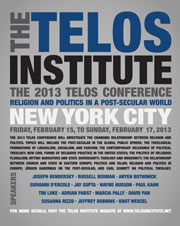
By Josef Bengtson · Friday, April 26, 2013 The following paper was presented at the Seventh Annual Telos Conference, held on February 15–17, 2013, in New York City.
 The philosopher John Caputo starts off his review of Slavoj Žižek and John Milbank’s debate book, The Monstrosity of Christ, by claiming that “Materialism just isn’t what it used to be. Nowadays everyone wants to be a materialist, even the theologians, while the materialists want to look like they lead a spiritual life.”[1] Caputo goes on to claim that today’s battle is “no longer between materialism and idealism, or hard-nosed Newtonians and far out spirit-seers, but between ‘materialist materialism’ and ‘theological materialism’,” and he continues and qualifies, “between crude soulless materialism and materialism with spirit.”[2] The philosopher John Caputo starts off his review of Slavoj Žižek and John Milbank’s debate book, The Monstrosity of Christ, by claiming that “Materialism just isn’t what it used to be. Nowadays everyone wants to be a materialist, even the theologians, while the materialists want to look like they lead a spiritual life.”[1] Caputo goes on to claim that today’s battle is “no longer between materialism and idealism, or hard-nosed Newtonians and far out spirit-seers, but between ‘materialist materialism’ and ‘theological materialism’,” and he continues and qualifies, “between crude soulless materialism and materialism with spirit.”[2]
Continue reading →
By Rahul Govind · Wednesday, April 24, 2013 Rahul Govind’s “The Fade-out of the Political Subject: From Locke to Mill” appears in Telos 162 (Spring 2013). Read the full version online at the Telos Online website, or purchase a print copy of the issue in our store.
The following essay takes as its conceptual core an investigation into the relation between time and political subjectivity, which is undertaken through a reading of John Locke and John Stuart Mill. The latter’s theorization of liberty and progress is contrasted to the former’s understanding of the political subject via an eschato-theological understanding of time. Ultimately Mill’s position—as a “stand-in” for modernity—will be found to be unjustifiable in its uncritical distinguishing between time and the (political) subject, thereby laying the groundwork for what is perhaps the dominant paradigm of political philosophy today: political not metaphysical. A subplot in the essay argues that Mill’s well-known endorsement of British imperialism can be traced to these problems besetting the theoretical relations between political liberty, time, and notions of progress. Through a constructive reading of Mill (finding echoes and cross-stitching the System of Logic and his political writings) and Locke (finding echoes and cross-stitching the Treatises and Reasonableness of Christianity), we hope to revisit the problem of the political subject though time. In the light of this, the conclusion engages the work of Foucault and Koselleck as they “overlap” in an evaluation of modernity in its temporal articulation.
Continue reading →
By Yonathan Listik · Tuesday, April 23, 2013
As an occasional feature on TELOSscope, we highlight a past Telos article whose critical insights continue to illuminate our thinking and challenge our assumptions. Today, Yonathan Listik looks at Cornelius Castoriadis’s “Socialism and Autonomous Society,” from Telos 43 (Spring 1980).
 Cornelius Castoriadis’s opening line in “Socialism and Autonomous Society”—”Henceforth, the terms ‘socialism’ and ‘communism’ will have to be abandoned”—clearly indicate that he is breaking with orthodox Marxism. But one must not rush to a conclusion since upon closer inspection the dissonances are not that relevant to Marx’s overall project as presented by Castoriadis. His criticism of notions such as the “dictatorship of the proletariat” could automatically place him outside the Marxist discourse. Nevertheless he manages to illustrate, even within orthodox Marxism, the minor position of canonical notions, compared to Marx’s essential project of an autonomous society: a society composed of free and sovereign people. Cornelius Castoriadis’s opening line in “Socialism and Autonomous Society”—”Henceforth, the terms ‘socialism’ and ‘communism’ will have to be abandoned”—clearly indicate that he is breaking with orthodox Marxism. But one must not rush to a conclusion since upon closer inspection the dissonances are not that relevant to Marx’s overall project as presented by Castoriadis. His criticism of notions such as the “dictatorship of the proletariat” could automatically place him outside the Marxist discourse. Nevertheless he manages to illustrate, even within orthodox Marxism, the minor position of canonical notions, compared to Marx’s essential project of an autonomous society: a society composed of free and sovereign people.
Continue reading →
By Mohammad Rafi · Friday, April 19, 2013 The following paper was presented at the Seventh Annual Telos Conference, held on February 15–17, 2013, in New York City.
German philosopher Martin Heidegger’s magnum opus, Being and Time (1927), constitutes one of the most important contributions to philosophy of the last century. Beyond having a defining influence on numerous fields of study within philosophy that include but are not limited to existentialism, post-structuralism, and deconstruction, Heidegger has often been viewed as “the most creative religious writer of the twentieth century” (Ireton, 243). It should thus not be surprising that his ideas were widely received and regarded by Iranian intellectuals and students before (and after) the Iranian Revolution of 1979. One of the main seeds of Heideggerian thought that blossomed particularly well in the Iranian context was his notion of authenticity (Eigentlichkeit). Used by Heidegger to draw ontological distinctions, authenticity inspired a politicized discourse—among its Iranian readers—on a return to an “authentic” self. The authenticity of the Iranian return to the self firmly grounded on a separation from imposed Western ideals. A tendency among Iranians toward the study of existentialism[1] in addition to Heidegger’s poignant critique of a decadent West cloaked in religious terminology made him an excellent partner to a group of Iranian intellectuals unsatisfied with a despotic monarch perceived to be antagonistic to Islam.
Continue reading →
|
|