By Juan Carlos Donado · Thursday, April 18, 2013 Juan Carlos Donado’s “Chiasms in Meditation or Toward the Notion of Cartesian Fiction” appears in Telos 162 (Spring 2013). Read the full version online at the Telos Online website, or purchase a print copy of the issue in our store.
 In constant friction with readings that are either completely oblivious of the notion or merely mention the fictional aspect of Descartes’ Meditations, this essay attempts to philosophically thematize the concept of fiction, based on a now famous interpretation by Michel Foucault. We will attempt to make a robust case for constructing the concept of Cartesian fiction as a philosophically crucial category, which cannot be absent from an analysis that pretends to capture the thrust of Descartes’ writing in the Meditations. We will address how fiction plays a determining role in defining certain philosophical pillars of Cartesian thought, such as the concepts of radical doubt, truth, and the extension of rationality itself. We will closely read various key moments of Meditations I–II to illustrate why fiction can be viewed as the hermeneutical catalyst that unlocks the interpretation of certain “chiasms,” which Foucault well identified within the Meditations as the crossing between two discursive lines, that of the system and that of the exercise. At the same time and by the same token, the focus on the concept of fiction will serve to provide our own interpretation of the meditating subject’s encounter with madness, an encounter that spurred a heated debate between Foucault and Jacques Derrida. In constant friction with readings that are either completely oblivious of the notion or merely mention the fictional aspect of Descartes’ Meditations, this essay attempts to philosophically thematize the concept of fiction, based on a now famous interpretation by Michel Foucault. We will attempt to make a robust case for constructing the concept of Cartesian fiction as a philosophically crucial category, which cannot be absent from an analysis that pretends to capture the thrust of Descartes’ writing in the Meditations. We will address how fiction plays a determining role in defining certain philosophical pillars of Cartesian thought, such as the concepts of radical doubt, truth, and the extension of rationality itself. We will closely read various key moments of Meditations I–II to illustrate why fiction can be viewed as the hermeneutical catalyst that unlocks the interpretation of certain “chiasms,” which Foucault well identified within the Meditations as the crossing between two discursive lines, that of the system and that of the exercise. At the same time and by the same token, the focus on the concept of fiction will serve to provide our own interpretation of the meditating subject’s encounter with madness, an encounter that spurred a heated debate between Foucault and Jacques Derrida.
Continue reading →
By J. F. Dorahy · Tuesday, April 16, 2013 As an occasional feature on TELOSscope, we highlight a past Telos article whose critical insights continue to illuminate our thinking and challenge our assumptions. Today, J. F. Dorahy looks at Joel Whitebook’s “Saving the Subject: Modernity and the Problem of the Autonomous Individual,” from Telos 50 (Winter 1981).
 Autonomy is, arguably, the most fundamental concept in the discursive constellation of modernity. If it is apposite, and I believe it is, to think in terms of the differentiation between political, socio-economic, and cultural modernities, then it is clear that the concept of autonomy—either with reference to the autonomous individual or the autonomous work of art—is a constitutive force within each sphere. In “Saving the Subject: Modernity and the Problem of the Autonomous Individual,” Joel Whitebook offers a historically nuanced overview of the difficulties involved in thinking the “autonomous individual” under the conditions of a dynamic and increasingly complex modernity. Whitebook’s piece is wide-ranging and fuses a deep psychoanalytic insight with a robust sociological consciousness: a fusion that accompanies, to my mind, the best critical theory. To be sure, the many subtleties and divergences that emerge from Whitebook’s dialectic are resistant to a full reconstruction within this preview. Rather, I would like to simplify Whitebook’s account by drawing out the three historical epochs examined by Whitebook and say a few things regarding the key aspects of Whitebook’s reading of Marx and Freud and Adorno and Habermas as thinkers who most significantly appreciate the problematic nature of the modern, autonomous individual. Finally, I conclude by arguing for the innovative character of Whitebook’s thoughts regarding the centrality of affective relationships in the formation of the autonomous individual. Autonomy is, arguably, the most fundamental concept in the discursive constellation of modernity. If it is apposite, and I believe it is, to think in terms of the differentiation between political, socio-economic, and cultural modernities, then it is clear that the concept of autonomy—either with reference to the autonomous individual or the autonomous work of art—is a constitutive force within each sphere. In “Saving the Subject: Modernity and the Problem of the Autonomous Individual,” Joel Whitebook offers a historically nuanced overview of the difficulties involved in thinking the “autonomous individual” under the conditions of a dynamic and increasingly complex modernity. Whitebook’s piece is wide-ranging and fuses a deep psychoanalytic insight with a robust sociological consciousness: a fusion that accompanies, to my mind, the best critical theory. To be sure, the many subtleties and divergences that emerge from Whitebook’s dialectic are resistant to a full reconstruction within this preview. Rather, I would like to simplify Whitebook’s account by drawing out the three historical epochs examined by Whitebook and say a few things regarding the key aspects of Whitebook’s reading of Marx and Freud and Adorno and Habermas as thinkers who most significantly appreciate the problematic nature of the modern, autonomous individual. Finally, I conclude by arguing for the innovative character of Whitebook’s thoughts regarding the centrality of affective relationships in the formation of the autonomous individual.
Continue reading →
By Roger K. Green · Thursday, April 11, 2013 The following paper was presented at the Seventh Annual Telos Conference, held on February 15–17, 2013, in New York City.
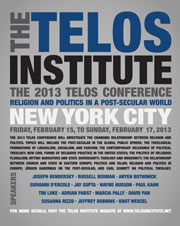 In Faith of The Faithless: Experiments in Political Theology, Simon Critchley writes: “What is lacking is a theory and practice of the general will understood as the supreme fiction of final belief that would take place in the act by which a people becomes a people or by which a free association is formed” (92). Critchley’s work turns to poetics or “making” as a mode of engagement and resistance for dealing with democratic-liberal crises. I suggest that psychedelic aesthetics and religion can provide a discursive ground for Critchley’s “supreme fiction” in the United States, because the making of the sacrificial figure in the psychedelic experience presents itself as capable of more ethically aware citizenship. A brief historical look at religions founded in the 1960s gives insight into the instantiation of a certain citizenship. In Faith of The Faithless: Experiments in Political Theology, Simon Critchley writes: “What is lacking is a theory and practice of the general will understood as the supreme fiction of final belief that would take place in the act by which a people becomes a people or by which a free association is formed” (92). Critchley’s work turns to poetics or “making” as a mode of engagement and resistance for dealing with democratic-liberal crises. I suggest that psychedelic aesthetics and religion can provide a discursive ground for Critchley’s “supreme fiction” in the United States, because the making of the sacrificial figure in the psychedelic experience presents itself as capable of more ethically aware citizenship. A brief historical look at religions founded in the 1960s gives insight into the instantiation of a certain citizenship.
Continue reading →
By Rebecca Gould · Wednesday, April 10, 2013 Rebecca Gould’s “Laws, Exceptions, Norms: Kierkegaard, Schmitt, and Benjamin on the Exception” appears in Telos 162 (Spring 2013). Read the full version online at the Telos Online website, or purchase a print copy of the issue in our store.
The concept of the exception has heavily shaped modern political theory. In modernity, Kierkegaard was one of the first philosophers to propound the exception as a facilitator of metaphysical transcendence. Merging Kierkegaard’s metaphysical exception with early modern political theorist Jean Bodin’s theory of sovereignty, Carl Schmitt introduced sovereignty to metaphysics. He thereby made an early modern concept usable in a post-metaphysical world. This essay carries Schmitt’s appropriation one step further. Drawing on Walter Benjamin’s replacement of transcendental metaphysics with contingent creaturehood, it reintroduces the anti-foundationalist concept of repetition that was implicit in Kierkegaard’s paradigm but which was not made lucid until Benjamin crafted from the Schmittian exception a vision of political life grounded in creaturely existence.
Continue reading →
By James Santucci · Tuesday, April 9, 2013 As an occasional feature on TELOSscope, we highlight a past Telos article whose critical insights continue to illuminate our thinking and challenge our assumptions. Today, James Santucci looks at François George’s “Reading Althusser,” from Telos 7 (Spring 1971).
François George believes that Louis Althusser does not deserve his reputation, and he wants to prove it to you. He writes:
 Since the mainstay of [Althusser’s] thought is its “rigor,” we will demonstrate that it is the least rigorous of all, taking as the principal example his recent work, Lenine et la Philosophic. The occasion for the following discussion is a conference in an extremely academic context: the French Society of Philosophy. Naturally, Althusser feels uneasy in this situation. Marxists, for whom thought should be practical, must seek to transform society rather than to exert themselves in these closed contexts. Was he forced to attend? Althusser accepts his role only by dismissing it. . . . Why has he come, if he rejects this degraded form of philosophy and human relations? He is interested only in the justification of this rejection or, in his own words, this denial: “the only possible communications and discussions are scientific ones.” Under the pretext of attacking the meaninglessness of the philosophical gatherings in which he participates, Althusser rejects all non-scientific human communications as a scientist addressing a “scientific society.” Evidently, then, Althusser attends the French Society of Philosophy conference because he lacks the qualifications required by the international congress on astrophysics. All would go well, said Proudhon, when the government’s power was replaced by that of the Academy of Sciences—which should not be confused with the workers’ councils. (73–74) Since the mainstay of [Althusser’s] thought is its “rigor,” we will demonstrate that it is the least rigorous of all, taking as the principal example his recent work, Lenine et la Philosophic. The occasion for the following discussion is a conference in an extremely academic context: the French Society of Philosophy. Naturally, Althusser feels uneasy in this situation. Marxists, for whom thought should be practical, must seek to transform society rather than to exert themselves in these closed contexts. Was he forced to attend? Althusser accepts his role only by dismissing it. . . . Why has he come, if he rejects this degraded form of philosophy and human relations? He is interested only in the justification of this rejection or, in his own words, this denial: “the only possible communications and discussions are scientific ones.” Under the pretext of attacking the meaninglessness of the philosophical gatherings in which he participates, Althusser rejects all non-scientific human communications as a scientist addressing a “scientific society.” Evidently, then, Althusser attends the French Society of Philosophy conference because he lacks the qualifications required by the international congress on astrophysics. All would go well, said Proudhon, when the government’s power was replaced by that of the Academy of Sciences—which should not be confused with the workers’ councils. (73–74)
Continue reading →
By Jeffrey W. Robbins · Friday, April 5, 2013 The following paper was presented at the Seventh Annual Telos Conference, held on February 15–17, 2013, in New York City.
With the confirmation hearings of John Brennan as director of the CIA fresh in the news, who can doubt the accuracy, or at least the resonance, of Carl Schmitt’s conception of the sovereign—the sovereign is “he who decides on the exception.” With sovereignty so conceived, it has effectively been cast outside the law, introducing a certain arbitrariness and creating a legal limbo that undermine the principles of a liberal democracy.
Enhanced interrogation. Drone attacks on foreign soil. Targeted assassinations. And now, a 16-page white paper from the Department of Justice outlining the legal authority to kill a U.S. citizen without trial. In the words of the New York Times report, the legal brief “adopts an elastic definition of an ‘imminent’ threat, saying it is not necessary for a specific attack to be in process when a target is found.” It also asserts that the decision to kill is not subject to judicial review or restraint.
Continue reading →
|
|