By Michael Marder · Friday, March 22, 2013 This is the second in a series of five blog entries aimed at understanding the current political crisis in the European Union through a Schmittian lens. (Read part 1 here.) In this post, Michael Marder suggests that a profound source of the problem is that the EU is not rooted in the collective existence of its citizens. In place of a political constituting subject, we find nothing but crass economic interests, covered over with a thin rhetorical veil. For a more extensive discussion of Schmitt, see Michael Marder’s Groundless Existence: The Political Ontology of Carl Schmitt.
Europe’s Existential De-Constitution
The “absolute concept of the constitution” refers to the constitution as a whole,[1] united not by virtue of an external system of basic laws but thanks to the pre-constitutional source from which these laws emanate and derive their legitimacy. Schmitt notes that “constitution in the absolute sense can mean, to begin with, the concrete manner of existence that is given with every political unity,”[2] whereby the “state does not have a constitution” but “is constitution, in other words, an actually present condition, a status of unity and order.”[3] In light of the already mentioned political existential vacuum at the core of the European Union, combined with the fact that it is neither a state nor a confederation of states, we may surmise that it is not a constitution, even though it claims the right to determine the conditions of its unity and order. Since there is no “concrete manner of existence” to draw upon, the status of the EU is equivalent to the formal guidelines, to which potential member states must adhere if they are to gain the right of admission. The deficit of actual unity is remedied by the imposition of ideal unity, procedural at worst and metaphysical at best. Instead of strengthening the status of the EU, this imposition makes it ever more precarious: it sets the stage for a violent standoff between the emergent realities of political existence and the idealities of an alien form foisted upon them.
Continue reading →
By Carlos Gasperi · Thursday, March 21, 2013 The following paper was presented at the Seventh Annual Telos Conference, held on February 15–17, 2013, in New York City.
 In the following, I wish to offer two reflections on the question of religion in Benjamin’s thought, the first of which pertains to the subject of translation, the second of which pertains to history. I will address the former first, for it is here, namely in Benjamin’s concept of “pure language,” that I have derived the eponymous notion of “pure religion.” These reflections will conclude in the form of open-ended questions, which I will elucidate at this time in order to orient my audience with regards to my stakes. The first question is whether the translatability of religious scripture is a condition of possibility for the multiplicity of world religions, and if so, what might the implications of this be. The second question, which I will distill from the first, is whether historicity, or what is in Benjamin the strife between historical materialism and historiography, grounds the essence, or “purity,” of religious experience. In the following, I wish to offer two reflections on the question of religion in Benjamin’s thought, the first of which pertains to the subject of translation, the second of which pertains to history. I will address the former first, for it is here, namely in Benjamin’s concept of “pure language,” that I have derived the eponymous notion of “pure religion.” These reflections will conclude in the form of open-ended questions, which I will elucidate at this time in order to orient my audience with regards to my stakes. The first question is whether the translatability of religious scripture is a condition of possibility for the multiplicity of world religions, and if so, what might the implications of this be. The second question, which I will distill from the first, is whether historicity, or what is in Benjamin the strife between historical materialism and historiography, grounds the essence, or “purity,” of religious experience.
Continue reading →
By Michael Marder · Wednesday, March 20, 2013 This is the first in a series of five blog entries aimed at understanding the current political crisis in the European Union through a Schmittian lens. The thesis I advance here is that speculative bubbles can burst not only in the economic domain but also on the political arena. The failure of constituting the EU on a political foundation—that is to say, on the basis of the collective existence of EU citizens—is a precipitating factor for the bursting of what I call its “speculative constitutional bubble.”
A Speculative Constitutional Bubble
In a 2000 Cardozo Law Review article, “Carl Schmitt and the Constitution of Europe,” which developed out of the International Symposium titled “Carl Schmitt: Legacy and Prospects” and held in New York City a year prior to the paper’s publication, Jan Müller raised a question we can finally respond to today, over a decade after its original formulation. “[D]oes European integration prove,” he asks, “how useless the Schmittian intellectual tool kit has become, and, in particular, that ‘Schmittian sovereignty’ remains caught in existentialist, concretist ways of thinking, which have long lost touch with the intricate ‘legitimation through procedure’ or the legitimation through prosperity which some see at the heart of the EU?”[1] In the intervening period, we have witnessed, among other things, a spectacular failure of the Treaty Establishing a Constitution for Europe, signed in the end of 2004 and rejected at the French and Dutch referendums half a year thereafter; the coming into effect, in 2009, of the Treaty of Lisbon, which focused on institutional procedures at the expense of actual constitution-making; and the ongoing Euro zone crisis, which, as I shall argue, stands for the culmination of a certain economic and political speculation on the meaning, role, and form of the European Union.
Continue reading →
By Russell A. Berman · Monday, March 18, 2013 Telos 162 (Spring 2013) is now available for purchase in our store.
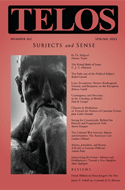 At its inception, Telos pursued a specific project as a journal: to serve as a bridge between the world of what was then often referred to as “European theory” and a U.S. intellectual world largely defined by quantitative methods in the social sciences. Over time, the terminology changed, and it is now more common to use the parlance of “analytic” and “continental” modes of philosophy, and if the latter term still clearly points toward Europe, there are representatives of both trends in the university lives on both sides of the Atlantic. In retrospect, however, the question for Telos was never one of a simple cultural transfer or the pursuit of some intellectual equilibrium in which scholars in both worlds would think the same way. On the contrary, instead of thinking about method in general, at stake for Telos was the difference between reflections on the meaning of the human condition, thoughtful explorations of the good life, and what appeared to be an exclusively numerical measuring of the status quo, a positivist description of what already exists, with no expectation of change. At its inception, Telos pursued a specific project as a journal: to serve as a bridge between the world of what was then often referred to as “European theory” and a U.S. intellectual world largely defined by quantitative methods in the social sciences. Over time, the terminology changed, and it is now more common to use the parlance of “analytic” and “continental” modes of philosophy, and if the latter term still clearly points toward Europe, there are representatives of both trends in the university lives on both sides of the Atlantic. In retrospect, however, the question for Telos was never one of a simple cultural transfer or the pursuit of some intellectual equilibrium in which scholars in both worlds would think the same way. On the contrary, instead of thinking about method in general, at stake for Telos was the difference between reflections on the meaning of the human condition, thoughtful explorations of the good life, and what appeared to be an exclusively numerical measuring of the status quo, a positivist description of what already exists, with no expectation of change.
Continue reading →
By Telos Press · Monday, March 18, 2013 Who Should Be The Next Mayor Of New York?
Discussions on a Wide-Open Race
St. Francis College is proud to host what promises to be a lively discussion on “Who Should be the Next Mayor of New York,” featuring a selection of reporters and activists from across the political spectrum.
Who: Panelists include John Avlon (CNN), Michael Powell (New York Times), Maggie Haberman (Politico), Harry Siegel (Daily Beast), and Michael Meyers (New York Civil Rights Coalition). The panel will be moderated by St. Francis College Scholar in Residence Fred Siegel.
Where: St. Francis College, Founders Hall, 180 Remsen Street, Brooklyn Heights, NY 11201
When: Tuesday, March 19, 7:00pm–9:00pm
The event is free and open to the public.
Continue reading →
By Giovanni D’Ercole · Thursday, March 14, 2013 The following paper was presented at the Seventh Annual Telos Conference, held on February 15–17, 2013, in New York City. Bishop Giovanni D’Ercole is Auxiliary Bishop of the Archdiocese of L’Aquila, Italy.
In the paper I am presenting, I shall focus on how I think the Catholic Church can contribute to solving the crucial issues facing humankind today. I will do so by referring to two events that have marked the evolution of the Church in her dialogue with the modern world, namely, the publication of the encyclical Pacem In Terris, and the Second Vatican Ecumenical Council. We are currently celebrating the 50th anniversary of both events.
A quick overview of the globalized world reveals the many contradictions and forms of injustice plaguing it. Underlying the crisis that has now taken on a global dimension is a three-fold question that characterizes what has come to be defined as the postmodern era. First of all, there is a fundamental question that is coming up again today, after the fall of totalitarian ideology. This is the anthropological question, a truly crucial question. The second question is related to the first. The social question has now become critical, and has to do with the very nature of man. Finally, the anthropological and the social question inevitably leads to the theological question, for man, by his very nature, is open to the transcendental and cannot be reduced to a creature that merely satisfies its material needs.
Continue reading →
|
|