By Maja Sidzinska · Tuesday, February 5, 2013 As an occasional feature on TELOSscope, we highlight a past Telos article whose critical insights continue to illuminate our thinking and challenge our assumptions. Today, Maja Sidzinska looks at Guenther Roth’s “Durkheim and the Principles of 1789: The Issue of Gender Equality,” from Telos 82 (Winter 1989).
 Guenther Roth positively establishes that the principles of 1789—liberté, egalité, fraternité—have been overridden by Émile Durkheim’s essentializing gender prescriptions in the service of social stability. He shows that mutually exclusive and unequal gender roles were central to Durkheim’s theory of organic solidarity. But Roth’s examination does more than just explain theoretical contradictions present in Durkheim’s work. His inquiry invites new investigations into Durkheim’s gender politics, the most intriguing one provoked by his comparative treatment of Durkheim’s and Marianne Weber’s perspectives on marriage and divorce. These contemporaries shared a political outlook yet diverged greatly in their ultimate directives for society. Guenther Roth positively establishes that the principles of 1789—liberté, egalité, fraternité—have been overridden by Émile Durkheim’s essentializing gender prescriptions in the service of social stability. He shows that mutually exclusive and unequal gender roles were central to Durkheim’s theory of organic solidarity. But Roth’s examination does more than just explain theoretical contradictions present in Durkheim’s work. His inquiry invites new investigations into Durkheim’s gender politics, the most intriguing one provoked by his comparative treatment of Durkheim’s and Marianne Weber’s perspectives on marriage and divorce. These contemporaries shared a political outlook yet diverged greatly in their ultimate directives for society.
Continue reading →
By Adrian Pabst · Thursday, January 31, 2013 Adrian Pabst’s “The Politics of Paradox: Metaphysics beyond ‘Political Ontology'” appears in Telos 161 (Winter 2012). Read the full version online at the Telos Online website, or purchase a print copy of the issue in our store.
 Since the onset of the Enlightenment, much of modern thought has celebrated the end of metaphysics and the death of God. The project of “political ontology,” which combines post-metaphysical with post-theistic thinking, underpins the scientific rationalism that pervades contemporary philosophy and politics. Faced with the secular slide into skepticism, relativism, and nihilism, this essay argues that the only genuine alternative to “political ontology” is a metaphysical politics of paradox. Philosophically, modernity and postmodernity invented and intensified the onto-theological science of transcendental ontology that can be traced to Scotus, Ockham, Machiavelli, and Suárez. They bequeathed three currents—possibilism, transcendentalism, and absolutism—that flow through figures such as Descartes, Wolff, and Clauberg to Kant, Hegel, and Comte. Since the onset of the Enlightenment, much of modern thought has celebrated the end of metaphysics and the death of God. The project of “political ontology,” which combines post-metaphysical with post-theistic thinking, underpins the scientific rationalism that pervades contemporary philosophy and politics. Faced with the secular slide into skepticism, relativism, and nihilism, this essay argues that the only genuine alternative to “political ontology” is a metaphysical politics of paradox. Philosophically, modernity and postmodernity invented and intensified the onto-theological science of transcendental ontology that can be traced to Scotus, Ockham, Machiavelli, and Suárez. They bequeathed three currents—possibilism, transcendentalism, and absolutism—that flow through figures such as Descartes, Wolff, and Clauberg to Kant, Hegel, and Comte.
Continue reading →
By Yonathan Listik · Tuesday, January 29, 2013 As an occasional feature on TELOSscope, we highlight a past Telos article whose critical insights continue to illuminate our thinking and challenge our assumptions. Today, Yonathan Listik looks Norbert Elias’s “Civilization and Violence: On the State Monopoly of Physical Violence and its Infringements,” from Telos 54 (Winter 1982).
 Norbert Elias’s argument in “Civilization and Violence: On the State Monopoly of Physical Violence and its Infringements” is especially helpful for understanding the developments of terrorism, and it also applies to contemporary phenomena such as the war on drugs. He contends that placing the monopoly of violence in the hands of the state comes from a desire of harmonization. The assumption is that stability depends on an imposed self-discipline. That is, the state represents the interests of the collective and should provide for it. This is very enlightening considering the assumptions in the “war on drugs.” Norbert Elias’s argument in “Civilization and Violence: On the State Monopoly of Physical Violence and its Infringements” is especially helpful for understanding the developments of terrorism, and it also applies to contemporary phenomena such as the war on drugs. He contends that placing the monopoly of violence in the hands of the state comes from a desire of harmonization. The assumption is that stability depends on an imposed self-discipline. That is, the state represents the interests of the collective and should provide for it. This is very enlightening considering the assumptions in the “war on drugs.”
Continue reading →
By Telos Press · Saturday, January 26, 2013 An excerpt from Carl Abrahamsson’s recent review of Ernst Jünger’s The Adventurous Heart, published by Telos Press. Read the full review here.
 The Adventurous Heart is a perfect title for the book. Once inside, each page is like an adventure and it does indeed belong more in the sphere of the heart than in the rational mind. Strolling through nature—both the chlorophyllic and the human—Jünger ponders phenomena as well as his own conclusions in an intuitive way. Aloof, yes, but always intriguing enough to keep you hooked. It’s an unpredictable mystery, very subtly designed, and which works over and over and over (try re-reading On the Marble Cliffs or this one and see how much new stuff actually appears. A literary tricking of memory or simply a living, sentient text?). . . . The Adventurous Heart is a perfect title for the book. Once inside, each page is like an adventure and it does indeed belong more in the sphere of the heart than in the rational mind. Strolling through nature—both the chlorophyllic and the human—Jünger ponders phenomena as well as his own conclusions in an intuitive way. Aloof, yes, but always intriguing enough to keep you hooked. It’s an unpredictable mystery, very subtly designed, and which works over and over and over (try re-reading On the Marble Cliffs or this one and see how much new stuff actually appears. A literary tricking of memory or simply a living, sentient text?). . . .
Continue reading →
By Alessandro Vitale · Friday, January 25, 2013 The following paper was presented at Telos in Europe: The L’Aquila Conference, held on September 7-9, 2012, in L’Aquila, Italy.
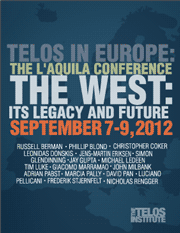 “Russia and the West” is a topic that never seems to be exhausted, and as a question, one that can never be answered satisfactorily. People and intellectuals use a staggering number of criteria to determine Russia’s suitability (or lack thereof) to be counted “Western,” ranging from the geographic and the linguistic to the political and institutional. For centuries, Russians have wondered if they are part of “Europe.” It is evident that geographically and culturally they are “Eurasians.” In any case, about three-quarters of the Russian population live west of the Urals, in what has always been considered a part of Europe. Russia has been connected to Europe for centuries. All the important movements, relevant things that Russia has made in history, have been through its connection to Europe. Russia has really been and remains an important part of Europe. But Russia is not only Europe. “Russia and the West” is a topic that never seems to be exhausted, and as a question, one that can never be answered satisfactorily. People and intellectuals use a staggering number of criteria to determine Russia’s suitability (or lack thereof) to be counted “Western,” ranging from the geographic and the linguistic to the political and institutional. For centuries, Russians have wondered if they are part of “Europe.” It is evident that geographically and culturally they are “Eurasians.” In any case, about three-quarters of the Russian population live west of the Urals, in what has always been considered a part of Europe. Russia has been connected to Europe for centuries. All the important movements, relevant things that Russia has made in history, have been through its connection to Europe. Russia has really been and remains an important part of Europe. But Russia is not only Europe.
Continue reading →
By Juan Carlos Donado · Tuesday, January 22, 2013 As an occasional feature on TELOSscope, we highlight a past Telos article whose critical insights continue to illuminate our thinking and challenge our assumptions. Today, Juan Carlos Donado looks at Carl Schmitt’s “The Age of Neutralizations and Depoliticizations,” from Telos 96 (Summer 1993).
 Perhaps Carl Schmitt would agree: more than ever before, we live today immersed within the spirit of technicity. Coined by Schmitt, the notion of the spirit of technicity serves the analytical purpose of allowing him to distinguish between the belief in technology and technology itself. Whereas technology signals the factual development of mechanistic progress and its link to natural science, the spirit of technicity, in Schmitt’s own words, is “perhaps an evil and demonic spirit, but not one which can be dismissed as mechanistic and attributed to technology” (141). Perhaps Carl Schmitt would agree: more than ever before, we live today immersed within the spirit of technicity. Coined by Schmitt, the notion of the spirit of technicity serves the analytical purpose of allowing him to distinguish between the belief in technology and technology itself. Whereas technology signals the factual development of mechanistic progress and its link to natural science, the spirit of technicity, in Schmitt’s own words, is “perhaps an evil and demonic spirit, but not one which can be dismissed as mechanistic and attributed to technology” (141).
Continue reading →
|
|