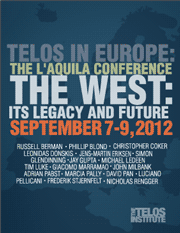
By Chantal Bax · Monday, January 14, 2013 The following paper was presented at Telos in Europe: The L’Aquila Conference, held on September 7-9, 2012, in L’Aquila, Italy.
 Should national identity be considered to be an outdated concept in this day and age? Have the adjectives “French,” “Italian,” “German,” and so on become meaningless terms over the last couple of decades? Both practical and theoretical developments may seem to suggest that this question should be answered in the affirmative. Processes of globalization, including increased mobility and migration, have made it unmistakably clear that the human world cannot be divided into discrete social units. In addition, much philosophical effort has been devoted to destabilizing notions like “community,” “sameness,” and “identity.” Should national identity be considered to be an outdated concept in this day and age? Have the adjectives “French,” “Italian,” “German,” and so on become meaningless terms over the last couple of decades? Both practical and theoretical developments may seem to suggest that this question should be answered in the affirmative. Processes of globalization, including increased mobility and migration, have made it unmistakably clear that the human world cannot be divided into discrete social units. In addition, much philosophical effort has been devoted to destabilizing notions like “community,” “sameness,” and “identity.”
Continue reading →
By Aryeh Botwinick · Friday, January 11, 2013 Aryeh Botwinick’s “Liberal Democracy, Negative Theory, and Circularity: Plato and Rawls” appears in Telos 161 (Winter 2012). Read the full version online at the Telos Online website, or purchase a print copy of the issue in our store.
 This paper argues that the best kind of philosophical defense of democracy is one that is worked out within the framework of negative theory. The phrase “negative theory” is being used on analogy with the term negative theology. Just as negative theology argues that we can only indefinitely say what God is not but cannot pinpoint in a positive sense what He is, so, too, negative theory advocates that we can only ceaselessly explore and highlight the limitations of reason, without being able to arrive at a positive content that is incontrovertible and uncontestable. This paper argues that the best kind of philosophical defense of democracy is one that is worked out within the framework of negative theory. The phrase “negative theory” is being used on analogy with the term negative theology. Just as negative theology argues that we can only indefinitely say what God is not but cannot pinpoint in a positive sense what He is, so, too, negative theory advocates that we can only ceaselessly explore and highlight the limitations of reason, without being able to arrive at a positive content that is incontrovertible and uncontestable.
Continue reading →
By Damien Booth · Tuesday, January 8, 2013 As an occasional feature on TELOSscope, we highlight a past Telos article whose critical insights continue to illuminate our thinking and challenge our assumptions. Today, Damien Booth looks at Pier Aldo Rovatti’s “Critical Theory and Phenomenology,” from Telos 15 (Spring 1973).
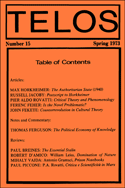 The relationship between phenomenology and critical theory is a complex one that deserves a great deal of attention. On the one hand, Marcuse, as a student of Heidegger, maintained a certain level of affiliation with his thought, while, on the other, Lukács and Adorno were critical of phenomenology, with Heidegger in particular coming under criticism. In “Critical Theory and Phenomenology,” Pier Aldo Rovatti attempts to show how these two modes of thought may have a meaningful encounter. The relationship between phenomenology and critical theory is a complex one that deserves a great deal of attention. On the one hand, Marcuse, as a student of Heidegger, maintained a certain level of affiliation with his thought, while, on the other, Lukács and Adorno were critical of phenomenology, with Heidegger in particular coming under criticism. In “Critical Theory and Phenomenology,” Pier Aldo Rovatti attempts to show how these two modes of thought may have a meaningful encounter.
Continue reading →
By Simon Glendinning · Monday, January 7, 2013 The following paper was presented at Telos in Europe: The L’Aquila Conference, held on September 7-9, 2012, in L’Aquila, Italy.
How should we conceive the distinctive character, the “particular rarity,” of the wearing and growing of the contemporary world? How should we come to terms with our time? What words can we find that are fitting for its specificity when so many of the words we have found fitting hitherto, especially promising words about the course of human history and its political hopes, its hopes in the political (modernity, Enlightenment, civilization, socialism, etc.) sound more and more like the road signs of another age?
Are we not floundering today? Isn’t this, at least in part, what we need to understand, to make intelligible? So we might look out for writings, wherever they come from, that speak to and speak from this world, a world which today, it seems, more than ever, “wears as it grows.”
Continue reading →
By Paul Rekret · Thursday, January 3, 2013 Paul Rekret’s “The Impasse of Post-Metaphysical Political Theory: On Derrida and Foucault ” appears in Telos 161 (Winter 2012). Read the full version online at the Telos Online website, or purchase a print copy of the issue in our store.
The debate between Jacques Derrida and Michel Foucault over the status of Descartes’ Meditations can be read to indicate some profound implications for the ways by which we conceive of a post-metaphysical political theory. This article documents the way in which the terms of the debate suggest that in conceiving politics after metaphysics in terms of competing accounts of the contingency of Being or, in Stephen White’s words, as weak ontologies, we are lead towards a profound paradox and impasse. To suggest that there is broad agreement in post-metaphysical political thought regarding the instability of ontology and the consequent theoretical task of questioning the grounds or foundations of particular political concepts or institutions is to overlook a fundamental paradox. What the debate between Derrida and Foucault in fact indicates is that these differing weak ontologies are in fact incommensurable with one another.
Continue reading →
By David Pan · Wednesday, January 2, 2013 The following paper was presented at Telos in Europe: The L’Aquila Conference, held on September 7-9, 2012, in L’Aquila, Italy.
Since the Treaty of Westphalia, sovereignty in the West has been imagined in terms of the nation-state and its ability to provide a universal basis for political relations both within state boundaries and in relations with other similarly organized entities. On the one hand, the nation-state originates as a means of overcoming the religious civil wars, and its establishment coincides with the attempt to relegate theological disputes to a private sphere that does not threaten the structure of the state. In this way, the state as opposed to the church becomes the primary form for defining the political. On the other hand, the development and stability of the nation-state system seems to have been inextricably linked to the dynamic of colonialism. As Carl Schmitt lays out in The Nomos of the Earth, the establishment of a jus publicum europaeum that created guidelines for limiting war between European states was accompanied and indeed predicated upon a complementary establishment of the amity lines that distinguished Europe from the rest of the world as the place of such limited war as against the “freedom” of the spaces beyond the line in which restrictions on warfare did not apply. For Schmitt, the relationship between these two dynamics, the coalescence of nation-state relations in Europe on the basis of a limitation of war and the establishment of unlimited war in those areas outside of Europe without nation-state structures, has not been coincidental but in fact constitutive for both the rise of the West and the structure of international relations in the modern world.
Continue reading →
|
|