By Tomash Dabrowski · Tuesday, March 27, 2012 As an occasional feature on TELOSscope, we highlight a past Telos article whose critical insights continue to illuminate our thinking and challenge our assumptions. Today, Tomash Dabrowski looks at Max Horkheimer’s “Materialism and Morality,” from Telos 69 (Fall 1986).
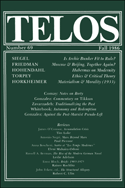 In 1933, the rise of National Socialism had terminated the Frankfurt School’s residency in Germany, and “Materialism and Morality” marks the last contribution by Max Horkheimer to the Institute’s journal, the Zeitschrift für Sozialforschung, while still located in Frankfurt. In this respect, the present essay is a macrocosm of the development of the thought of the Frankfurt School at the cusp of exile. Key concepts in Horkheimer’s more widely known mature work already germinate in “Materialism and Morality,” but the essay’s unique position in his individual intellectual development likewise straddles the ongoing process of elaborating a cohesive sociological vision for the institute. The still nascent idea of a “Critical Theory,” which is now synonymous with the school, had yet to wait four years to be coined by Horkheimer; indeed “Materialism and Morality” is part of a still continuing clarification of what an interdisciplinary critical method might look like in application. In 1933, the rise of National Socialism had terminated the Frankfurt School’s residency in Germany, and “Materialism and Morality” marks the last contribution by Max Horkheimer to the Institute’s journal, the Zeitschrift für Sozialforschung, while still located in Frankfurt. In this respect, the present essay is a macrocosm of the development of the thought of the Frankfurt School at the cusp of exile. Key concepts in Horkheimer’s more widely known mature work already germinate in “Materialism and Morality,” but the essay’s unique position in his individual intellectual development likewise straddles the ongoing process of elaborating a cohesive sociological vision for the institute. The still nascent idea of a “Critical Theory,” which is now synonymous with the school, had yet to wait four years to be coined by Horkheimer; indeed “Materialism and Morality” is part of a still continuing clarification of what an interdisciplinary critical method might look like in application.
Continue reading →
Telos 158 (Spring 2012) is now available for purchase in our store.
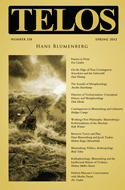 This special issue of Telos focusing on the work of the German philosopher Hans Blumenberg aims to reinvigorate the critical engagement with his work in the English-speaking world by casting a new light on his thought and its fundamental concerns. The American reception of Blumenberg reached an initial high point in the late 1980s and 1990s with Robert M. Wallace’s remarkable translation of three monumental volumes: The Legitimacy of the Modern Age (1983), Work on Myth (1985), and The Genesis of the Copernican World (1987). This reception often (though not exclusively) focused on the questions prompted by Blumenberg’s contributions to the secularization debates surrounding thinkers such as Karl Löwith, Carl Schmitt, and Ernst Kantorowicz. In what can be read as a response to Schmitt’s famous claim that “all significant concepts of the modern theory of the state are secularized theological concepts,” Blumenberg introduces the notion of reoccupation (Umbesetzung). With it he argues against the continuity of theology as the “answer” to the question of the political in favor of the persistence of questions, including that of the political, that are constantly re-answered in original ways. Hence, the modern state for Blumenberg is not based on secularized theological concepts but on new answers to ongoing questions; modernity thus possesses at least the relative “legitimacy” characteristic of systems and institutions in general. For Blumenberg, the latter are never completely originary or purely (i.e., legitimately) derived but are always the result of the complex system of exigencies that produce each “reoccupation.” The specific quality of the modern age, which differentiates it from all others, is “self-assertion” (Selbstbehauptung), a paradoxical form of self-legitimation according to which historical transfers and traditions are the basis for unprecedented new formations. Such questions of secularization, together with their important implications for a theory of modernity and the conceptualization of history, have been discussed and debated by prominent thinkers like Robert Pippen, Richard Rorty, Martin Jay, and Elizabeth Brient. This special issue of Telos focusing on the work of the German philosopher Hans Blumenberg aims to reinvigorate the critical engagement with his work in the English-speaking world by casting a new light on his thought and its fundamental concerns. The American reception of Blumenberg reached an initial high point in the late 1980s and 1990s with Robert M. Wallace’s remarkable translation of three monumental volumes: The Legitimacy of the Modern Age (1983), Work on Myth (1985), and The Genesis of the Copernican World (1987). This reception often (though not exclusively) focused on the questions prompted by Blumenberg’s contributions to the secularization debates surrounding thinkers such as Karl Löwith, Carl Schmitt, and Ernst Kantorowicz. In what can be read as a response to Schmitt’s famous claim that “all significant concepts of the modern theory of the state are secularized theological concepts,” Blumenberg introduces the notion of reoccupation (Umbesetzung). With it he argues against the continuity of theology as the “answer” to the question of the political in favor of the persistence of questions, including that of the political, that are constantly re-answered in original ways. Hence, the modern state for Blumenberg is not based on secularized theological concepts but on new answers to ongoing questions; modernity thus possesses at least the relative “legitimacy” characteristic of systems and institutions in general. For Blumenberg, the latter are never completely originary or purely (i.e., legitimately) derived but are always the result of the complex system of exigencies that produce each “reoccupation.” The specific quality of the modern age, which differentiates it from all others, is “self-assertion” (Selbstbehauptung), a paradoxical form of self-legitimation according to which historical transfers and traditions are the basis for unprecedented new formations. Such questions of secularization, together with their important implications for a theory of modernity and the conceptualization of history, have been discussed and debated by prominent thinkers like Robert Pippen, Richard Rorty, Martin Jay, and Elizabeth Brient.
Continue reading →
By Telos Press · Thursday, March 22, 2012 The Midwest Book Review recommends A Journal of No Illusions:
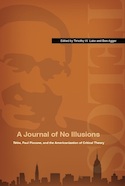 Anything of worth is worthy of criticism. A Journal of No Illusions: Telos, Paul Piccone, and the Americanization of Critical Theory traces the history behind the journal Telos, which contained many writings discussing the new direction of the American left, with much discussion of European social theory and its future and applications to our world. Paul Piccone created the journal and never expected it to grow to the place it has, and Timothy W. Luke and Ben Agger present an intriguing literary history behind the publication and where it has came from. A Journal of No Illusions is a fine pick for any journalistic studies collection discussing historic publications. Anything of worth is worthy of criticism. A Journal of No Illusions: Telos, Paul Piccone, and the Americanization of Critical Theory traces the history behind the journal Telos, which contained many writings discussing the new direction of the American left, with much discussion of European social theory and its future and applications to our world. Paul Piccone created the journal and never expected it to grow to the place it has, and Timothy W. Luke and Ben Agger present an intriguing literary history behind the publication and where it has came from. A Journal of No Illusions is a fine pick for any journalistic studies collection discussing historic publications.
Purchase your copy of A Journal of No Illusions here and save 20% off the list price.
Continue reading →
By Telos Press · Friday, March 16, 2012 Milan Vukomanovic reviews Jens-Martin Eriksen and Frederik Stjernfelt’s The Democratic Contradictions of Multiculturalism, now available in English translation from Telos Press.
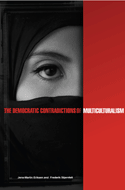 In its “soft” meaning multiculturalism is, according to these authors, quite compatible with the idea of democracy and liberal-democratic political culture. It concerns the freedom of an individual to choose culture, religion, worldview and identity that suits him/her, as long as that person does not represent an obstacle to freedom of others who also wish to affirm, or determine, themselves within their own individual rights, values, proclivities and norms. However, problems arise in the context of a “hard” interpretation of multiculturalism seen as a system that advocates inviolability, and even sovereignty, of collective cultural rights. In other words, as Eriksen and Stjernfelt argue, this is a version of multiculturalism based on the holiness and immunity of different cultures as their collective rights. . . . In its “soft” meaning multiculturalism is, according to these authors, quite compatible with the idea of democracy and liberal-democratic political culture. It concerns the freedom of an individual to choose culture, religion, worldview and identity that suits him/her, as long as that person does not represent an obstacle to freedom of others who also wish to affirm, or determine, themselves within their own individual rights, values, proclivities and norms. However, problems arise in the context of a “hard” interpretation of multiculturalism seen as a system that advocates inviolability, and even sovereignty, of collective cultural rights. In other words, as Eriksen and Stjernfelt argue, this is a version of multiculturalism based on the holiness and immunity of different cultures as their collective rights. . . .
Continue reading →
By Juan Carlos Donado · Thursday, March 15, 2012 As an occasional feature on TELOSscope, we highlight a past Telos article whose critical insights continue to illuminate our thinking and challenge our assumptions. Today, Juan Carlos Donado looks at Paul Piccone’s “Science, Art and Revolution: An Introduction to Galileo as a Poet,” from Telos 4 (Fall 1969).
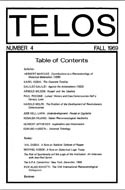 Even if Paul Piccone in fact mistakenly attributes the poem Contro Gli Aristotelici to Galileo—as scholars such as Charles B. Schmitt claim—the conclusion remains invariably the same. Piccone, of course, is not alone in this: the mistake originated in an early article written by the great Galilean scholar Antonio Favaro (1869–1922), responsible for the colossal twenty-volume edition of Galileo’s Opere. Favaro himself corrected the mistake one year later in a much lesser known article, but in print the attribution was already made and Jacopo Soldani’s satire, for years, was adopted by Galileo’s pen. Even if Paul Piccone in fact mistakenly attributes the poem Contro Gli Aristotelici to Galileo—as scholars such as Charles B. Schmitt claim—the conclusion remains invariably the same. Piccone, of course, is not alone in this: the mistake originated in an early article written by the great Galilean scholar Antonio Favaro (1869–1922), responsible for the colossal twenty-volume edition of Galileo’s Opere. Favaro himself corrected the mistake one year later in a much lesser known article, but in print the attribution was already made and Jacopo Soldani’s satire, for years, was adopted by Galileo’s pen.
Continue reading →
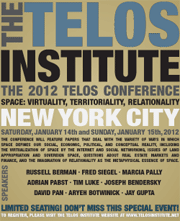
By Gary Shapiro · Thursday, March 8, 2012 This paper was presented at the 2012 Telos Conference, “Space: Virtuality, Territoriality, Relationality,” held on January 14–15, in New York City.
Nietzsche-Schmitt Dialogue
 Carl Schmitt’s TheNomos of the Earth and related work conduct a generally unacknowledged dialogue with Nietzsche; both Schmitt’s geophilosophy and Nietzsche’s politics of the earth are clarified by unearthing this dialogue. Schmitt rarely mentions Nietzsche in his published works (excepting Glossarium) and then to marginalize or distance him. Carl Schmitt’s TheNomos of the Earth and related work conduct a generally unacknowledged dialogue with Nietzsche; both Schmitt’s geophilosophy and Nietzsche’s politics of the earth are clarified by unearthing this dialogue. Schmitt rarely mentions Nietzsche in his published works (excepting Glossarium) and then to marginalize or distance him.
Nietzsche and Schmitt are both paradigmatic geophilosophical thinkers, in Deleuze and Guattari’s sense—they conceptualize territorialization, deterritorialization, and reterritorialization, and they raise questions about the future of the earth. Schmitt’s Nomos articulates problems of earthly order and orientation in the post-Columbian age. Nietzsche’s Zarathustra descends a mountain, calls on the urban multitude to think the direction of the earth (Sinn der Erde), even to sacrifice themselves for it. Later, he explicitly raises the question of hegemony—who will be the lords of the earth?
Continue reading →
|
|