By Jeffrey Bussolini · Friday, February 3, 2012 Jeffrey Bussolini’s “Ongoing Founding Events in Carl Schmitt and Giorgio Agamben” appears in Telos 157 (Winter 2011). Read the full version online at the TELOS Online website, or purchase a print copy of the issue here.
 This article considers ongoing founding events in the work of Carl Schmitt and its interpretation by Giorgio Agamben. The term refers to decisive “events” in Schmitt, which, although they may be exceptional (or perhaps because they are), play a continual role in generating and maintaining the political order. These events are not merely mythic or imaginary devices to describe politics, like the social contract and the veil of ignorance. These events are crucial, in Schmitt’s terms, for understanding “concrete reality.” His idea that the event of decision generates sovereignty, and the related formulation of the friend-enemy distinction founding the political order, are the initial and best-known examples of this argument, and they form a paradigm for considering other instances of this kind in his work and that of Agamben. The article contains five subsections considering events that have enduring effects on the political order. The term “ongoing founding events” calls attention to the persisting action and effect of these events, distinguishing them from historical turns or developments which don’t seem to have the same degree of internal necessity for contemporary politics. In addition to multiple interrelations between them, these five aspects share the evental structure of the exception as described by Schmitt and its special epistemological status for understanding concrete reality and the norm itself. This article considers ongoing founding events in the work of Carl Schmitt and its interpretation by Giorgio Agamben. The term refers to decisive “events” in Schmitt, which, although they may be exceptional (or perhaps because they are), play a continual role in generating and maintaining the political order. These events are not merely mythic or imaginary devices to describe politics, like the social contract and the veil of ignorance. These events are crucial, in Schmitt’s terms, for understanding “concrete reality.” His idea that the event of decision generates sovereignty, and the related formulation of the friend-enemy distinction founding the political order, are the initial and best-known examples of this argument, and they form a paradigm for considering other instances of this kind in his work and that of Agamben. The article contains five subsections considering events that have enduring effects on the political order. The term “ongoing founding events” calls attention to the persisting action and effect of these events, distinguishing them from historical turns or developments which don’t seem to have the same degree of internal necessity for contemporary politics. In addition to multiple interrelations between them, these five aspects share the evental structure of the exception as described by Schmitt and its special epistemological status for understanding concrete reality and the norm itself.
Continue reading →
By Ulrike Kistner · Tuesday, January 31, 2012 Ulrike Kistner’s “The Exception and the Rule: Fictive, Real, Critical” appears in Telos 157 (Winter 2011). Read the full version online at the TELOS Online website, or purchase a print copy of the issue here.
Walter Benjamin’s famous statement, in the eighth of his “Theses on the Philosophy of History” (1940), that “the state of exception in which we live is not the exception but the rule,” has become as normalized as its proposition asserts. Yet it has given rise to different and contrasting understandings variously bounced around between Carl Schmitt, Benjamin, and Giorgio Agamben. Benjamin’s thesis could be read in correlation with Schmitt’s invocation of the state of exception to protect the Weimar Constitution from its own fragility. However, this would not explain the adjective “real” in “a real state of exception” of the task posed by the thesis. The term clearly points in the direction of the distinction between “fictive” and “real” states of exception, which in turn brings into focus the distinction and relation between sovereign and commissarial dictatorship, as outlined by Schmitt in his history of the concept of sovereignty. It is within the paradox of an impossible form of sovereign dictatorship that Schmitt indicates the possibility of constituent power in constitutional democracies. This idea can be connected with the ruptural power of divine violence of Benjamin’s “Critique of Violence” (1921). While Agamben recognizes some of the lines of derivation of “state of siege” and “state of exception,” he does not realize the critical force of Schmitt’s paradox of sovereign dictatorship or Benjamin’s notion of pure violence. This blind spot is consequential: it eclipses the possibility of critique, along with the imagination figuring possibilities of the new.
Continue reading →
By Telos Press · Monday, January 30, 2012 Telos Press is pleased to announce the upcoming publication of The Democratic Contradictions of Multiculturalism by Jens-Martin Eriksen and Frederik Stjernfelt. This title will be available on March 1, 2012. Pre-order your copy now, and we will ship it to you as soon as it is available. Save 20% when you purchase on the Telos Press website.
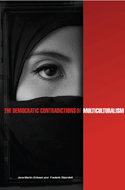 What is multiculturalism? Is it every person’s right in a democratic society to choose his or her religion and culture and to express criticism regardless of taboos and moralistic norms? Or is it, on the contrary, the right of cultures and religions to be protected from insult and to preserve themselves against change? In The Democratic Contradictions of Multiculturalism, Jens-Martin Eriksen and Frederik Stjernfelt examine these questions in relation to both the ideology and the reality of multiculturalism. The discussion covers a range of issues, including the Muhammad cartoons, laws against blasphemy, hijab, the Islamic ban on apostasy, and the limits of the freedom of religion. What is multiculturalism? Is it every person’s right in a democratic society to choose his or her religion and culture and to express criticism regardless of taboos and moralistic norms? Or is it, on the contrary, the right of cultures and religions to be protected from insult and to preserve themselves against change? In The Democratic Contradictions of Multiculturalism, Jens-Martin Eriksen and Frederik Stjernfelt examine these questions in relation to both the ideology and the reality of multiculturalism. The discussion covers a range of issues, including the Muhammad cartoons, laws against blasphemy, hijab, the Islamic ban on apostasy, and the limits of the freedom of religion.
Continue reading →
By Peter A. Redpath · Friday, January 27, 2012 Peter A. Redpath’s “Justice in the New World Order: Reduction of Justice to Tolerance in the New Totalitarian World State” appears in Telos 157 (Winter 2011). Read the full version online at the TELOS Online website, or purchase a print copy of the issue here.
This article’s general thesis is that, shortly after World War II, some leading Western intellectuals started to work to build a new world order based upon a modified understanding of national sovereignty and a notion of justice that rejected Machiavellianism. It claims that during the 1960s, this project became hijacked by Western socialists and was turned toward undermining the authority of national constitutions and legal traditions and promoting Machiavellianism on a global scale. Socialists effected this transformation by wedding Nietzsche’s Machiavellianism to Rousseau’s teaching about morality. From Rousseau they adopted the notion of “tolerance”—having the right feelings and right way of reading history about an exploited, sinless, innocent class (the proletariat under communism)—to replace the classical notion of justice as a moral, behavioral, quality (habitually behaving rightly toward other people) in human affairs. Of crucial significance is that, in the process, they changed the West’s understanding of justice from a classical moral category related to behaving rightly toward others into a hermeneutical category of having the right political reading of history.
Continue reading →
By James V. Schall · Tuesday, January 24, 2012 James V. Schall’s “A Catholic Reading of the Gorgias of Plato” appears in Telos 157 (Winter 2011). Read the full version online at the TELOS Online website, or purchase a print copy of the issue here.
The Gorgias of Plato is of particular interest to political philosophy. Not only is there a detailed discussion of punishment and oratory, but also of practical political ways of action and their foundation. This dialogue is of particular worth for the Roman Catholic notion of the relation of reason and revelation. Political life leaves us with the notion that not all crimes are punished, nor are all good deeds rewarded. This fact leaves the Platonic concern of whether the world is created in injustice. The myth at the end of the Gorgias suggests that politicians are the ones most likely to cause extensive damage and evil in the world. It also argues that unless such deeds are suffered for, thus righting the principle, they will be punished. This consideration naturally leads to the issue of resurrection, an issue about which even Marxist-oriented philosophers like Adorno and Horkheimer saw the logic.
Continue reading →
By Mark Chou · Friday, January 20, 2012 Mark Chou’s “Morgenthau, the Tragic: On Tragedy and the Transition from Scientific Man to Politics Among Nations” appears in Telos 157 (Winter 2011). Read the full version online at the TELOS Online website, or purchase a print copy of the issue here.
When Hans J. Morgenthau first penned Scientific Man vs. Power Politics, it was his scorn of modern science or “dogmatic scientism,” as he put it, that spoke most loudly. But with the publication of Politics Among Nations several years later, his concerns had shifted, as he set about to present a rational theory of international politics. In a matter of only two years, or so it seemed, Morgenthau’s tune had changed—from a clear denunciation of science to the espousal of a nascent science of International Relations. Why did Morgenthau so vehemently decry dogmatic scientism and all that it embodied in Scientific Man, only to establish a theory of international politics that would eventually inspire the “science” of International Relations? The answer, at least the one that this article entertains, was tragedy. Using the lens of tragedy, which Morgenthau first embraced in Scientific Man, this article offers a narrative of the seemingly paradoxical transition that occurs between Scientific Man and Politics Among Nations.
Continue reading →
|
|