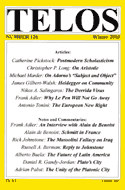
By Juan Carlos Donado · Monday, February 13, 2012 As an occasional feature on TELOSscope, we highlight a past Telos article whose critical insights continue to illuminate our thinking and challenge our assumptions. Today, Juan Carlos Donado looks at Alberto Buela’s “The Katechon and the Future of Latin America,” from Telos 126 (Winter 2003).
 A recent Colombian periodical announced the news: by the end of 2011, the country’s capital, Bogotá, reported an unemployment rate, at least by official accounts, 0.3% lower than that of the United States. The headlines, mediatic as they may intend, aim at fixing in print the dynamics of a continental reality: while European and American economies struggle with unprecedented crises, at least eight Latin American economies closed the year, according to the Centre for Latin American Studies (CESLA), with above average growth. A recent Colombian periodical announced the news: by the end of 2011, the country’s capital, Bogotá, reported an unemployment rate, at least by official accounts, 0.3% lower than that of the United States. The headlines, mediatic as they may intend, aim at fixing in print the dynamics of a continental reality: while European and American economies struggle with unprecedented crises, at least eight Latin American economies closed the year, according to the Centre for Latin American Studies (CESLA), with above average growth.
Continue reading →
By Emily Zakin · Friday, February 10, 2012 Emily Zakin’s “The Image of the People: Freud and Schmitt’s Political Anti-Progressivism” appears in Telos 157 (Winter 2011). Read the full version online at the TELOS Online website, or purchase a print copy of the issue here.
 The origin stories of Schmitt and Freud characterize “the people” as emerging and transmitted through processes of identification and embodied in an image. In both their views, the constitution of a body politic requires, logically and psychologically, a protective boundary that delimits inside and outside and a representation (however mythic or phantasmatic) of authority as the basis for preserving imaginary forms of identification and attachment that anchor bonds of association and provide the requisite boundaries for the unities of ego and nation to form. In this essay I develop the idea that the intensity of association that generates a people is not a metaphysical substance but a metaphysical image. I make use of the Freudian idea of a protective shield that enables an organism to withstand vulnerability and counter excitation with representation, in order to demonstrate that any image of the people is captive to tribal forms of affectivity. I conclude by discussing the danger of replacing the image of the people with the image of universal humanity, an appeal that Schmitt claims can only end in the transformation of cosmopolitanism into the terrifying violence of cosmopartisanship. The origin stories of Schmitt and Freud characterize “the people” as emerging and transmitted through processes of identification and embodied in an image. In both their views, the constitution of a body politic requires, logically and psychologically, a protective boundary that delimits inside and outside and a representation (however mythic or phantasmatic) of authority as the basis for preserving imaginary forms of identification and attachment that anchor bonds of association and provide the requisite boundaries for the unities of ego and nation to form. In this essay I develop the idea that the intensity of association that generates a people is not a metaphysical substance but a metaphysical image. I make use of the Freudian idea of a protective shield that enables an organism to withstand vulnerability and counter excitation with representation, in order to demonstrate that any image of the people is captive to tribal forms of affectivity. I conclude by discussing the danger of replacing the image of the people with the image of universal humanity, an appeal that Schmitt claims can only end in the transformation of cosmopolitanism into the terrifying violence of cosmopartisanship.
Continue reading →
By Katherine McGinity · Thursday, February 9, 2012 As an occasional feature on TELOSscope, we highlight a past Telos article whose critical insights continue to illuminate our thinking and challenge our assumptions. Today, Katherine McGinity looks at Michael Mack’s “Richard Wagner and the Trajectory of Transcendental Philosophy,” from Telos 123 (Spring 2002).
 Michael Mack’s “Richard Wagner and the Trajectory of Transcendental Philosophy” explores the differing brands of anti-Semitism in Kant, Hegel, Feuerbach, and Schopenhauer, and explains how their scrutiny of Jews as a hindrance to society was radicalized by Richard Wagner. Mack details how each philosopher’s particular form of anti-Semitism fed into Wagner’s social-political writings as well as his “total works of art.” By investigating the concepts put forth by Wagner’s philosophical predecessors, one can more fully understand how a radicalized version of Kantian moral philosophy infiltrated German national culture through the composer’s art. Mack specifically addresses how these ideas manifested in Wagner’s Ring Cycle. Michael Mack’s “Richard Wagner and the Trajectory of Transcendental Philosophy” explores the differing brands of anti-Semitism in Kant, Hegel, Feuerbach, and Schopenhauer, and explains how their scrutiny of Jews as a hindrance to society was radicalized by Richard Wagner. Mack details how each philosopher’s particular form of anti-Semitism fed into Wagner’s social-political writings as well as his “total works of art.” By investigating the concepts put forth by Wagner’s philosophical predecessors, one can more fully understand how a radicalized version of Kantian moral philosophy infiltrated German national culture through the composer’s art. Mack specifically addresses how these ideas manifested in Wagner’s Ring Cycle.
Continue reading →
By Marcia Pally · Tuesday, February 7, 2012 Marcia Pally’s “Non-Market Motives at Work in the Market: ‘New Evangelicals’ in Civil Society in the United States and Overseas” appears in Telos 157 (Winter 2011). Read the full version online at the TELOS Online website, or purchase a print copy of the issue here.
Since the 2008 global financial crisis, a reassessment of our global market system seems to be afoot: if neoliberalism (too much market) yields the Great Recession, if socialist planned markets (not enough market) produce the failed economies of the former Soviet bloc, and if social-market combinations (too much market centralization) progress toward the high-cost and slow growth of Western Europe, what are better options? This essay describes the economic justice efforts of “new evangelicals,” those who have left the right for an anti-consumerist, anti-militarist focus on economic justice, environmental protection, immigration reform, and racial/religious reconciliation. It reviews the history of U.S. evangelicalism, describes the current shift away from the religious right, and details “new evangelical” common-good capitalism, where the benefits of capitalist markets are preserved yet embedded in—and constrained by—common-good values. This is not alms-giving but the restructuring of opportunity for those whom the market has failed—not an undoing of market relations but a radical change of relations within the market. The undergirding religious doctrines and case studies, both domestic and overseas, are described. Against the view that linking markets to common-good principles is romantic or useless, “new evangelicals” are already on the ground, doing just this sort of linking.
Continue reading →
By Jeffrey Bussolini · Friday, February 3, 2012 Jeffrey Bussolini’s “Ongoing Founding Events in Carl Schmitt and Giorgio Agamben” appears in Telos 157 (Winter 2011). Read the full version online at the TELOS Online website, or purchase a print copy of the issue here.
This article considers ongoing founding events in the work of Carl Schmitt and its interpretation by Giorgio Agamben. The term refers to decisive “events” in Schmitt, which, although they may be exceptional (or perhaps because they are), play a continual role in generating and maintaining the political order. These events are not merely mythic or imaginary devices to describe politics, like the social contract and the veil of ignorance. These events are crucial, in Schmitt’s terms, for understanding “concrete reality.” His idea that the event of decision generates sovereignty, and the related formulation of the friend-enemy distinction founding the political order, are the initial and best-known examples of this argument, and they form a paradigm for considering other instances of this kind in his work and that of Agamben. The article contains five subsections considering events that have enduring effects on the political order. The term “ongoing founding events” calls attention to the persisting action and effect of these events, distinguishing them from historical turns or developments which don’t seem to have the same degree of internal necessity for contemporary politics. In addition to multiple interrelations between them, these five aspects share the evental structure of the exception as described by Schmitt and its special epistemological status for understanding concrete reality and the norm itself.
Continue reading →
By Ulrike Kistner · Tuesday, January 31, 2012 Ulrike Kistner’s “The Exception and the Rule: Fictive, Real, Critical” appears in Telos 157 (Winter 2011). Read the full version online at the TELOS Online website, or purchase a print copy of the issue here.
Walter Benjamin’s famous statement, in the eighth of his “Theses on the Philosophy of History” (1940), that “the state of exception in which we live is not the exception but the rule,” has become as normalized as its proposition asserts. Yet it has given rise to different and contrasting understandings variously bounced around between Carl Schmitt, Benjamin, and Giorgio Agamben. Benjamin’s thesis could be read in correlation with Schmitt’s invocation of the state of exception to protect the Weimar Constitution from its own fragility. However, this would not explain the adjective “real” in “a real state of exception” of the task posed by the thesis. The term clearly points in the direction of the distinction between “fictive” and “real” states of exception, which in turn brings into focus the distinction and relation between sovereign and commissarial dictatorship, as outlined by Schmitt in his history of the concept of sovereignty. It is within the paradox of an impossible form of sovereign dictatorship that Schmitt indicates the possibility of constituent power in constitutional democracies. This idea can be connected with the ruptural power of divine violence of Benjamin’s “Critique of Violence” (1921). While Agamben recognizes some of the lines of derivation of “state of siege” and “state of exception,” he does not realize the critical force of Schmitt’s paradox of sovereign dictatorship or Benjamin’s notion of pure violence. This blind spot is consequential: it eclipses the possibility of critique, along with the imagination figuring possibilities of the new.
Continue reading →
|
|