By Kiron Skinner · Tuesday, January 3, 2012 Kiron Skinner is a Telos Editorial Associate. The following post originally appeared on the Hoover Institution’s Advancing a Free Society blog.
Success in Iowa is no guarantee of subsequent victories, but candidates and their advisers who dismiss the importance of the caucuses do so at their own peril. The first nominating contest of the presidential election year may give momentum to the victor and those candidates who perform above expectations. The caucuses also have important lessons for the candidates, whose challenge is to discern those lessons and make course corrections in time for the primaries that quickly follow.
Continue reading →
By Russell A. Berman · Monday, December 19, 2011 Telos 157 (Winter 2011) is now available for purchase here.
 The political disorder grows ever thicker. As of this writing, the European financial crisis seems as far away from resolution as ever, although the same complaint might have pertained three months ago nor is the diagnosis likely to lose its validity three months hence. The eurozone insists on tumbling toward an economic catastrophe that may drag the rest of the world down as well. Meanwhile prospects for a liberalizing democracy in the former Communist empire have largely vanished from living (or incarcerated) memory, and the trajectory of the Arab Spring poses more questions than answers. To be sure, things may still take a turn for the good, and the ignominious ends of some of the dictators merit celebration. Yet deserving candidates for violent overthrow and execution remain in power, in Damascus and Tehran, terrorizing their populations, amidst a larger civil war throughout the Middle East. Much of this disorder has profound local roots, stemming from competition among alternative religious traditions, political models, and economic agenda. But some of the instability results as well from the loss of ballast in the wake of the American retreat, itself a symptom of the chaos of American politics. The pre-primary period optimizes neither political virtue nor sober leadership, but even with that qualification, this lead-up to the 2012 electoral season stands out for its chilling hopelessness. It is hard to imagine a happy end to the story. The power of the state continues to expand, which undermines the integrity of individuals, but its capacity to influence the economy nonetheless diminishes. Disorder surrounds us, and the center gives way. Is there room for civic virtue? The political disorder grows ever thicker. As of this writing, the European financial crisis seems as far away from resolution as ever, although the same complaint might have pertained three months ago nor is the diagnosis likely to lose its validity three months hence. The eurozone insists on tumbling toward an economic catastrophe that may drag the rest of the world down as well. Meanwhile prospects for a liberalizing democracy in the former Communist empire have largely vanished from living (or incarcerated) memory, and the trajectory of the Arab Spring poses more questions than answers. To be sure, things may still take a turn for the good, and the ignominious ends of some of the dictators merit celebration. Yet deserving candidates for violent overthrow and execution remain in power, in Damascus and Tehran, terrorizing their populations, amidst a larger civil war throughout the Middle East. Much of this disorder has profound local roots, stemming from competition among alternative religious traditions, political models, and economic agenda. But some of the instability results as well from the loss of ballast in the wake of the American retreat, itself a symptom of the chaos of American politics. The pre-primary period optimizes neither political virtue nor sober leadership, but even with that qualification, this lead-up to the 2012 electoral season stands out for its chilling hopelessness. It is hard to imagine a happy end to the story. The power of the state continues to expand, which undermines the integrity of individuals, but its capacity to influence the economy nonetheless diminishes. Disorder surrounds us, and the center gives way. Is there room for civic virtue?
Continue reading →
By Emelie Whiting · Thursday, December 8, 2011 As an occasional feature on TELOSscope, we highlight a past Telos article whose critical insights continue to illuminate our thinking and challenge our assumptions. Today, Emelie Whiting looks at Mark W. Rectanus’s “Performing Knowledge: Cultural Discourses, Knowledge Communities, and Youth Culture,” from Telos 150 (Spring 2010).
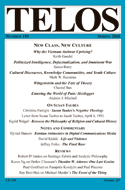 Academic discourse in the twenty-first century has undergone profound transformations. With new methods of knowledge production and consumption brought about by an increase in electronic resources and databases as well as the advent of social networking, there have been widespread changes in scholarly publishing, centers of knowledge, and knowledge communities. In his article “Performing Knowledge: Cultural Discourses, Knowledge Communities, and Youth Culture,” Mark W. Rectanus provides a compelling look at the shift in the significance and acquisition of knowledge resulting from changes in the publishing industry, literary reception, and access to different kinds of information as they stand in relation to a new “pedagogy of media”—a new way of teaching and learning in our technologically advanced age. Rectanus asserts that such developments require a revised conception of what it means to acquire knowledge as well as what constitutes scholarly knowledge. Academic discourse in the twenty-first century has undergone profound transformations. With new methods of knowledge production and consumption brought about by an increase in electronic resources and databases as well as the advent of social networking, there have been widespread changes in scholarly publishing, centers of knowledge, and knowledge communities. In his article “Performing Knowledge: Cultural Discourses, Knowledge Communities, and Youth Culture,” Mark W. Rectanus provides a compelling look at the shift in the significance and acquisition of knowledge resulting from changes in the publishing industry, literary reception, and access to different kinds of information as they stand in relation to a new “pedagogy of media”—a new way of teaching and learning in our technologically advanced age. Rectanus asserts that such developments require a revised conception of what it means to acquire knowledge as well as what constitutes scholarly knowledge.
Continue reading →
By Michael Bacal · Tuesday, November 29, 2011 As an occasional feature on TELOSscope, we highlight a past Telos article whose critical insights continue to illuminate our thinking and challenge our assumptions. Today, Michael Bacal looks at Howard Eiland’s “Superimposition in Walter Benjamin’s Arcades Projects,” from Telos 138 (Spring 2007).
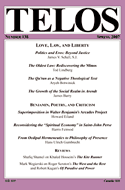 Walter Benjamin’s Arcades Project is likely the most jarring and ambitious work of cultural history of the twentieth century. Breathtaking in its scope, brilliant in its insight, and stamped throughout with his inimitable style, it is the unfinished, thirteen-year project Benjamin attempted as an encyclopedic capture of the emergence of Paris as the capital of the nineteenth century. Touching on everything from urban development to literary analysis and revolutionary consciousness, it presents a vast palimpsest of quotations, theoretical reflections, and minutiae taken from the most quotidian aspects of Parisian life. In a recent Telos article, Howard Eiland, one of the translators responsible for bringing the Passagenwerk into English, offers a compelling overview of Benjamin’s text and a stable set of theoretical coordinates with which to navigate it. His essay, “Superimposition in Walter Benjamin’s Arcades Project,” does this by putting forth the figure of the flâneur as the organizing locus of the book and by developing his unique experience of the world as central not only to the text but also to Benjamin’s theoretical project as a whole. By elaborating this through the notion of “superimposition,” Eiland outlines the singular experience of the flâneur and connects it with the broader historical and political dimensions to which it opens. Walter Benjamin’s Arcades Project is likely the most jarring and ambitious work of cultural history of the twentieth century. Breathtaking in its scope, brilliant in its insight, and stamped throughout with his inimitable style, it is the unfinished, thirteen-year project Benjamin attempted as an encyclopedic capture of the emergence of Paris as the capital of the nineteenth century. Touching on everything from urban development to literary analysis and revolutionary consciousness, it presents a vast palimpsest of quotations, theoretical reflections, and minutiae taken from the most quotidian aspects of Parisian life. In a recent Telos article, Howard Eiland, one of the translators responsible for bringing the Passagenwerk into English, offers a compelling overview of Benjamin’s text and a stable set of theoretical coordinates with which to navigate it. His essay, “Superimposition in Walter Benjamin’s Arcades Project,” does this by putting forth the figure of the flâneur as the organizing locus of the book and by developing his unique experience of the world as central not only to the text but also to Benjamin’s theoretical project as a whole. By elaborating this through the notion of “superimposition,” Eiland outlines the singular experience of the flâneur and connects it with the broader historical and political dimensions to which it opens.
Continue reading →
By Frederik Stjernfelt · Tuesday, November 22, 2011 The following talk was presented at the Central European Forum, held in Bratislava, on November 16–19, 2011. Telos Press looks forward to publishing Democratic Contradictions of Multiculturalism by Jens-Martin Erikson and Frederik Stjernfelt, scheduled to appear in March 2012.
“The language of fear” is the headline of this section at the Central European Forum. My contention is that fear is best fought in open democratic debate. Yesterday, Pascal Bruckner said that Europe did not sufficiently stand up for its own core values. One, central, of those values is free speech. As I cannot address all problems at the same time, let me on focus upon this particular problem in this context. Free speech is a European heritage: originating in Holland and England, and first formalized in Denmark, France, and the United States in the second half of the 18th century. But a major contemporary problem in Europe is what could be called the “legislation of fear,” the increasing belief that unwelcome utterances are best fought by means of legislation, prohibition, criminalization—in short, by the curtailment of free speech. The most terrible aspect about this development is that it plays into the hands of terrorists wishing to fight free speech. Let me mention but two examples from Europe in the recent weeks. The German so-called “Döner killings” of Turkish immigrants were finally resolved and a neo-Nazi group in Zwickau claimed responsibility. In their posthumous manifesto, the two central members claimed they fought, among other things, for the radical change of freedom of opinion. In Paris, unknown arsonists burned down the offices of the satirical weekly Charlie Hebdo—no doubt because of the weekly’s focus upon the current development of sharia policies for Tunisia and Libya. So both the neo-Nazi right wing and the islamist right wing agree upon the fight against free speech as a common denominator.
Continue reading →
By Adrian Pabst · Monday, November 21, 2011 SAVE THE DATE!
The West: Its Legacy and Future
September 7–10, 2012
L’Aquila, Italy
Recent developments appear to end the “end of history” and foreshadow instead the end of the West. After 1989, many expected a gradual convergence toward Western models of liberal market democracy. But Western responses to 9/11 and the 2007–8 transatlantic “credit crunch” have exposed the limits of U.S. international primacy and accelerated the global shift of power from West to East and North to South—as evinced by the rise of China, India, and other emerging markets.
Politically and economically, that shift seems to portend the emergence of a post-American and perhaps even a post-Western world. Yet the United States is still the default superpower whose military might and economic energy ensure its pre-eminence for the foreseeable future. Likewise, Europe’s institutions, culture, and way of life remain attractive across the globe. Even the near meltdown of Wall Street and the mishandling of the sovereign debt crisis have so far not led to a decoupling of the rest from the West.
Continue reading →
|
|