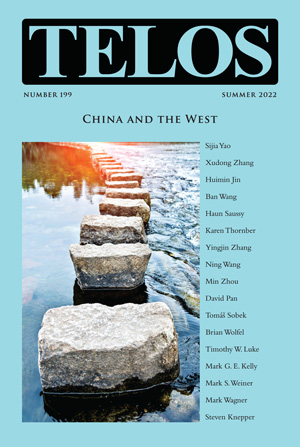
In today’s episode of the Telos Press Podcast, David Pan talks with Karen Thornber about her article “Decentering the ‘West’ and ‘China’ in China–West Comparison,” from Telos 199 (Summer 2022). An excerpt of the article appears here. In their conversation they discuss the inherent pitfalls of the project of literary comparison, and how these pitfalls can be avoided; what it means to “decenter” the “West” and “China,” and how the process of decentering relates to the process of centering; whether the process of decentering involves the recognition of alternative imperial (or nation-based) centers and in a sense a re-establishing of the paradigm of centering; how the focus on decentering relates to the center-periphery paradigm in the production and dissemination of national literatures; how the transnational approach affects our consideration of problems such as discrimination, healthcare, ecological degradation, and climate change; and how the political nature of the opposition of China and the West affects the study of literature. If your university has an online subscription to Telos, you can read the full article at the Telos Online website. For non-subscribers, learn how your university can begin a subscription to Telos at our library recommendation page. Print copies of Telos 199 are available for purchase in our online store.
|
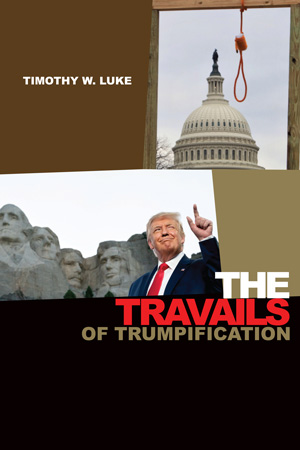
Save 20% on the paperback edition of The Travails of Trumpification by purchasing it in our online store and using the coupon code BOOKS20 during checkout.
Forthcoming in Educational Philosophy and Theory is a collection of reviews of Timothy W. Luke’s recent book The Travails of Trumpification, published by Telos Press Publishing. Excerpts from the reviews appear below, and the full set of reviews can be read here (subscription required). Save 20% on the paperback edition of The Travails of Trumpification by purchasing it in our online store and using the coupon code BOOKS20 during checkout. In today’s episode of the Telos Press Podcast, David Pan talks with Ban Wang about his article “The Clash of Civilization and World Community: The West and China,” from Telos 199 (Summer 2022). An excerpt of the article appears here. In their conversation they discuss whether it still makes sense to speak of distinct human cultures; if the very ideas of China and the West need to be discarded, or, if not, what the basis of such distinctions would be and why they persist; whether there is a human commonality that lies below and beyond age-old cultural norms, and if so what is its content and what forms does it take; how both Chinese and Western forms of universalism have converged to form a cosmopolitan unity; how multiculturalism and identity politics have undermined cross-cultural interaction and a universalist vision; and what alternatives there are for affirming both universalism and local culture. If your university has an online subscription to Telos, you can read the full article at the Telos Online website. For non-subscribers, learn how your university can begin a subscription to Telos at our library recommendation page. Print copies of Telos 199 are available for purchase in our online store.
In today’s episode of the Telos Press Podcast, David Pan talks with Tomáš Sobek about his article “Tolerance as Suppressed Disapproval,” from Telos 199 (Summer 2022). An excerpt of the article appears here. In their conversation they discuss the difference between a moral norm and tolerance as well as the consequences of this difference for understanding tolerance; tolerance as a second-order attitude that involves a suppression of disapproval; how excessive tolerance can be wrong; the difference between positive and negative liberalism; and whether negative liberalism is opposed to or destructive of moral norms. If your university has an online subscription to Telos, you can read the full article at the Telos Online website. For non-subscribers, learn how your university can begin a subscription to Telos at our library recommendation page. Print copies of Telos 199 are available for purchase in our online store. |
   |
|||
|
Privacy Policy · Data Protection Copyright © 2026 Telos Press Publishing · All Rights Reserved |
||||