By Telos Press · Monday, October 19, 2020 Writing at the Wall Street Journal, Tunku Varadarajan profiles Fred Siegel, author of The Crisis of Liberalism: Prelude to Trump, now available from Telos Press Publishing. Order your copy in our online store and save 20% by using the coupon code BOOKS20 during checkout. Also available in Kindle ebook format from Amazon.com.
An excerpt:
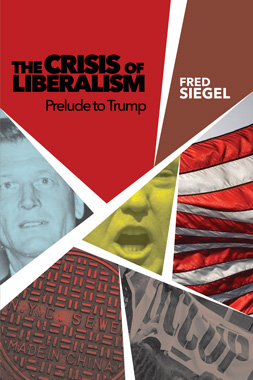 . . . Mr. Siegel traces the origins of the “present-day contempt” for the middle class back a century. He cites H.L. Mencken’s demeaning of the bourgeoisie, in the celebrated editor’s coinage of “booboisie.” Mr. Siegel has written extensively on Herbert Croly, the political philosopher and co-founder of the New Republic, as well as on the novelists H.G. Wells and Sinclair Lewis (who, in 1930, became the first American to win the Nobel Prize for Literature). These three men, Mr. Siegel says, laid the foundation for an elite revolt against the American middle class that endures to this day. . . . Mr. Siegel traces the origins of the “present-day contempt” for the middle class back a century. He cites H.L. Mencken’s demeaning of the bourgeoisie, in the celebrated editor’s coinage of “booboisie.” Mr. Siegel has written extensively on Herbert Croly, the political philosopher and co-founder of the New Republic, as well as on the novelists H.G. Wells and Sinclair Lewis (who, in 1930, became the first American to win the Nobel Prize for Literature). These three men, Mr. Siegel says, laid the foundation for an elite revolt against the American middle class that endures to this day.
“Croly’s idea was that the college-educated, the elite, should become a new aristocracy,” Mr. Siegel says. “Croly believed that the middle-class and their allies—latter-day Jeffersonians who advocated individual freedom and acted in their own self-interest—were impeding the path of the experts, who were ‘disinterested.'”
Wells and Lewis bolstered the view that the professional class was above the fray, giving the argument an almost aesthetic hue. “They thought the middle class was vulgar,” Mr. Siegel says. Mr. Siegel cites a passage in Lewis’s novel “Main Street” (1920), which he regards as “a sardonic sally at the small-town American middle class and its commercial culture.” In the passage, Carol Kennicott, a young woman from the big city trapped by marriage in small-town America, describes Americans as “a savorless people, gulping tasteless food, and sitting afterward, coatless and thoughtless, in rocking chairs . . . and viewing themselves as the greatest race in the world.” In a word, deplorables.
Croly has been largely forgotten, Mr. Siegel says, because liberalism has been largely eclipsed. “Wokeism is not liberalism,” he says. “I don’t want to be unfair to liberals. I was very critical of liberals, but they were in favor of debate; they were in favor of empiricism, of open argument.” Wokeism, by contrast, is a “new secular revealed religion,” which involves no “investigation or empirical study.”
Continue reading →
By Jon Simons · Friday, October 16, 2020 Jon Simons’s “Divine Violence, Profane Peace: Walter Benjamin, Rabbis for Human Rights, and Peace in Israel–Palestine” appears in Telos 192 (Fall 2020): Truth and Power. Read the full article at the Telos Online website, or purchase a print copy of the issue in our online store. Individual subscriptions to Telos are available in both print and online formats.
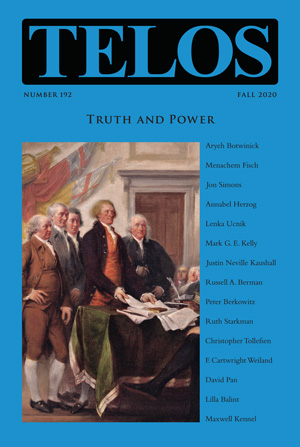 One of the reasons for disaffection toward peace among Jewish Israelis may be a “Judaic deficit” in the secular, liberal conceptions of peace implicit in both official peace processes and peace activism. I address this deficit by bringing the Judaically inflected but nonreligious work of Walter Benjamin into conversation with the thought and practice of Rabbis for Human Rights, who combine Judaism with liberal, universal rights. Benjamin’s essay “Critique of Violence” counters the legally enforced violence of liberal peace with a conjugation of divine violence and nonviolent conflict resolution. Interpreting his essay with particular attention to his reading of the Biblical story of Korah leads to a theologico-political notion of peace as agonistic, human wrestling with divine violence and power. Rabbis for Human Rights embody such peace to some degree in their simultaneous interpretation of divine law and “small acts” of nonviolent opposition to Occupation. One of the reasons for disaffection toward peace among Jewish Israelis may be a “Judaic deficit” in the secular, liberal conceptions of peace implicit in both official peace processes and peace activism. I address this deficit by bringing the Judaically inflected but nonreligious work of Walter Benjamin into conversation with the thought and practice of Rabbis for Human Rights, who combine Judaism with liberal, universal rights. Benjamin’s essay “Critique of Violence” counters the legally enforced violence of liberal peace with a conjugation of divine violence and nonviolent conflict resolution. Interpreting his essay with particular attention to his reading of the Biblical story of Korah leads to a theologico-political notion of peace as agonistic, human wrestling with divine violence and power. Rabbis for Human Rights embody such peace to some degree in their simultaneous interpretation of divine law and “small acts” of nonviolent opposition to Occupation.
Continue reading →
By Isaac Lopez · Thursday, October 15, 2020 Donald Trump will win in November because the same forces that propelled him to victory in 2016 are even stronger today in 2020. This year is shaping up to be the most turbulent in American history since at least 1968, if not 1941: we are living in the era of black swans. But if you keep spotting them, are black swans still so rare? Common sense dictates that Trump will lose resoundingly in November given the chaos of the past eight months, public fatigue from the last four years, and near-daily October surprises. Then again, common sense also dictated that Trump and his campaign would have gone the way of the 9-9-9 Plan and Original Mavericks within three weeks of descending the escalator at Trump Tower. At the risk of eating my own words in a bit less than one month, here is the quant- and wonk-free case for why Trump will win, poll numbers be damned.
The reason for Trump’s 2016 victory is simple: support of Donald Trump was and is a reactionary backlash against eight years of progressive overreach during the Obama administration and twenty-five years of weak Republican leadership. Donald Trump is crude, ill-tempered, unprofessional, and unfit to be president—much less a cultural figure—but was elected almost exclusively for these reasons. Contrary to the media catechism, Russia did not throw the election to Donald Trump, fake news articles from Macedonian click farms did not convince hordes of Baby Boomers on Facebook that Hillary Clinton leads a ring of satanic pedophiles, and 46.1% of voters in 2016 were not white nationalists. Trump won because a plurality of voters hated the elite class so much that they were willing to vote for such a man just to humiliate the GOP in the primary and the overall political establishment in the general. Trump’s victory was because of voters’ frustrations, and any retrospective analysis of 2016 applied to the current election year must start and end with them.
Continue reading →
By Norbert Bolz · Wednesday, October 14, 2020 Are we living once more in a Weimar Republic that no longer knows a center? The toxic climate of public opinion suggests just that. The language of irreconcilability allows some to speak of “covid idiots,” while others see our politics as heading toward dictatorship. And even government pronouncements are sounding more authoritarian, as with the call for a “tightening of the reins” that Bavarian Prime Minister Söder repeated after the chancellor.
Panic and hysteria are the reliable companions to nearly every major political theme today. But of course, corona is central. The most important political effect of the pandemic could well be the growing readiness to endure whatever may come. By contrast, the “corona rebels” wanted to set an example over the weekend. Their protest drew motivation from the impression that with the slogan “because of corona,” one can at any time call a state of emergency, in which freedom and democracy then no longer play a role.
Continue reading →
By Norbert Bolz · Wednesday, October 7, 2020 Nietzsche once said that culture was only a thin apple peel over a glowing hot chaos. That is probably to say that even a small shock suffices to confront us anew with barbarism and dizzying stupidity. And now we are actually dealing with a worldwide pandemic. In effect, the thin apple peel tore at once and an abyss of the most dangerous folly has opened up. Thus one headline read in the weekly newspaper Die Zeit: “Mankind takes a break—the planet exhales.” One might simply accept as childish impudence calling the lockdown, the curfew that has practically brought the entire global society to a standstill, a “break.” But the madness lies in the presumptuousness of assuming a perspective above humans and of making oneself the voice of the “tortured” earth. Giovanni di Lorenzo, an intelligent, educated man, is the editor-in-chief of that newspaper. But today he evokes Hermann Melville’s captain Benito Cereno: The barbarians have his ship in their hands—and he can do nothing about it.
Continue reading →
By Dr. Jacqueline C. Rivers · Monday, October 5, 2020 The following essay originally appeared on June 12, 2020, at Religion Unplugged. Reposted here by permission.
For more than a week, hundreds of thousands of Americans, black and white, have taken to the streets across the country in an enormous outpouring of pain and rage. People, throughout the nation, primarily youth and of every race and ethnicity, have been responding to the vicious murder of George Floyd in Minneapolis on Memorial Day. Their powerful emotions have overwhelmingly been channeled into protests in over 75 cities.
Starting in Minneapolis and spreading to cities as far-flung as Atlanta, Boston, New York, Chicago, and Los Angeles and even to London and Paris, people have gathered in large numbers from coast to coast, in the north and south. The vast majority of protesters have been peaceful, and the events themselves have generally been nonviolent throughout their scheduled duration. However, a smaller number of rioters have resorted to shocking levels of violence, often after the official end of the protest. Their actions have been extremely destructive and deeply troubling: police cars have been burned; police officers have been pelted with projectiles; a police precinct in Minneapolis was torched; small businesses have been destroyed. In many cities such as Boston, some police officers have shown great restraint in the face of insults and harassment. But in almost every city, we have seen arrests and the use of violence against peaceful protesters, notably in the nation’s capital, Washington, D.C.
Continue reading →
|
|